.jpg)
Ravenglass and Eskdale Railway
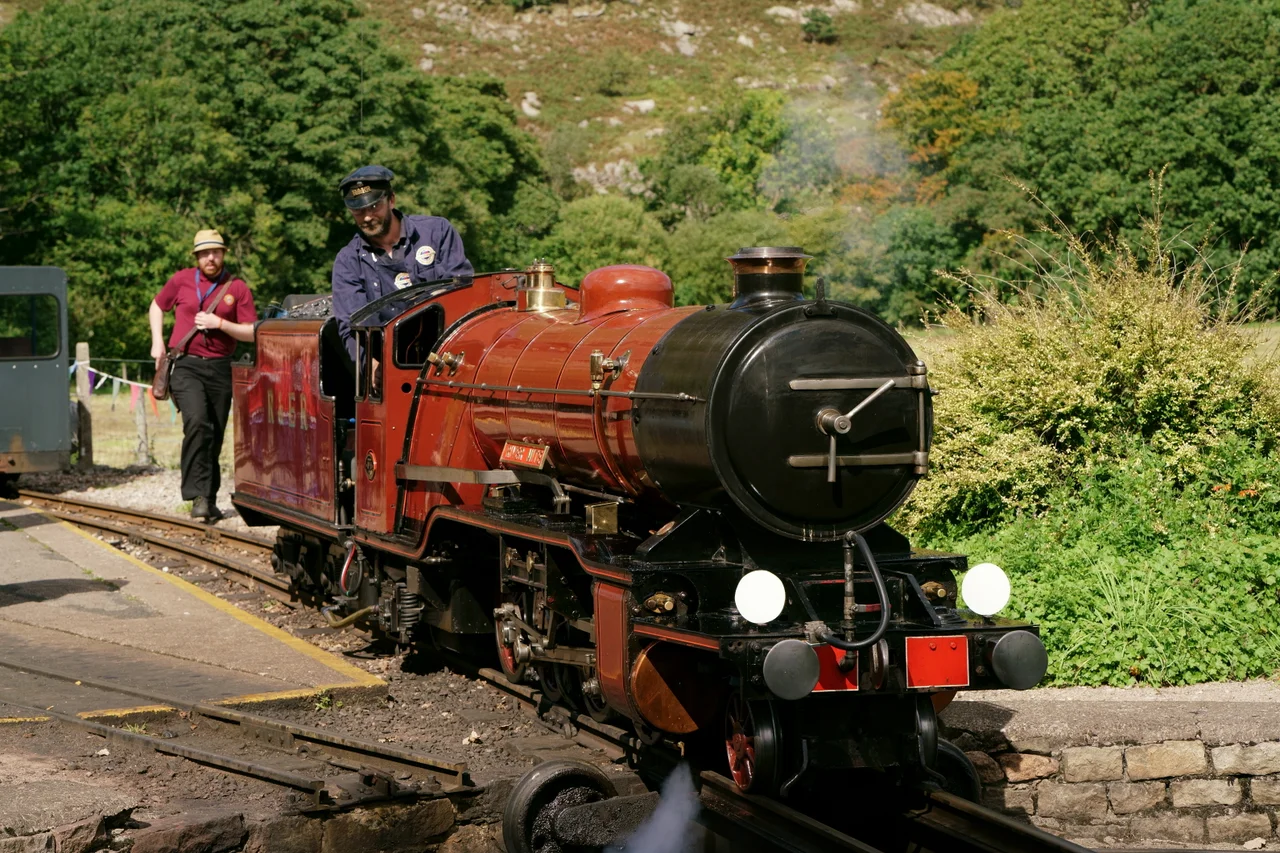
Stand on the platform at Ravenglass and the train pulling in looks wrong. The locomotive is the size of a sit-on lawnmower; the carriages would fit in a large living room. Children settle into seats designed for them. Adults fold in next, knees touching strangers' knees, because the gauge here is fifteen inches - barely wide enough for an adult to straddle. The line is called the Ravenglass and Eskdale Railway. Locals call it La'al Ratty. And the small thing, surprisingly, has been running for over 150 years.
Iron Ore and the Owd Ratty
The original railway opened on 24 May 1875, built for a single, blunt purpose: getting hematite iron ore out of three mines around the village of Boot, down the seven miles of Eskdale, to the Furness Railway's standard-gauge line on the Cumbrian coast at Ravenglass. The gauge - now known to have been three feet - was a matter of dispute for decades, with some books citing two feet nine inches. The dispute was settled by an old sleeper found by the current company, its spike holes preserving the truth. The trouble was that mining never went the way the railway's investors hoped. All but one of the iron-ore mines closed within ten years of the line opening, leaving the railway scrambling. It carried granite from local quarries. It carried summer tourists. By 1908 the track was in such poor condition that the Board of Trade declared it unsafe for passengers, and the railway closed to passenger traffic that year. Goods trains crawled on while the owners tried to raise money to rebuild. They couldn't. In April 1913, the Owd Ratty - the old Ratty - closed completely, advertised for sale in 60 separate lots.
Rebuilt to Fifteen Inches
Two years later, the line came back - but on a different scale. Bassett-Lowke, the famous model engineers, took it over and relaid it at fifteen-inch gauge to use a kind of railway that had until then existed mostly in the gardens of wealthy enthusiasts. The minimum-gauge experiment turned out to suit Eskdale beautifully. The locomotives were tiny, scaled-down versions of mainline engines. They could haul real passengers and real freight up real gradients, but on track that needed only minimal earthworks. By the 1920s, the railway was hauling granite from quarries again, taking schoolchildren to school, and carrying summer tourists up the valley. Then the granite business fell away, the war years pinched, and by 1960 closure loomed once more. Locals and railway enthusiasts formed the Ravenglass and Eskdale Railway Preservation Society. With financial backing from Sir Wavell Wakefield - rugby international, MP for Marylebone, owner of the Ullswater Steamers - and stockbroker Colin Gilbert, the society won the auction in September 1960 and saved the line.
Gilbert's Cutting and the Trade Off
Until 1964, trains crossing the line had to thread a sharp curve at Holling Head - a 145-foot radius that punished both locos and track - to avoid steep gradients. The fix was unglamorous and effective: dynamite. Using what the railway's records charmingly call "opencast gelignite," workers blasted Gilbert's Cutting through 3,000 tons of rock and earth, exposing Eskdale's pink granite along its inside curve. The new cutting was straighter, less punishing, and shortened the line slightly to 6.91 miles total. On Friday 27 March 1964, the 11:20am train from Ravenglass, hauled by River Irt and driven by Colin Gilbert himself, stopped at the western entrance of the cutting. Patrick Satow, chairman of the preservation society, cut the ribbon. The cutting was named in Gilbert's honour. The railway runs through it still, fifteen-inch wheels singing over pink granite that has been waiting since the volcano that made it cooled in the Ordovician.
La'al Ratty Today
The journey from Ravenglass to Dalegarth for Boot takes 40 minutes - long enough to settle in, watch the coast give way to wooded valley, and pass the seven intermediate stations and halts along the way. Some, like Miteside, are reachable only by footpath; the Miteside shelter is the wooden hull of an old boat. Other stops have such delicate histories - The Green was once called King of Prussia after a local pub - that the renaming itself becomes part of the timetable. The line uses Radio Control Train Order signalling, where drivers contact the controller using RANDER numbers (even for up trains, odd for down). British Rail later borrowed elements of this system to cut costs on remote main-line routes. The oldest engine in the fleet, River Irt, has parts dating from 1894; the newest, Douglas Ferreira, is a diesel-hydraulic built in 2005. The Reverend Wilbert Awdry visited in the 1960s and based his fictional Arlesdale Railway on it in his Railway Series books. He and his fellow-visitor the Reverend Edwin Boston appear in the stories as the Thin Clergyman and the Fat Clergyman. La'al Ratty has been carrying its passengers, real and fictional, for a very long time now - and shows no sign of stopping.
Flight Context
The Ravenglass and Eskdale Railway runs west to east along Eskdale, with the western terminus at Ravenglass station near 54.35 degrees north, 3.41 degrees west, and the eastern terminus at Dalegarth for Boot, about 7 miles inland. From the air the line is identifiable as a narrow track threading up the valley parallel to the road and river, with passing loops at Miteside, Irton Road and Fisherground. Best viewed from 3,000 to 5,000 feet AGL. Nearest airfields: Walney Island Barrow (EGNL) about 20 nm south, Carlisle Lake District (EGNC) about 35 nm north.
From the Air
Ravenglass terminus at 54.35 N, 3.41 W; Dalegarth for Boot about 7 mi inland. From above: a narrow track threading up Eskdale parallel to road and river, with passing loops at Miteside, Irton Road, Fisherground. View from 3,000-5,000 ft AGL. Nearest fields: Walney Island Barrow (EGNL) about 20 nm S, Carlisle Lake District (EGNC) about 35 nm N.
Nearby Stories
- Isel Hall 3.3 km away
- Walney Island 7.1 km away
- Kendal 9.7 km away
- Lancaster Priory 10 km away
- Raeberry Castle 15 km away
- Cross Fell 21 km away
- Ramsey Bay 29 km away
- Santon Railway Station 47 km away