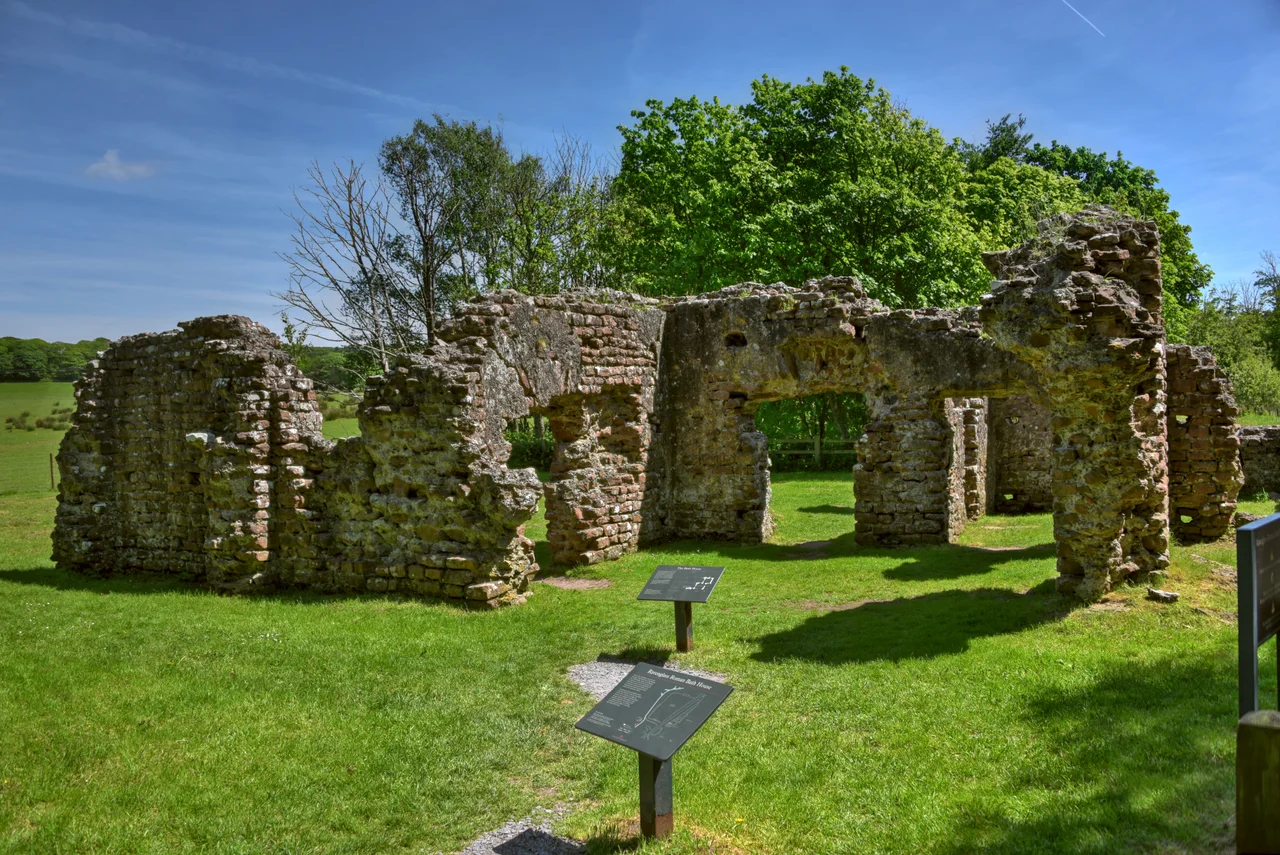

Ravenglass Roman Bath House
Most Roman buildings in Britain survive as low foundations buried in turf - footprints you have to imagine into walls. The bath house at Ravenglass refuses to play that game. Walk up the path through the woods south of the village, round a bend, and you find yourself in front of a building thirteen feet tall - real, ancient masonry standing four metres above the ground, with traces of red and white internal plaster still clinging to the stones. Matthew Hyde, updating the Pevsner Architectural Guide to Cumbria, called it "an astonishing survival." He was not exaggerating.
Walls Castle
Locals have known the structure for centuries as Walls Castle, and for most of that time everyone assumed it was a medieval building. Excavations in 1881 began to suggest otherwise. By the twentieth century the truth was clear: this was the bath house of a 2nd-century Roman fort and naval base, identified by the Romans as Itunocelum, situated on the Cumbrian coast at the western extremity of what became Hadrian's frontier system. The surviving fragment is the west end of a building once around 40 feet wide and 90 feet long, organised as a double sequence of rooms running the length of the structure. Visitors entered through the apodyterium, the changing room, where niches in the walls probably held statues. Then came the standard Roman bathing circuit - warm rooms, a hot bath, a cold plunge. North and south walls show external buttresses, almost certainly built to take the thrust of a heavy vaulted roof.
Hypocaust Beneath the Floor
The 1881 excavations uncovered traces of the hypocaust - the underfloor heating system that warmed every serious Roman bath. Hot air from a furnace at one end of the building circulated beneath the floor, supported on small brick or stone piles, then rose through hollow tiles in the walls to warm both floor and air at once. The Ravenglass hypocaust was uncovered, recorded, and then re-buried for preservation. The system probably drew water from higher ground east of the fort, gravity-fed through pipes or channels to the building. Soldiers stationed at this damp, windy edge of the empire would have looked forward to a session here the way any modern shift worker looks forward to a hot shower. The fact that the bath house sits outside the walls of the fort, rather than inside, suggests it was meant to serve the civilian community alongside the military - the vicus that grew up around almost every long-occupied Roman base.
Why the Walls Are Still Standing
The reason this much survives - when other Roman structures across Britain have been quarried for farm walls and church foundations - seems to be a medieval misunderstanding. Sometime after Rome left, somebody local repurposed the building for domestic use. Walls were maintained, perhaps a roof was patched, niches became cupboards. By the time Victorian antiquarians began arguing about its origins, the structure had been continuously inhabited or used long enough that nobody had ever pulled it down for building stone. Even after it was identified as Roman, it was initially mistaken for a villa rather than a bath house, and only properly classified in the 20th century. Today it has scheduled monument status, is managed by English Heritage, and forms part of the Frontiers of the Roman Empire World Heritage Site that also includes Hadrian's Wall.
Getting There, Looking Around
Reaching the bath house is itself a pleasure. From Ravenglass village, a "miles without stiles" pedestrian route - part of a Lake District National Park project to improve access for people with disabilities - leads south along a private road that runs parallel to the railway. The path is gentle and the destination unmissable: the bath house emerges out of trees almost without warning. The ditch of the long-buried Roman fort itself is visible from the bath house, though it lies on private land and is bisected by the modern tracks of the Cumbrian Coast Line. Trains rattle past between Carlisle and Barrow-in-Furness with little awareness that, a few yards away, four-metre walls still stand because nobody, for nearly two thousand years, ever quite got around to knocking them down.
Flight Context
The Ravenglass Roman Bath House sits at 54.35 degrees north, 3.40 degrees west, just south of Ravenglass village on the West Cumbrian coast. From the air the bath house itself is small but distinctive - a tall stone structure in a clearing south of the Cumbrian Coast Line tracks, with the modern Ravenglass village and estuary to the north. Best viewed from 2,000 to 4,000 feet AGL. Nearest airfields: Walney Island Barrow (EGNL) about 20 nm south, Carlisle Lake District (EGNC) about 36 nm north. Expect coastal turbulence in westerlies.
From the Air
Ravenglass Roman Bath House at 54.35 N, 3.40 W, just S of Ravenglass village. From above: a small but distinctive tall stone structure in a clearing south of the Cumbrian Coast Line, with the village and estuary to the N. View from 2,000-4,000 ft AGL. Nearest fields: Walney Island Barrow (EGNL) about 20 nm S, Carlisle Lake District (EGNC) about 36 nm N.
Nearby Stories
- Isel Hall 3.3 km away
- Walney Island 7.1 km away
- Kendal 9.7 km away
- Lancaster Priory 10 km away
- Raeberry Castle 15 km away
- Cross Fell 21 km away
- Ramsey Bay 29 km away
- Santon Railway Station 47 km away