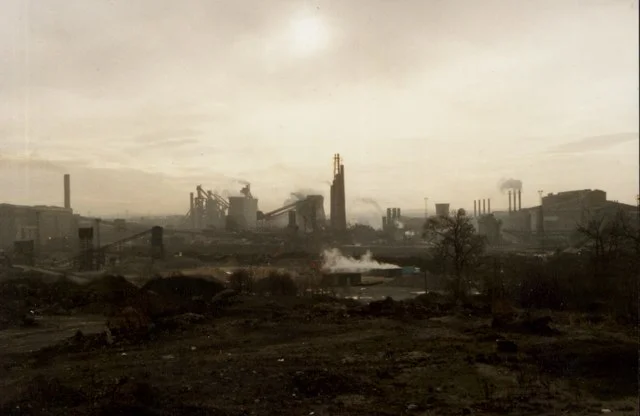

Ravenscraig Steelworks
On the day Ravenscraig closed in 1992, 770 men stopped being steelworkers. They had been the last of more than 13,000 who had worked the site at its peak in the mid-1970s. Outside the plant, an estimated 10,000 more jobs depended on what came out of those furnaces - hauliers, fabricators, engineering shops, the pubs and corner shops of Motherwell and Wishaw. For nearly forty years three cooling towers and a blue gasometer had been the skyline of central Lanarkshire, visible for miles across the Clyde valley. Four years later, in 1996, the gasometer was demolished too. The brownfield that followed remains the largest in Europe.
The Plant Britain Built
Construction of the integrated iron and steel works started in 1954, with the strip mill that followed becoming one of only four in the United Kingdom. The decision had been made by the Iron and Steel Board the previous July, against opposition from English commercial interests who argued no Scottish strip mill was justified. Iron ore arrived from Sweden, North Africa and Newfoundland: in 1954 Scotland imported 1,436,000 tons. It came first to General Terminus Quay in Glasgow, then by rail to Motherwell. By the late 1970s the trade had outgrown the city quay and a purpose-built deep-water terminal at Hunterston, near West Kilbride, opened in 1978 to handle bulk ore carriers of up to 350,000 tonnes. By 1992 Ravenscraig held the title of the largest hot strip steel mill in Western Europe and one of the longest continuous casting and hot rolling production lines in the world.
Steelopolis
Motherwell had been a steel town since David Colville opened his first iron works in 1871, switching to steel production in 1880. By the 1970s the industry employed 13,000 in the town alone, and the nickname Steelopolis was used without irony. The three cooling towers and the blue gasometer of Ravenscraig were the landscape that a generation of Lanarkshire children grew up under. They were also the heat, the noise and the smoke that came in through every window south of the South Calder Water. The works ran continuously, the shifts changed at fixed times, and the whole rhythm of the town was set by the plant. In 1955 Colvilles was returned by the government to private ownership after a brief period of nationalisation. In 1967 it was nationalised again as part of British Steel Corporation, under whose name Ravenscraig spent its final twenty-five years.
The Closure
The end came in stages. The 1980 national steel strike cost British Steel important contracts. Two of Ravenscraig's biggest customers - the Linwood car plant and the Bathgate truck works - closed in the early 1980s. Employment at Ravenscraig had fallen to 3,200 by the end of that decade. In 1992 British Steel made the final decision: closure, demolition, no replacement. The 770 men still on the books on closure day went home and did not come back. Many of them had been steelworkers for thirty years, some for forty. Some had fathers who had worked the same site. The local economy did not recover quickly. Motherwell's unemployment rate spiked, the town's commercial heart took years to find a new shape, and the figures cited at the time - 10,000 jobs in supply and service that depended on the plant - turned out to be roughly right.
What Came After
Demolition began in earnest in 1996 with the blue gasometer. The cleanup that followed was the largest brownfield reclamation in Europe, a vast scoured site of around 1,100 acres between Motherwell and Wishaw. The plan for the new town of Ravenscraig has been more than two decades in the making, partly funded by Tata Steel Europe as the successor company to British Steel, and progressing in stages. New College Lanarkshire moved onto the site in 2009. Ravenscraig Sports Centre, with its top-class indoor athletics track, has hosted national and international competition. Housing has gone up in phases. The other Lanarkshire steel plants - Dalzell in Motherwell, Clydebridge in Cambuslang - were taken over by Liberty Steel, though both have been idle since 2024 amid financial difficulties at their parent company. They are smaller, more specialised survivors of a much larger industry. The men who worked Ravenscraig and the families they came home to remain, for many in central Scotland, the central memory of what an industrial town meant and what was lost when it stopped being one.
From the Air
Located at 55.792 N, 3.968 W in the eastern part of Motherwell, North Lanarkshire. The site lies between Motherwell and Wishaw and is now visible as a large area of new development on previously industrial ground, with the new Ravenscraig Sports Centre as a landmark. Best viewed from 2,500-4,000 ft. Glasgow Airport (EGPF) is about 14 nm northwest; Edinburgh Airport (EGPH) about 30 nm east. The M74 motorway runs about 1 nm west; the M8 about 3 nm north.
Nearby Stories
- HMS Gannet 3.6 km away
- Luss 5.3 km away
- Oliver Castle 6.8 km away
- Battle of Bannockburn 6.9 km away
- Beith 7.9 km away
- Pentland Hills 7.9 km away
- Lochleven Castle 16 km away
- Cumnock 17 km away