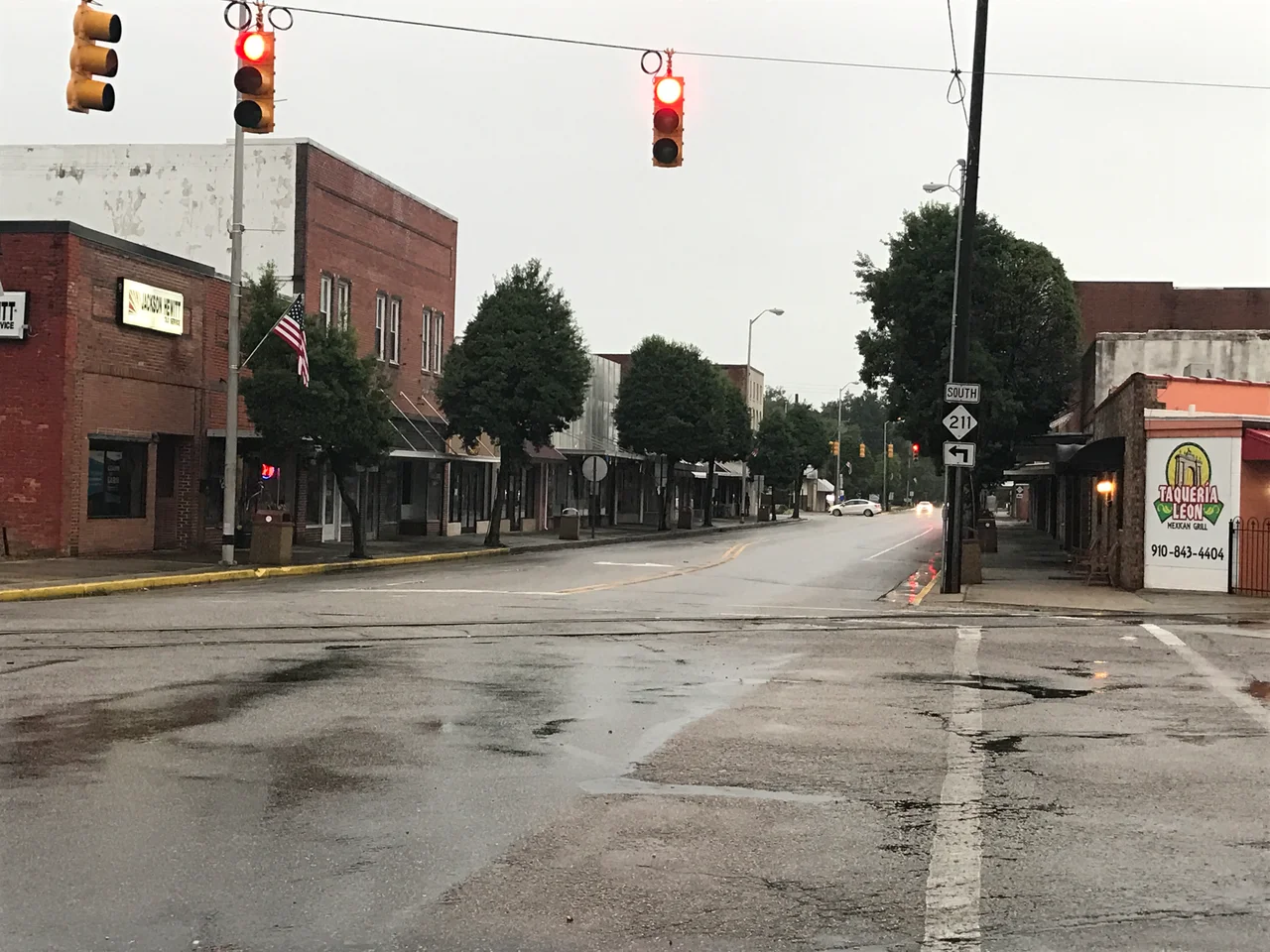

Red Springs, North Carolina
The water came up rust-red, and that was the whole point. In the 1850s, when Malcolm McNiell built a hotel on the rolling sandhills of northern Robeson County, what drew Victorian travelers wasn't the scenery. It was the iron-tinged mineral springs, said to do wonders for whatever ailed you. When the railroad finally arrived in 1884 and a post office opened, locals briefly called the place Dora. A year later, they reconsidered. The springs were the reason anyone came at all. The town has been Red Springs ever since.
Sailor Hector's Hill
Before the hotels and the railroad, there was Sailor Hector McNeill. Nobody knows exactly why a man living on the sandhills earned a nautical nickname, but the Bladen County tax rolls of 1771 record it without explanation. In 1775, on the eve of revolution, McNeill secured a royal land grant from King George III for the ground that would become Red Springs - a small irony given that the king's authority over these acres had only months to run. McNeill's home stood at the top of the hill on the edge of what's now the McNeill cemetery in town. He and his wife Mary lie buried there in unmarked graves, somewhere among the headstones of descendants who outlived their memory. Robeson County itself didn't exist yet; it would split from Bladen in 1787, drawing new lines around the same families.
Mineral Water and Music
By the 1890s, Red Springs had become an unlikely cultural outpost. The Cape Fear and Yadkin Valley Railway brought summer guests to the hotels, but it also brought students - lots of them. Between 1896 and 1915, the town supported both a military school for boys and the Southern Conservatory of Music for girls drawn from across the country. Picture the contrast: cadet drill on one campus, piano scales drifting from another, all set in a town small enough that everyone shared the same handful of streets. The military school eventually closed. The conservatory transformed into Flora MacDonald College, named for the Scottish heroine who helped Bonnie Prince Charlie escape after Culloden - a fitting reference in this corner of North Carolina, where Highland Scottish settlement ran deep. Today it survives as Flora MacDonald Academy, a private day school. Down the road, a few miles south, Floral College for young women had already come and gone, opened in the 1840s by lawyer John Gilchrist Jr. of the nearby Mill Prong House and closed by 1870.
A Bonanza in Red Springs
For four summers between 1947 and 1950, the smallest Class D ballpark in the Tobacco State League hosted a Philadelphia Athletics farm team called the Red Springs Red Robins. They won the league championship in 1948 and again in 1949, the second title led by a young pitcher named Bill Harrington who would eventually throw for the parent club. Player-manager Ducky Detweiler, a former Boston Brave, ran the 1950 squad. The team folded after that season, the way minor-league outposts always seem to. Then, improbably, professional baseball came back in 1969 when the Minnesota Twins relocated their Class A franchise to town. Forty thousand fans walked through the gates that season - more than ten times the town's population. Sports Illustrated wrote about it. Six of the players on the roster would reach the majors. The team lasted exactly one summer.
What February Took
On February 17, 1906, fire moved through downtown and took most of it. The wood-frame storefronts of the 1880s and 1890s burned together, leaving the rebuilt brick blocks visitors see today. Almost every small Southern town has a fire story like this one, but Red Springs' is striking for how cleanly it bisected the town's history - the world before downtown burned, and the world that replaced it. The legislator who'd pushed for the town's incorporation in 1887, Hamilton McMillan, lived through it. The Scottish Chief newspaper, founded the year after incorporation, had already moved to Maxton by then. Today the town's population sits at 3,087, smaller than the crowds the 1969 Twins drew. The springs themselves still bubble up rust-colored, mostly unremarked, in a place that was briefly famous for them.
From the Air
Located at 34.81°N, 79.18°W in northern Robeson County, eastern North Carolina. Nearest commercial field is Fayetteville Regional Airport (KFAY) about 30nm northeast. Pope Field (KPOB) at Fort Bragg lies roughly 25nm north-northeast. The town sits on the sandhills transition between coastal plain and Piedmont; from cruising altitude in clear weather, look for the cluster of streets at the junction of NC-211 and NC-71. Lumber River and adjacent swampland visible to the south.
Nearby Stories
- Battle of Averasborough 14 km away
- Carolina Sandhills 15 km away
- Cheraw, South Carolina 23 km away
- Lumberton, North Carolina 24 km away
- Yadkin River 34 km away
- Darlington County, South Carolina 36 km away
- Sampson County, North Carolina 36 km away
- Lake Waccamaw, North Carolina 41 km away