
Renwick Gallery
Half a block from the White House, a red-brick Second Empire confection rises from Pennsylvania Avenue like something the architect imagined while flipping through pictures of Paris. James Renwick Jr. did exactly that, modeling the building on the Tuileries addition to the Louvre and earning the place its first nickname: the American Louvre. He drew it for William Wilson Corcoran, a banker who wanted Washington to have a real art museum. The Civil War had other ideas. By August 1861, before the building was finished, the U.S. Army had seized it as a warehouse for Quartermaster records and uniforms, and by 1864 General Montgomery C. Meigs had moved his headquarters inside. The walls were built for paintings. They held paperwork for a generation.
The American Louvre
The site Renwick chose at 1661 Pennsylvania Avenue NW puts visitors within sight of the executive mansion, a deliberate gesture about where art belonged in the young republic. Inspired by the Tuileries wing of the Louvre, the building leans into French Second Empire idiom - steep mansard roofs, ornate window surrounds, sculptural niches along the facade. When critics called it the American Louvre, the comparison was partly aspirational and partly literal: Washington had no comparable gallery, and Renwick was importing a Parisian silhouette to a city still finding its architectural voice. Corcoran's collection of American and European art was meant to fill the rooms. War delayed everything. By the time the Renwick name actually settled on the building, it had served as a warehouse, a general's office, and from 1899 onward as the home of the federal Court of Claims.
Rescued by Executive Order
By the mid-twentieth century the old Corcoran building had drifted far from its original purpose. Court of Claims judges worked in its galleries; the facade had lost its sculpture niches; the place looked tired. In 1965, President Lyndon Johnson signed an executive order transferring the building to the Smithsonian Institution, with instructions that it become a gallery of arts, craft, and design. The Smithsonian named it for the architect, an unusual honor for a building most Washingtonians had walked past for decades without noticing. It opened in 1972 as the contemporary craft program of what is now the Smithsonian American Art Museum. Admission was free then and remains free now. The first-floor galleries rotated temporary shows twice a year, and the Renwick built a niche for itself as the place American craft was treated as high art rather than as the everyday objects critics had long mistaken it for.
The Wonder Years
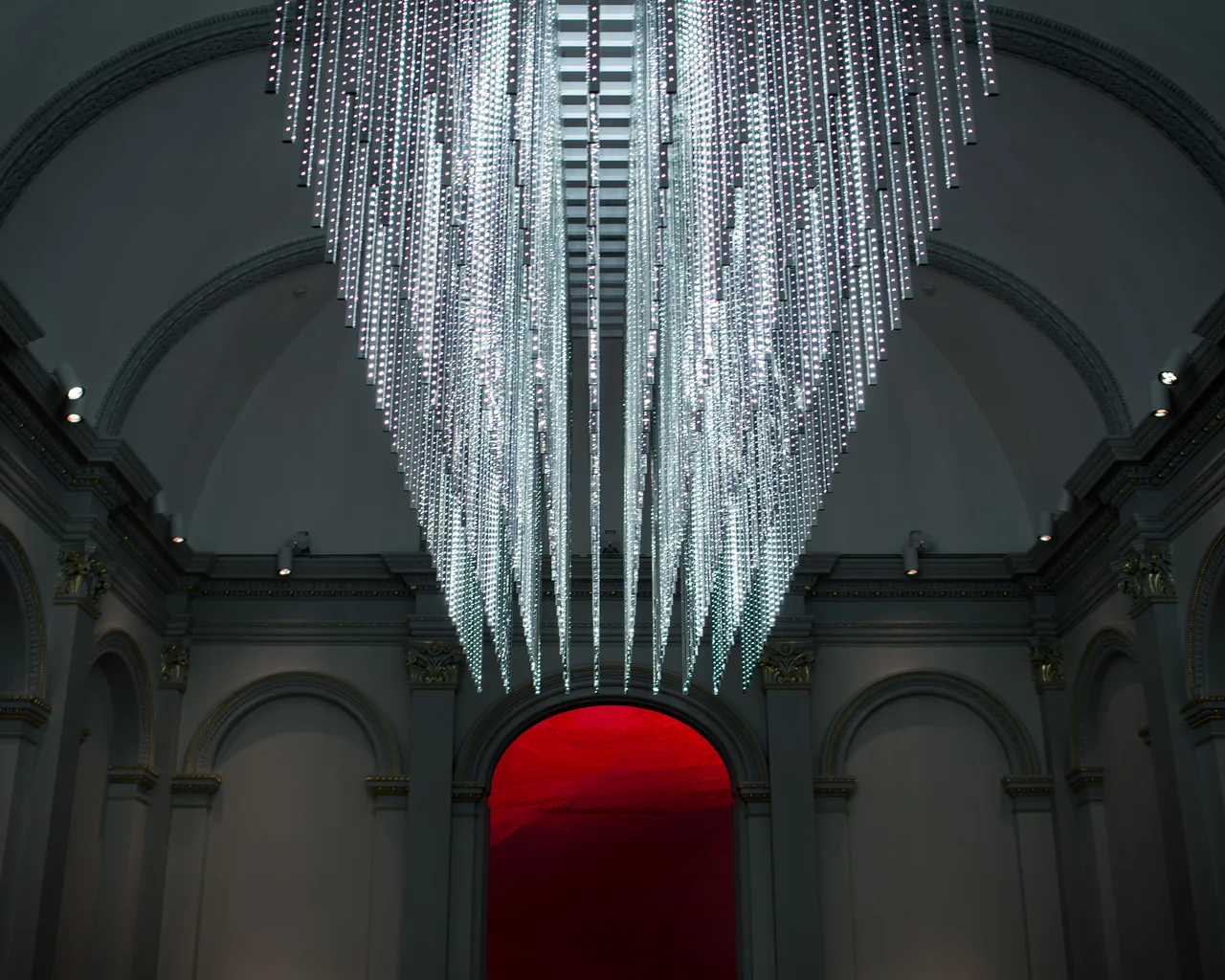
After a two-year renovation, the Renwick reopened on Friday, November 13, 2015, with an exhibition called Wonder. Nine contemporary artists were given the nine main galleries and told to fill them. The instructions were that loose. Jennifer Angus pinned more than 5,000 beetles, moths, and cicadas across the walls of a single room. Gabriel Dawe stretched colored thread floor-to-ceiling, weaving an actual rainbow into the gallery. Tara Donovan stacked thousands of plain index cards into a topography of white peaks. Patrick Dougherty wove saplings into shelters. Janet Echelman drew her floating, billowing piece from NOAA imagery of waves spreading across the Pacific after the 2011 Tohoku tsunami. Leo Villareal, Chakaia Booker, John Grade, and Maya Lin filled the remaining rooms. Visitor numbers nearly doubled. The Renwick was tagged on Instagram more than 20,000 times. Some critics worried the social-media frenzy had pulled the museum away from its craft mission. Others noticed people lining up at a federal art gallery to see beetles.
Craft, Reconsidered
The Renwick Craft Invitational, held biennially, is the museum's argument with the old hierarchy that put painting at the top and weaving at the bottom. The 2016 edition featured Steven Young Lee, Kristen Morgin, Jennifer Trask, and Norwood Viviano. Disrupting Craft in 2018 brought work by Tanya Aguiniga, Sharif Bey, Dustin Farnsworth, and Stephanie Syjuco - artists pulling craft into conversations about labor, identity, and migration. In 2019, glass artist Ginny Ruffner collaborated with Grant Kirkpatrick on an augmented-reality exhibition called Reforestation of the Imagination, layering digital growth atop physical sculpture. In 2023, the tenth Renwick Invitational, Sharing Honors and Burdens, featured six Native American artists: Joe Feddersen, Erica Lord, Geo Soctomah Neptune, Maggie Thompson, Lily Hope, and Ursala Hudson. Since 2011 the gallery has hosted Handi-hour, a quarterly crafting-themed happy hour with beer curated by Greg Engert of ChurchKey - the unbuttoning of a museum that knows the difference between reverence and stuffiness.
The Building Itself
Even with the exhibitions changing constantly, the building is its own argument. The Grand Salon on the second floor, restored to its nineteenth-century proportions, has the deep crimson walls and the salon-style hanging that Corcoran would have recognized. From outside, the mansard roof line and the rebuilt facade sculpture niches show what Renwick intended, and the building's relationship to its neighbors - the White House across one corner, Blair House next door - reminds you that this small brick gallery sits at the symbolic heart of the federal city. It is the kind of building you can walk through in under an hour and remember for years. Renwick designed two other Washington landmarks (the Smithsonian Castle and the Oak Hill Cemetery Chapel) and St. Patrick's Cathedral in Manhattan. The gallery that bears his name is the smallest of them, and arguably the most surprising.
From the Air
Renwick Gallery sits at 38.8991 degrees N, 77.0390 degrees W, on Pennsylvania Avenue NW directly across Lafayette Square from the White House. From the air it reads as a small red-brick Second Empire block with a mansard roof, immediately northwest of the executive mansion and adjacent to Blair House. Best viewed at 1,500 to 3,000 feet AGL in clear daytime conditions; the surrounding restricted airspace (P-56) means general aviation traffic must transit well clear. Nearest airports are Ronald Reagan Washington National (KDCA) about 3.5 nm south, Washington Dulles (KIAD) 23 nm west, and College Park (KCGS) 8 nm northeast.
Nearby Stories
- Gunston Hall 1.1 km away
- 2023 Baltimore Shooting 4.9 km away
- Battle of Middleburg 6.6 km away
- Crownsville Hospital Center 10 km away
- Battle of Loudoun Heights 13 km away
- First Battle of Rappahannock Station 20 km away
- Howard County, Maryland 21 km away
- Harriet Tubman Underground Railroad 50 km away