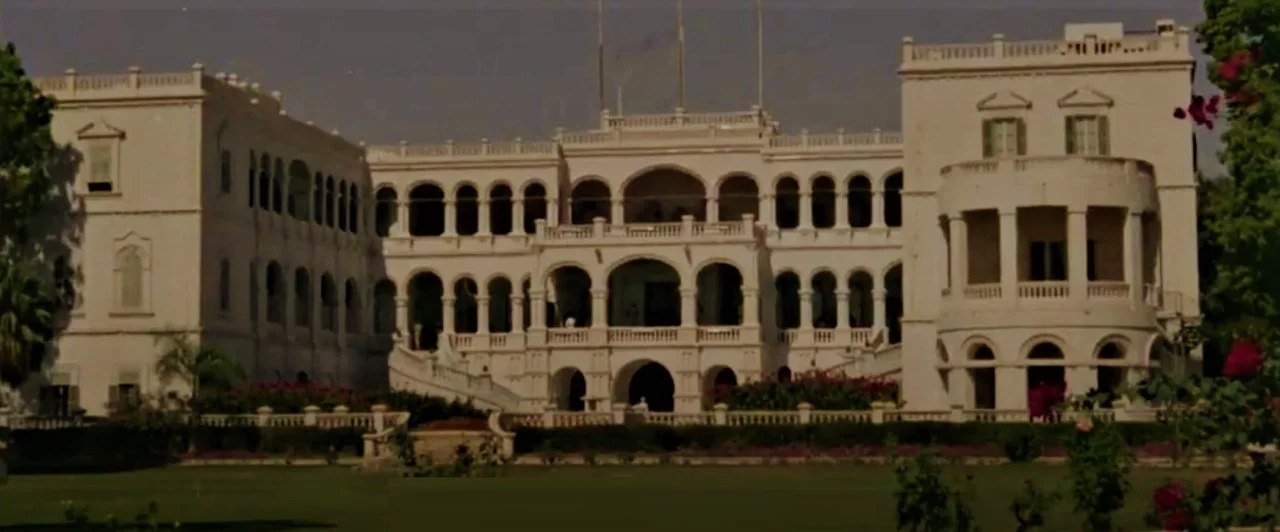

Republican Palace, Khartoum
Two palaces share a single garden on the southern bank of the Blue Nile, and the story of Sudan is written between them. The Old Palace, in English Palladian style, rose on the stones of its Ottoman predecessor in 1899 - built for colonial governors-general who did not ask permission. The New Palace, a Chinese-funded Arabic-style complex, opened in 2015 for President Omar al-Bashir. Between the two buildings, separated by a hundred meters and a hundred and fifty years, sits the ghost of every Sudanese regime that rose and fell in Khartoum.
The First Palace
Before any of the stone buildings, there was a rectangular mud palace. Mahu Bey Urfali, the Hakimadar who governed for just ten months in 1825-26, raised it as the administrative seat of the newly-conquered Turco-Egyptian Sudan. The site was chosen for its position: less than a kilometer from the confluence of the White and Blue Niles, with a view across the water that carried military and symbolic weight. Ali Khurshid Pasha expanded the compound in 1834. For the next half century, Egyptian and Ottoman officials ran their province from this spot - collecting tribute, organizing slave caravans, sending expeditions southward into territory their maps could not yet describe. The building was functional, not grand. It would take the British to make it monumental.
Gordon's Stairs
By the 26th of January 1885, the palace was a fortress waiting to fall. Inside, Charles Gordon had spent ten months directing the siege defense of Khartoum against the Mahdist army. When the Mahdists broke the walls before dawn that morning, accounts split on how he died. One version has Gordon in full uniform at the top of the palace steps, refusing to draw his sword. Another has him killed in the street trying to reach the Austrian consulate. The most detailed account came thirteen years later from his servant Khaleel Aga Orphali: Gordon died fighting on the staircase of the west wing, wounded in the shoulder by a spear, still standing when Orphali last saw him. Thirteen years after that, Kitchener razed what remained. The Hakimadaria Palace was demolished, and on its stones the first British governor-general began a new building in 1899. By 1906 the palace that would shape the next century of Sudanese history was complete.
January 1956
The transition, when it came, was ceremonial. On 1 January 1956, at this palace, British and Egyptian flags came down from the staff. The Sudanese flag went up. Condominium rule - the awkward joint Anglo-Egyptian arrangement that had governed Sudan since the reconquest - ended not with a battle but with a raising. The building ceased to be the Governor-General's Palace and became the Republican Palace. The Sovereignty Council took residence. Presidents began moving in, and so did the history they made: Queen Elizabeth II stayed in the residential wing in February 1965, with Prince Philip beside her and Sudanese psychiatrist El-Tigani el-Mahi to her left. Haile Selassie came from Ethiopia, Nasser from Egypt, Tito from Yugoslavia. In 1967 Arab heads of state met here to issue the Khartoum Resolution - the famous Three No's directed at Israel. The palace was becoming a stage.
Coups on the Lawn
Every decade seemed to bring another military overthrow, and each time the cameras assembled at the same gate. In May 1969, Gaafar Nimeiry took power here. In April 1985, a coup against Nimeiry replaced him with a civilian government - Nimeiry, detained inside, managed to escape by jumping the palace's southern wall. In June 1989, Brigadier Omar al-Bashir posed for photographs in front of the palace with Defense Minister Abdel Rahim Mohammed Hussein after overthrowing the brief democratic government that followed. Each regime accepted the same address as proof it now ran the country. When al-Bashir commissioned his Chinese-built New Palace in 2015, the Antiquities Authority was not consulted. Directors of museums complained publicly that the Arabic-style additions clashed with the old Palladian building's lines and ruined the historic garden. Bashir opened it anyway. Four years later, in April 2019, he too was gone - arrested after months of protests that began over tripled bread prices.
A Palace in Crossfire
In April 2023, war came back to the palace grounds. The paramilitary Rapid Support Forces, which had grown out of the Janjaweed of the Darfur conflict, seized the complex and most of central Khartoum. For nearly two years they held it while the Sudanese Armed Forces bombed and shelled their own capital's most symbolic building - airstrikes on 6 August 2023, artillery throughout, a fire that gutted the new palace, shelling on the old building on 12 May 2024. Khartoum residents sent photographs to the BBC showing the damage. On 21 March 2025 the Sudanese Armed Forces retook the palace. What happens next no one can say. For the people of Khartoum - for the civil servants whose salaries froze, for the museum staff whose collections burned, for families displaced into refugee camps - the palace's story is not academic. It is the place where every version of their country has begun and ended.
From the Air
The Republican Palace sits at 15.610°N, 32.527°E on the south bank of the Blue Nile, just east of the confluence with the White Nile. From altitude the Y-shape of the rivers is the primary landmark - the palace occupies the narrow peninsula between them near the tip. Nearest airport is Khartoum International (HSSS); Wadi Seidna (HSSW) lies to the north on the other side of Omdurman. The complex appears as a walled rectangular compound facing Nile Street; the old Palladian building and the larger 2015 Arabic-style addition are both visible in clear weather.
Nearby Stories
- Esh Shaheinab 27 km away
- Naqa 56 km away
- Mahdist War 65 km away
- Musawwarat es-Sufra 100 km away
- Gezira State 101 km away
- Northern Sudan 215 km away