.jpg)
Republican Palace Museum
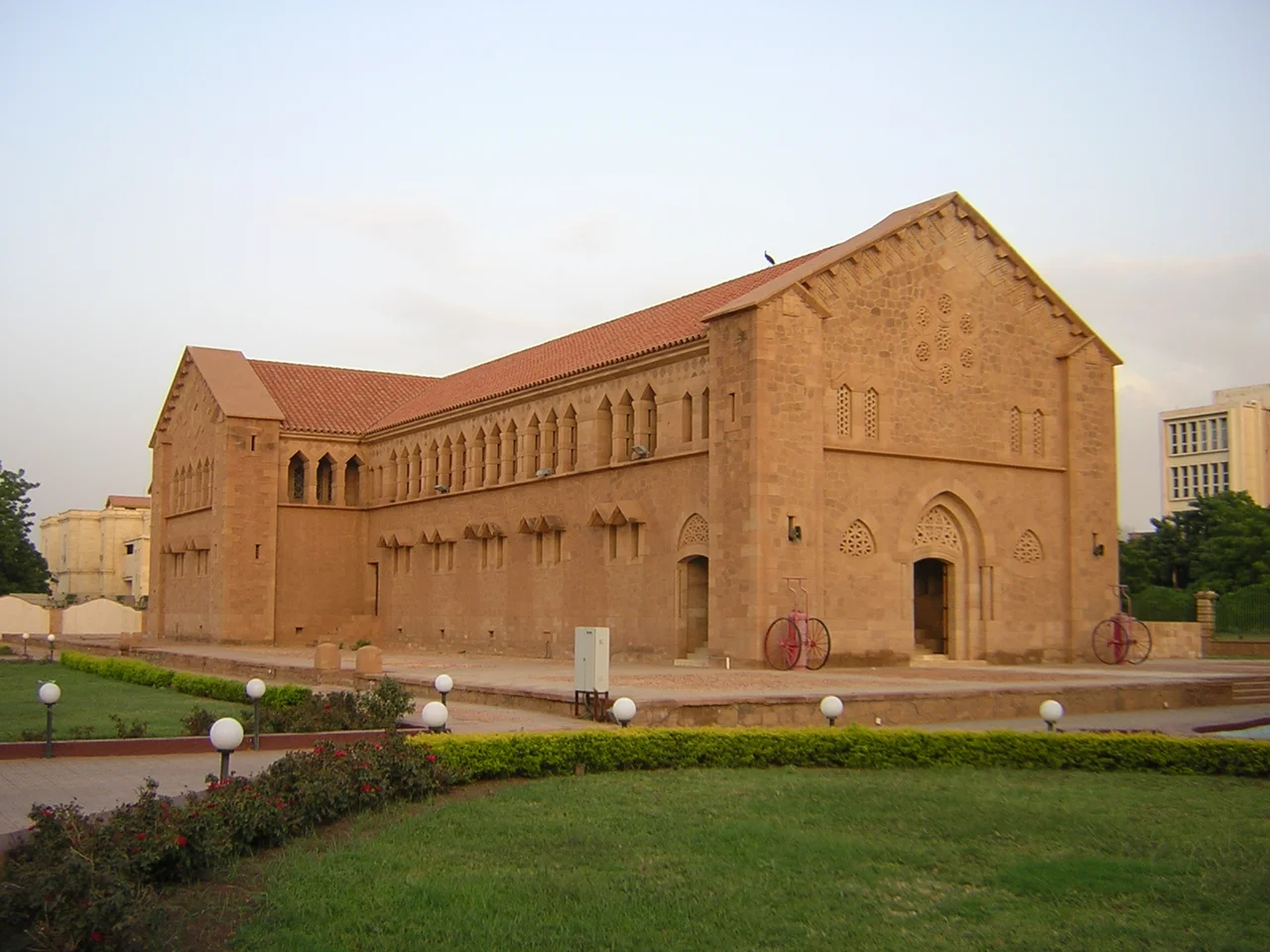
The stained glass window depicts the Magi - except Balthazar, the Persian-born wise man, is dressed as a Sudanese sheikh. Mabel Esplin designed it in 1912 as an attempt to bring local colour into the new All Saints' Cathedral at Khartoum. A century later, visitors wander past the same window in a building that has been, in turn, an Anglican cathedral, a closed security site, and since 1999 the Republican Palace Museum of Sudan. The Magi are still on the wall. Around them now: presidential Rolls-Royces, Mahdist swords, and the furniture of everyone who ever tried to govern this country.
A Cathedral in the Desert
Reginald Wingate, the second British governor-general of the Anglo-Egyptian Sudan, commissioned the building in the years after the 1898 reconquest. When All Saints' Cathedral opened in 1912 it was built in Byzantine style on a scale that announced imperial permanence - 50 meters long, 14 meters wide, 13 meters high from the outside. Mabel Esplin's windows filled it with saints: Alban, Edmund, Theodore, Sebastian, each on a lancet panel along the north transept. She also produced two three-light windows for the Gordon Memorial Chapel - one themed "Hope, Faith and Charity," the other "Fortitude, Justice and Wisdom." When her health failed, her former assistant Joan Fulleylove completed the project. The cathedral was the spiritual anchor of British Khartoum, located a stone's throw from the Governor-General's Palace. When Sudan became independent in 1956, the building kept functioning as a cathedral for another fifteen years.
Closed and Reopened
In 1971, citing security reasons, the government closed All Saints' and built a replacement in the Al-Amarat neighborhood. The old cathedral stood empty for a quarter of a century. In October 1996 its bell tower was removed. A year later, work began to convert the building into something new - not a place of worship, but a place for the state to tell its own story. On the night of 31 December 1999, President Omar al-Bashir opened the Republican Palace Museum. The Byzantine shell remained. The altar was gone. In its place: exhibits designed to "foster national loyalty" and trace Sudan's governance from the Turco-Egyptian period through Anglo-Egyptian condominium rule to independence. Three parts of the complex stayed open to the public - the museum, a library, and a small mosque tucked into the southeast corner of the palace wall.
The Cars
Outside the main hall, a long pavilion holds the cars. King Fuad of Egypt gifted a Rolls-Royce in 1924 to Sir Robert Howe, then Governor-General of Sudan. The King of Egypt gifted another Rolls-Royce to President Nimeiri in 1984, this one with a bulletproof body - a hint of what governing Sudan had become by the 1980s. A row of Humbers, used by the British governors-general from 1940 to 1956, sits beside them. There is a 1954 Rolls-Royce driven by Alexander Knox Helm, the last British governor-general, and then by members of the Sudanese Sovereignty Council after independence. The same car ferried Gamal Abdel Nasser around Khartoum during his November 1959 state visit. Each vehicle is a time capsule: the leather stitched in Britain, the fate of its passengers decided in Khartoum.
What the Rooms Hold
The weapons suite displays swords and rifles from the Turco-Egyptian period, the Mahdist uprising, and the Anglo-Egyptian reconquest - three armies, overlapping collections, displayed together. The documentation suite narrates the national struggle for independence with photographs and letters. The decoration suite holds medals and ceremonial pieces. A library attached to the complex collects the books that accumulated in the palace itself, mostly during the dual rule of 1898 onwards - volumes that had been deposited in the ceremonial department and scattered until a reading room was finally assigned in 1976. The museum opens three days a week, Sundays and Wednesdays and Fridays, morning and evening, with a pause during the heat of the afternoon. Its position behind the Old Republican Palace means the security of both has been tied together - when the palace fell to the Rapid Support Forces in 2023, the museum was caught in the fighting too.
What Survives
The purpose the museum states for itself is to "preserve Sudan's historical symbols of governance, sovereignty, and the national movement." That was always a tall order in a country where governance has changed hands by force more often than by ballot. And it became an even taller one once the 2023 civil war put Khartoum itself in the crossfire. The building has endured shelling, fire, and occupation since the war began. What survives of Mabel Esplin's windows, of the Rolls-Royces, of the library that took a century to assemble - much of that is unknown at the time of writing. Khartoum's museums were under the control of the Sudanese Armed Forces again as of March 2025. But the museum's story - cathedral, silence, reopening, war - is itself a kind of exhibit. It tells you how many versions of Sudan this building has already outlasted.
From the Air
The museum lies at 15.608°N, 32.529°E, directly southeast of the Old Republican Palace on the south bank of the Blue Nile in central Khartoum. From altitude look for the Y-shape of the Nile confluence; the palace complex sits on the peninsula between the two rivers. The museum building, a rectangular structure with Byzantine proportions (50m x 14m x 13m), sits inside the walled palace compound. Nearest airport is Khartoum International (HSSS), about 5km southeast; Wadi Seidna (HSSW) lies to the north across Omdurman.
Nearby Stories
- Esh Shaheinab 27 km away
- Naqa 56 km away
- Mahdist War 65 km away
- Musawwarat es-Sufra 100 km away
- Gezira State 101 km away
- Northern Sudan 215 km away