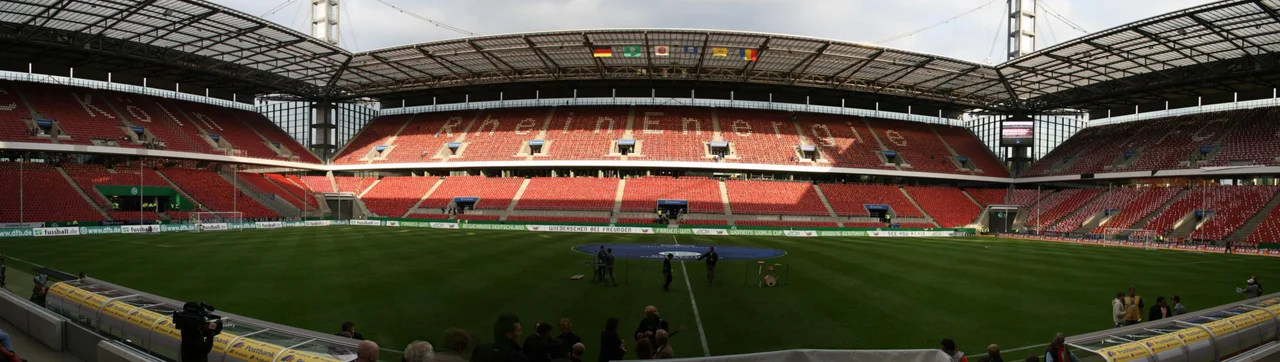

RheinEnergieStadion
The land underneath the RheinEnergieStadion exists because Germany lost the First World War. Under the 1919 Treaty of Versailles, the fortifications ringing Cologne had to come down, and the freshly cleared belt of land on the city's western edge needed a use. The City of Cologne chose to build a stadium and 15,000 jobs at the same time, in what was as much an economic-recovery programme as a sports project. The original Müngersdorfer Stadion opened on the site, hosted its first international match on 20 November 1927 — a 2-2 draw between Germany and the Netherlands — and over the next century would be torn down, rebuilt, renamed, and rebuilt again. Today its third incarnation seats about 50,000 people and bears the name of the city's energy utility. The Bundesliga side 1. FC Köln calls it home.
Built on the Old Walls
The first Müngersdorfer Stadion cost the city 47.4 million Deutsche Mark, an enormous sum for a country still digging itself out of the war. The investment paid off in a different currency: prestige. Within a year of opening, the stadium was hosting matches in front of crowds that the older venues in Cologne could not have held. The German national team played there 19 times across the decades and lost only once. The first postwar football match in the rebuilt stadium drew 75,000 people to watch 1. FC Nürnberg defeat 1. FC Kaiserslautern 2-1 — a crowd larger than the current stadium can accommodate. The Müngersdorfer also became famous for amateur athletics, hosting track meets that attracted over 38,000 participants in 1929. In 1933 Jews were barred from those events. After the war the amateur tradition ended; the stadium would host only professional sport from then on.
The Stadium That Almost Wasn't
When the 1974 FIFA World Cup was awarded to West Germany, Cologne wanted in. The city's bid was accepted, and planning began on an 80,000-seat replacement for the aging Müngersdorfer. Then the budget started moving in the only direction stadium budgets ever move. The original 23.5 million Deutsche Mark figure swelled past 93.5 million, and the city could find only an extra 6 million. Cologne lost its World Cup hosting slot. The city pressed on with the construction anyway at reduced scale, and on 12 November 1975 — more than a year after the World Cup it had been meant to anchor — the new 61,000-seat stadium opened with a friendly between 1. FC Köln and SC Fortuna Köln. 1. FC Köln won 1-0. That second-generation stadium hosted UEFA Euro 1988, including a USSR victory over the Netherlands and an Italian win over Denmark.
Tearing It Down to Bring the World Cup Back
When Germany won the right to host the 2006 FIFA World Cup, Cologne rebuilt the stadium yet again. The renovation ran from 2002 to 2004 and erased the running track that had separated the spectators from the pitch — a deliberate move toward the English football-stadium model, where the stands push right up to the touchline. The 2005 FIFA Confederations Cup served as the trial run; Argentina beat Tunisia 2-1 in the opening match. A year later the venue, contractually rebranded as the FIFA World Cup Stadium Cologne for the duration of the tournament, hosted World Cup matches in front of full houses. The Cologne energy company RheinEnergie AG bought the naming rights soon after. UEFA, which forbids commercial naming during its own tournaments, simply called the place "Stadion Köln" in 2020 and "Cologne Stadium" again in 2024.
The Empty Final
The strangest match the RheinEnergieStadion has ever held was played on 21 August 2020 in front of nobody. The COVID-19 pandemic had forced UEFA to move the 2020 UEFA Europa League Final out of Gdańsk and into Cologne, and to play it behind closed doors. Sevilla beat Inter Milan 3-2 in a 50,000-seat stadium with zero spectators in the seats; the sound on the broadcast was almost entirely the players themselves. Four years later, with the pandemic past, the same stadium was one of ten host venues for UEFA Euro 2024 — full houses again, the roar back in the upper tiers. Outside the north grandstand, a small museum tells the history of 1. FC Köln, whose fans have been chanting in this same field of ground for nearly a hundred years, in three different stadiums built on top of each other on the same patch of earth.
From the Air
The RheinEnergieStadion sits in Sportpark Müngersdorf on the western edge of Cologne, at roughly 50.934°N, 6.875°E, about 5 km west of the cathedral and immediately south of Aachener Straße. From the air the stadium's distinctive corner pylons rising above the open bowl are easy to pick out against the surrounding parkland. The Bundesautobahn 1 runs just 1.2 km to the west via the Cologne Beltway. Nearest airport is Cologne Bonn (EDDK / CGN), about 18 km southeast across the Rhine.
Nearby Stories
- Diamond Interchange: How a Simple Idea Reshapes Towns Like Julich 2.8 km away
- Dusseldorf-Unterbach 6.1 km away
- Baumwollspinnerei Ermen & Engels 11 km away
- RAF Bruggen 15 km away
- Hagen Open-air Museum 21 km away
- Belgium 130 km away
- Marcinelle Mining Disaster 173 km away
- Zwingenberg Castle 178 km away