
Rhodes Blood Libel
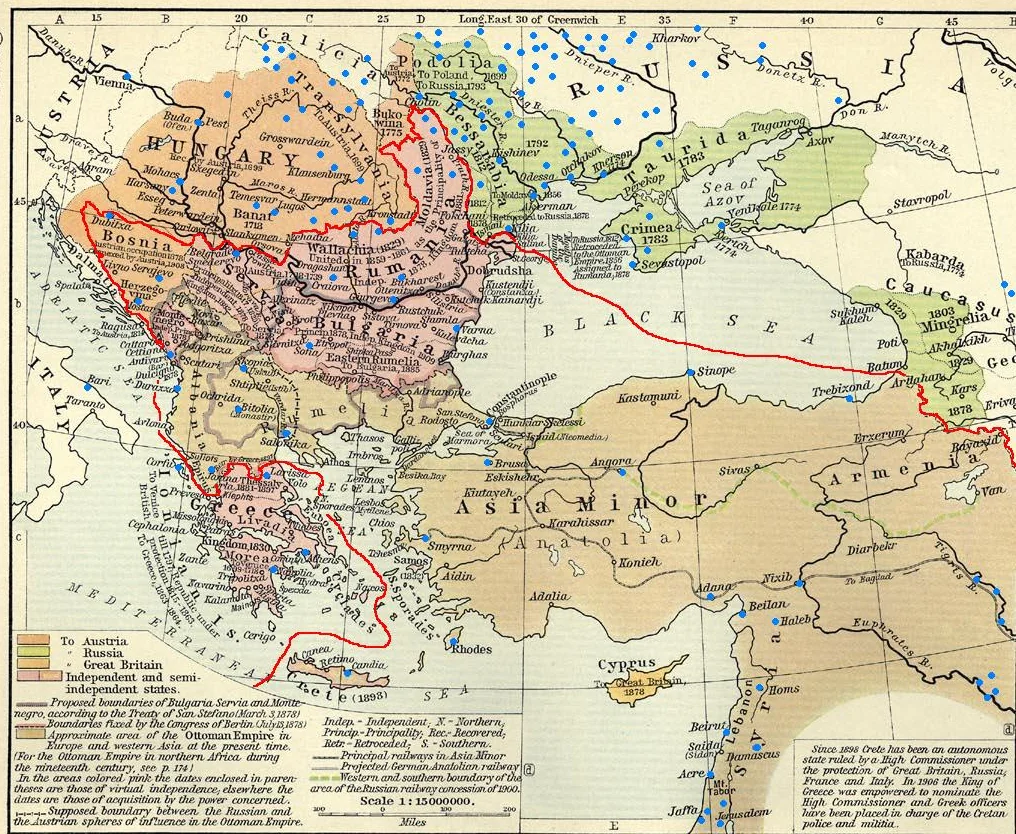
On February 17, 1840, a Greek Orthodox boy went for a walk in Rhodes and did not come home. His mother reported him missing the next day. Within a week, the island's Jewish community, who had lived on Rhodes for nearly two thousand years, would be accused of a crime that had no factual basis in any era of their religious practice but that medieval Christian Europe had circulated for centuries: the so-called blood libel, the lie that Jews murdered Christian children to use their blood for Passover. What followed was torture, a twelve-day siege of the Jewish quarter on the eve of Purim, and an international diplomatic battle that would clear the community's name and produce an Ottoman imperial decree denouncing the libel as false.
A Community Older Than the Charge
Jews had lived in Rhodes since at least 142 BC, when the island appears in a Roman decree renewing the friendship treaty between Rome and the Jewish nation. Benjamin of Tudela, the twelfth-century traveler, counted around 400 Jews in the city. The community survived the catastrophic earthquakes of 1481 and 1482, then lost most of those who remained when the Knights Hospitaller, ruling Rhodes at the time, expelled non-converts after the plague years of 1498-1500 and brought 2,000 to 3,000 captured Jews to the island as enslaved laborers on the fortifications. Those Jews and their descendants helped the Ottomans take Rhodes in 1522, and under Ottoman rule the community recovered. By the nineteenth century, perhaps 2,000 to 4,000 Jews lived in Rhodes, governed by a council of seven, working as merchants in cloth, silk, sulfur, and resin, or as artisans and fishermen.
The Accusation Takes Hold
Two Greek women came forward several days after the boy disappeared, claiming they had seen him walking with four Jewish men. One was identified as Eliakim Stamboli. He was arrested and given five hundred blows of the bastinado on the soles of his feet. On February 23, in a room containing Governor Yusuf Pasha, the Muslim qadi, the Greek archbishop, and the European consuls, his torture intensified. He was loaded with chains, beaten further, burned, and crushed under a stone laid on his chest. Reduced, in the words of the community's appeal, to the point of death, he confessed to whatever was demanded and named other Jews. About six men in total were arrested and tortured. The chief rabbi was interrogated about whether Jews practiced ritual murder. He told the truth: they did not. Jewish law forbids the consumption of any blood, animal or human.
The Quarter Under Siege
On the eve of Purim, Yusuf Pasha sealed off the entire Jewish quarter. No one could enter or leave. Someone tried to smuggle a corpse into the quarter to fabricate evidence; the residents stopped the attempt. The blockade lasted twelve days, lifted only after a senior Ottoman treasury official visiting Rhodes intervened. The community gave thanks for what they thought was deliverance. Then word arrived from Damascus, where a parallel blood libel had erupted at almost the same moment, with Jews in that city tortured into similar confessions. The relief vanished. The European vice-consuls in Rhodes, including the British consul J. G. Wilkinson and Sweden's E. Masse, had supported the accusation throughout, and now used the Damascus reports to push harder. They had been present during much of the torture.
The International Fight
Word reached Constantinople, then London, then Vienna. The Rothschild family bank in Vienna, run by Salomon Mayer von Rothschild, had close ties to Chancellor von Metternich. On April 10, Metternich dispatched instructions calling the libel "absurd" and ordering the Austrian ambassador to pressure the Ottoman government. The Board of Deputies of British Jews placed paid advertisements condemning the charges in 35 British journals. On April 30, a delegation met Foreign Secretary Lord Palmerston, who called the accusation a calumny and instructed the British ambassador in Constantinople to demand an immediate and strict inquiry, especially into the role of the Christian leaders and European consuls who had pushed the case. By the end of April, instructions arrived in Rhodes ordering the release of the remaining six Jewish prisoners. They were freed on May 21 under the guarantees of the community elders.
Acquittal and the Sultan's Decree
On May 26, an Ottoman tribunal in Constantinople opened the formal investigation, with Jewish and Greek delegations of five each, joined by the qadi from Rhodes, the French consul, and the Austrian vice-consul. The qadi testified that the entire affair had been the product of hatred, instigated by the British and Austrian consuls. On July 21, the verdict came down. The Jewish community of Rhodes was acquitted. Yusuf Pasha was dismissed from his governorship for permitting torture forbidden under the recent Hatt-i Sharif reforms. In November, after a delegation led by Adolphe Crémieux and Sir Moses Montefiore had also secured the release of the imprisoned Jews of Damascus, the Ottoman sultan issued a firman declaring that competent investigators had reviewed Jewish religious literature and confirmed that Jews are forbidden from consuming animal blood, let alone human blood. The blood libel, the firman stated, was false. The decree did not stop the libel from circulating elsewhere; the lie has continued into modern times. But the Jews of Rhodes survived 1840, and their innocence was a matter of imperial record.
From the Air
The Rhodes Jewish quarter, La Juderia, sits in the southeast section of the medieval old city of Rhodes at approximately 36.45°N, 28.22°E (note: the article coordinates point to the broader island). The Kahal Shalom Synagogue, built in 1577, still stands and is the oldest synagogue in Greece. Nearest airport is Rhodes Diagoras International (ICAO: LGRP) about 14 km southwest. Best viewed from 3,000-5,000 ft over the medieval walled city.
Nearby Stories
- Acropolis of Rhodes 24 km away
- Battle of Rhodes (1912) 33 km away
- Astypalaia 96 km away
- Toplou Monastery 130 km away
- Antalya Museum 204 km away
- Archaeological Museum of Agios Nikolaos 215 km away
- Antalya 218 km away
- Agios Neophytos Monastery 377 km away