.JPG)
Richard Bong
A bridge in the Townsville suburb of Annandale carries the name of a man who never lived there: Major Richard Ira Bong, an American fighter pilot from a Wisconsin dairy farm. He passed through this city during the war, staging north through the Garbutt airfield with his squadron on the way to the fighting in New Guinea. By the time he was finished he had shot down forty Japanese aircraft, more than any American pilot in history, before or since. He was twenty-four when he died, and he never died in combat at all.
The Boy Who Watched the Sky
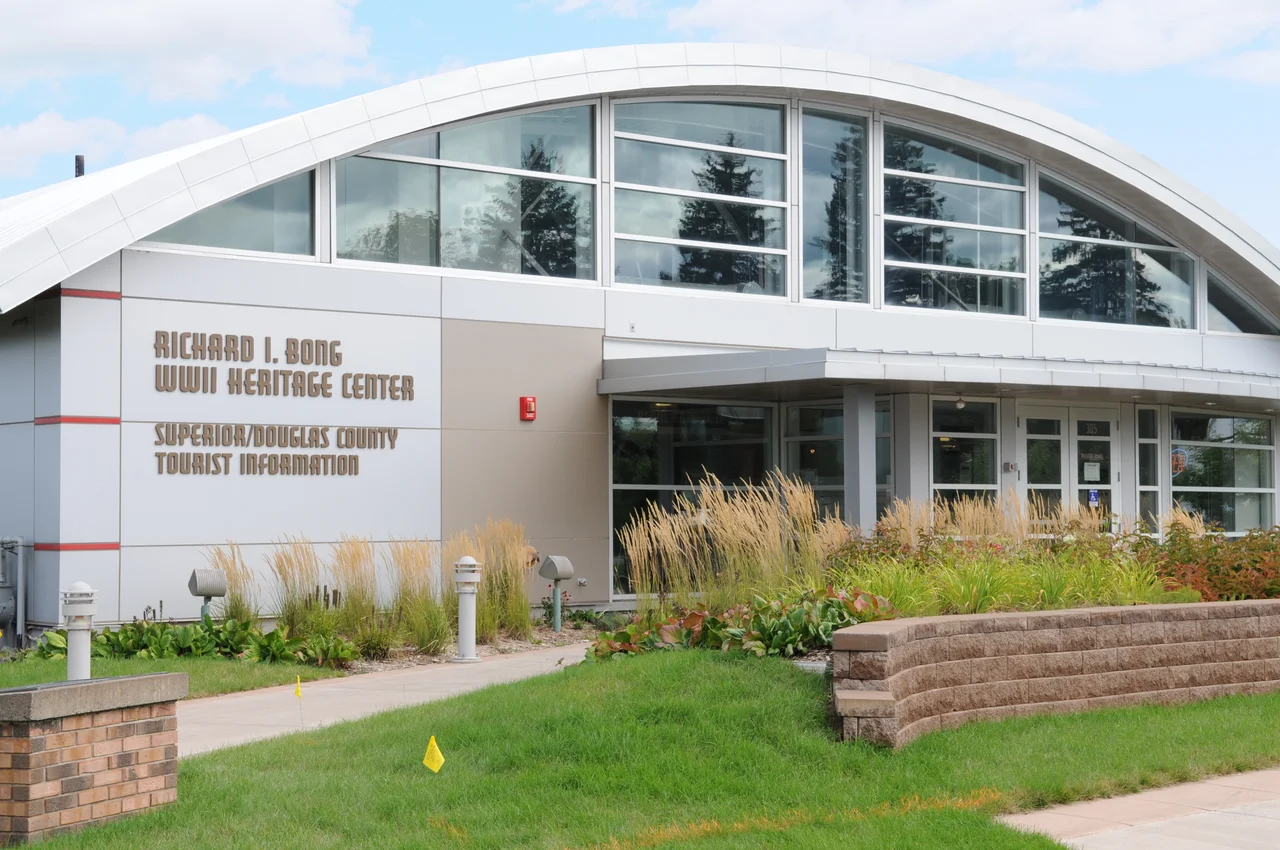
Bong grew up on a farm in Poplar, Wisconsin, the eldest of nine children of a Swedish immigrant father. As a boy he watched mail planes drone overhead toward President Coolidge's summer retreat in nearby Superior, and he built models obsessively. He played clarinet in the marching band and skated hockey through the long northern winters. He enrolled at the local teachers college, signed up for civilian flying lessons, and in May 1941 joined the Army Air Corps. One of his flight instructors, as it happened, was a young Arizonan named Barry Goldwater, who would later run for president. Bong earned his wings in January 1942, a quiet, almost shy young man who turned out to have an extraordinary gift in the cockpit.
Grounded for Buzzing San Francisco
That gift first showed itself as mischief. Training over California in his new twin-boomed P-38 Lightning, Bong flew low down Market Street in San Francisco, looped around bridges, and reportedly blew the washing off an Oakland woman's clothesline. He was hauled before General George Kenney and reprimanded; he was also, the story goes, ordered to go do the woman's laundry. Kenney's words were stern, but his private verdict was warmer: "We needed kids like this lad." Bong was still grounded when the rest of his group shipped out to England, which is how he ended up bound instead for the South-West Pacific, the theatre where his name would be made.
Ace of Aces
He reached his first victories at the end of 1942 over Buna in New Guinea, flying with a borrowed squadron while his own waited for its scarce Lightnings. The tally climbed through 1943 and 1944. In April 1944 he passed the American record of twenty-six kills set by Eddie Rickenbacker in the previous war. He named his P-38 "Marge" and painted on its nose the face of Marjorie Vattendahl, the college girl he had fallen for back home. In December 1944 General MacArthur pinned the Medal of Honor on him at Leyte, and days later, over the Philippines, he scored his fortieth and final victory. He married Marge in February 1945, the celebrated Ace of Aces and his sweetheart, the wedding splashed across newspapers. He had survived two years of the most dangerous flying in the world.
Lost Before the End
What combat could not do, a test flight did. Pulled from the front and assigned to Lockheed's plant in Burbank, Bong was flying the new P-80 Shooting Star, America's first operational jet fighter, still a temperamental and lethal machine. On 6 August 1945, on a routine acceptance flight, the primary fuel pump failed on takeoff. He did not switch to the backup pump in time, bailed out far too low, and was killed almost instantly when the jet exploded. He had logged barely four hours in the type. His death made front pages across America, sharing the day's news with the first reports of the atomic bomb falling on Hiroshima. He is buried in the small cemetery at Poplar, near the farm where he learned to watch the sky. Half a world away, a Townsville bridge still carries his name.
From the Air
The Major Richard I. Bong Bridge that commemorates him crosses Ross River on Macarthur Drive in Annandale, Townsville, at roughly 19.313 degrees S, 146.786 degrees E, near the site of the wartime Ross River airfield his squadron used. The bridge sits on the southern side of the city; Castle Hill's pink-granite dome rises about 290 m to the north over the CBD, and the active RAAF Base Townsville and civil airport (ICAO YBTL) lie a few kilometres to the northwest. Cleveland Bay and Magnetic Island are visible to the north. Best appreciated at low level in clear dry-season weather. Bong himself flew from this region's fields, including Garbutt, on his way to the New Guinea campaign.
Nearby Stories
- Ayr 13 km away
- SS Yongala 34 km away
- Great Palm Island 35 km away
- Bindal People 50 km away
- Cardwell UFO Festival 83 km away
- Hinchinbrook Island 113 km away
- Porcupine Gorge 215 km away
- Samarai 998 km away