
Richard Trevithick
On the morning of 21 February 1804, a strange machine sat on the cast-iron tramway at the Penydarren Ironworks in Merthyr Tydfil. It had a boiler, a single horizontal cylinder, a tall flywheel, and rails for wheels. Behind it were hooked five wagons loaded with ten tons of iron and seventy curious passengers. Two ironmasters, Samuel Homfray and Richard Crawshay, had a bet running on whether the contraption could haul that load nine and three-quarter miles to Abercynon. The bet was 500 guineas. At an average speed of about 2.4 miles per hour, in four hours and five minutes, the machine won the bet. It was the world's first railway journey by a steam locomotive. The man who built it was a six-foot-tall Cornish wrestler, school dropout and arithmetic prodigy named Richard Trevithick.
The Boy at the Mines
Trevithick was born on 13 April 1771 at Tregajorran, in the parish of Illogan, between Camborne and Redruth in the heart of the Cornish mining country. His father was a mine captain. His mother was a miner's daughter. He was the only boy in a family of six children. A schoolmaster wrote of him that he was "a disobedient, slow, obstinate, spoiled boy, frequently absent and very inattentive." The one exception was arithmetic, which he picked up with uncanny intuition and solved his own way. He grew to over six feet tall, won wrestling matches across Cornwall, and at nineteen went to work at the East Stray Park Mine, where steam pumping engines lifted water out of the deep tin and copper shafts. He grew up watching those engines run.
High-Pressure Steam
The steam engines of the day, designed by James Watt and Matthew Boulton, ran near atmospheric pressure with a separate condenser. Watt held the patents, and Cornish mine owners hated the royalties they had to pay. Trevithick, working at the Ding Dong Mine from 1797, began building engines that avoided Watt's patent by using much higher steam pressures. Around thirty pounds per square inch, ten times atmospheric, with no condenser. The exhaust steam was sent straight up the chimney. Higher pressure meant smaller cylinders, lighter engines, and engines small enough to carry their own weight. Watt thought it dangerous and tried to discredit him; one of Trevithick's boilers did explode at Greenwich in 1803, killing four men, and Watt used the incident to lobby against high-pressure steam. Trevithick responded by inventing the safety valve as we know it, the fusible plug, and the mercury manometer. He made the engines safer, and they kept getting smaller.
Puffing Devil and Pen-y-Darren
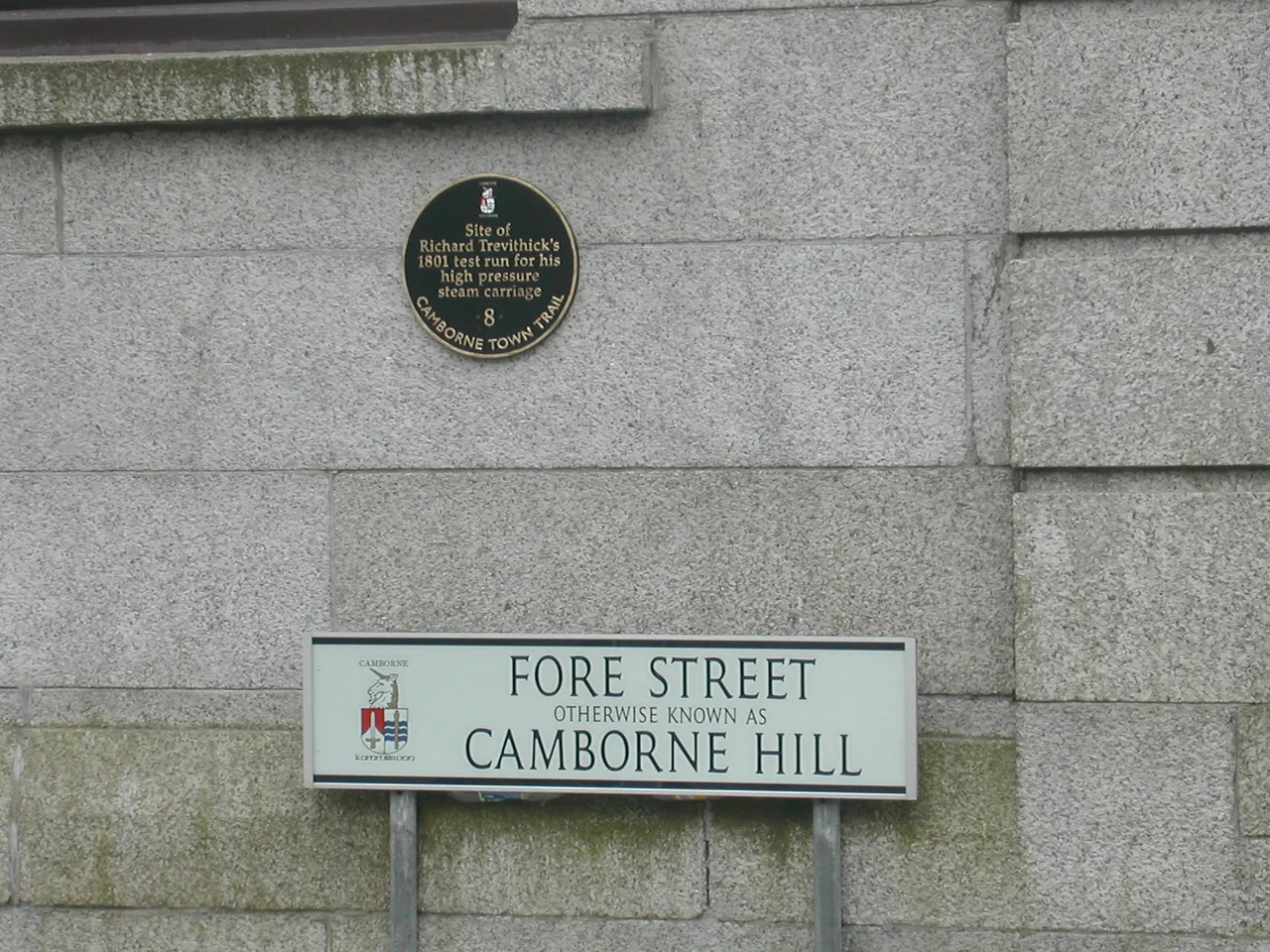
On Christmas Eve 1801, in Camborne, Trevithick demonstrated a full-size steam road locomotive he called Puffing Devil. With his cousin Andrew Vivian steering, it carried six passengers up Camborne Hill. The Cornish folk song "Camborne Hill" is still sung about that day. Three days later the engine broke down on a rough section of road. Trevithick and his crew went into a pub for roast goose; the boiler boiled dry, and the engine destroyed itself in a fire. Undeterred, Trevithick took out a patent on high-pressure steam in 1802. In 1803 he built a stationary high-pressure hammer engine at the Penydarren Ironworks for Samuel Homfray. Then he mounted it on wheels. On 21 February 1804, that machine, now usually called the Pen-y-Darren locomotive, ran the Merthyr Tramroad to Abercynon, winning Homfray his 500 guineas and making history. The cast-iron plates of the tramway broke under the locomotive's weight, and Homfray's tramroad went back to horses. The lesson of the day was not the breakages. The lesson was that a steam engine could pull more than its own weight along iron rails.
Peruvian Silver and a Costa Rican Jungle
What followed for Trevithick was, in some ways, the eternal story of an inventor twenty years ahead of his market. He built a passenger steam carriage in London in 1803. He built Catch Me Who Can, the first locomotive to give paying passengers rides, in a circle of track in 1808 in Bloomsbury. He helped sink the first attempt at a tunnel under the Thames in 1807. Then he turned south. In 1816 he sailed to Peru to drain silver mines at Cerro de Pasco, at 4,330 metres altitude, where only a high-pressure engine could work. He fought in Simon Bolivar's army of liberation. He nearly drowned crossing the rivers of Costa Rica in 1822, was nearly killed by an alligator, and chanced to meet Robert Stephenson, the young son of George Stephenson, near Cartagena. Stephenson, on his way home from a failed mining venture, gave Trevithick £50 to get back to England. Trevithick arrived in Falmouth in October 1827 with very little more than the clothes he stood in.
A Pauper's Grave and a Plaque
He kept inventing. A Cornish boiler. A reaction turbine, twenty-four feet across, an ancestor of the steam turbines that would power twentieth-century power stations. A storage room heater. A thousand-foot iron column to commemorate the Reform Bill. None of them made him rich. He died on 22 April 1833 in a small hotel room at the Bull Inn in Dartford, Kent, where he had been working on an engine. He died penniless. No relative attended his bedside. His colleagues at the Hall engineering works passed a collection to pay for his burial, carried him themselves to the burial ground at St Edmund's, and hired a watchman to guard the grave at night against body snatchers. He was buried in an unmarked plot. The burial ground later closed; the gravestones were removed; a plaque marks roughly where he lies. The locomotive he built at Penydarren is remembered with a memorial outside the fire station at Abercynon and a stone on Penydarren Road in Merthyr Tydfil. The works are gone. The railway age he started is still here.
From the Air
Trevithick's most important moment was at Pen-y-darren in Merthyr Tydfil, at roughly 51.748 N, 3.371 W. The route of his 1804 run followed the Merthyr Tramroad south down the Taff Valley to Abercynon at 51.645 N, 3.327 W, a distance of about nine and three-quarter miles. Best traced from 3,000 feet southbound down the Taff Valley. The Glamorganshire Canal followed the same valley. Cardiff Airport (EGFF) is 22 nm south of Abercynon.
Nearby Stories
- Portishead Point Lighthouse 3 km away
- St Fagans National Museum of History 5 km away
- Museum of Cider 6.5 km away
- Monmouth 8.3 km away
- Carreg Cennen Castle 11 km away
- Builth Castle 14 km away
- Craig Gwrtheyrn 29 km away
- Ilfracombe Lifeboat Station 37 km away