.jpg)
Riviera Tower
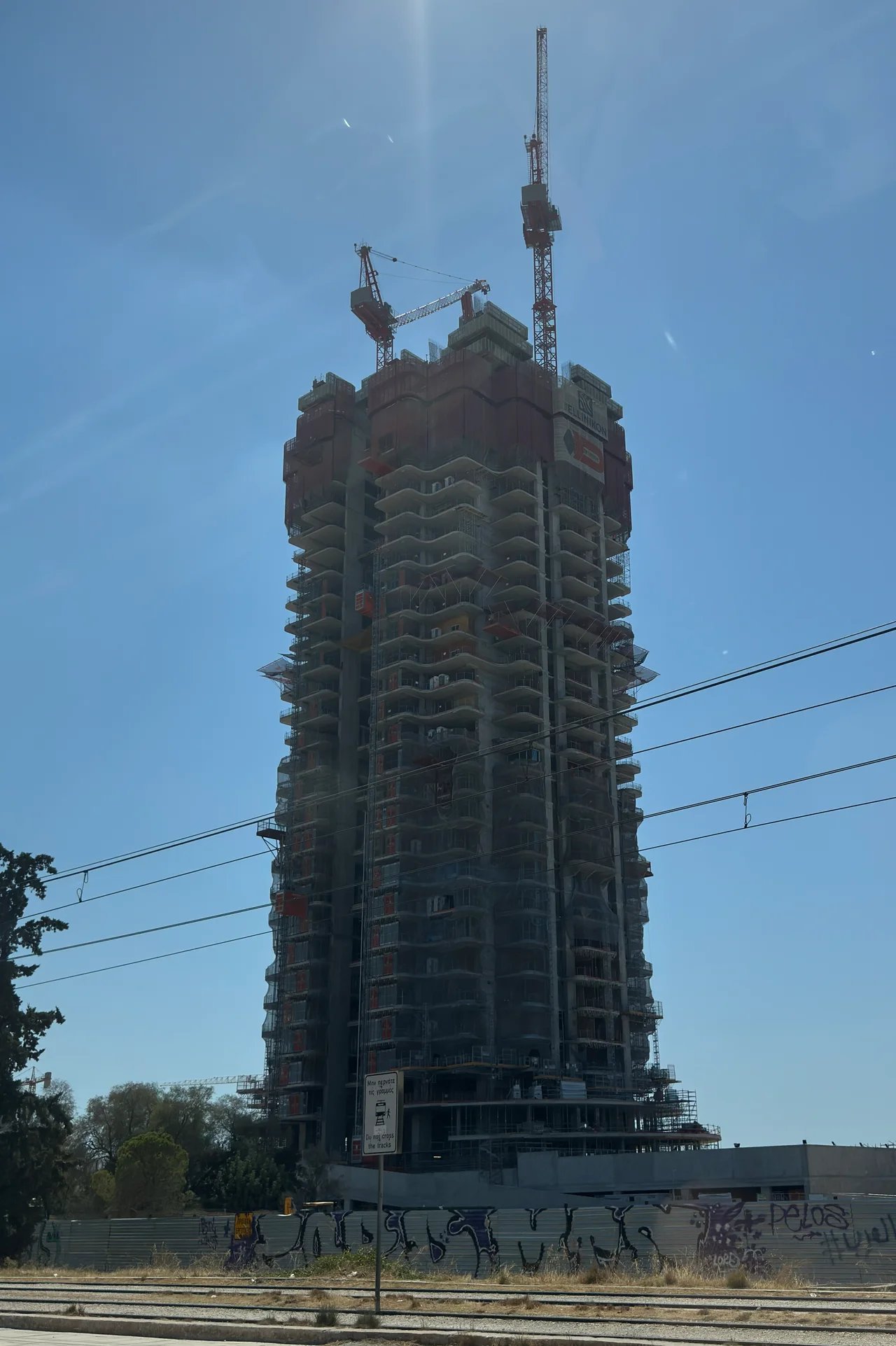
For forty years, jets from around the world landed at Ellinikon International Airport, tucked against the Athenian Riviera coast south of the capital. The airport closed in 2001, displaced by the new Athens International Airport built for the 2004 Olympics. The old site sat idle for two decades — a vast coastal flatland surrounded by one of Europe's fastest-growing cities, generating proposals, lawsuits, and political arguments but no buildings. Then in December 2022, construction crews began drilling the first of 111 piles into the Ellinikon earth, each 1.5 meters in diameter and up to 50 meters deep, for the foundation of the Riviera Tower. Something was finally happening.
The Ghost Airport Reborn
Ellinikon Airport closed ahead of the Athens Olympics and left behind a 6.2 square kilometer gap in the coastal urban fabric — an expanse that included a former NATO base, Olympic venues, and a disused terminal. The redevelopment project, taken on by the private developer Lamda Development, became one of the most contested urban projects in modern Greek history. Legal challenges delayed ground-breaking for years. When construction finally began in earnest in the early 2020s, the Riviera Tower emerged as the centerpiece: a 200-meter glass-and-steel skyscraper designed by the London-based firm Foster + Partners, working in collaboration with the Athens practice Alexandros N. Tombazis and Associates Architects. Structural engineering was handled by Buro Happold alongside Deta Engineering, with TEKEM providing electromechanical systems.
A Building on Piles
The foundation alone is an engineering story. Ellinikon sits on coastal ground that required extraordinary preparation before any tower could rise. Construction began in December 2022 with the installation of the initial piles; over the following months, the full complement of 111 piles, each 1.5 meters across, was driven to a depth of 50 meters into the ground. The foundation slab was completed in late October 2023, requiring 7,500 cubic meters of concrete poured over 40 continuous hours without interruption — a logistical undertaking that demanded meticulous coordination to prevent the concrete from setting unevenly. By the time the foundation was done, the project had already secured strong market interest: Lamda Development announced in August 2022 that three-quarters of the tower's sellable area had been pre-sold, generating estimated revenues of approximately 600 million euros.
Greece's First True Skyscraper
Athens is not a city of towers. Strict height limits tied to protection of the Acropolis sight-lines have kept the Athens skyline unusually low for a European capital of its size. The Riviera Tower, at 200 meters, will shatter that pattern — not in central Athens, where restrictions remain, but on the southern coastal strip at Hellinikon, outside the protected viewshed. When complete, it will be the tallest building in Greece by a considerable margin, announcing a new chapter in a city that has been defined architecturally by the ancient rather than the contemporary. Adjacent to the tower, the Hard Rock Hotel and Casino Athens will become Greece's first integrated resort, adding another layer of ambition to the Hellinikon project's claims on the country's future.
Architecture and Ambition
Foster + Partners brings a portfolio that includes 30 St Mary Axe (the Gherkin) in London, the Hearst Tower in New York, and the Apple Park campus in California. For Athens, the firm envisioned a tower that would read as elegant and luminous against the Mediterranean light — a slender glass form rising from a redeveloped coastal park rather than a dense urban core. The landscaping around the base, designed by Doxiadis+, is conceived as part of the Hellinikon Metropolitan Park, the largest urban park development in Greece. That juxtaposition — a 200-meter tower set within parkland, on a former airfield, above the Saronic Gulf — is either a remarkable piece of urban design or a cautionary tale about the confidence of developers. Probably, in Athens's way, it will be both.
From the Air
The Riviera Tower site at Hellinikon lies at 37.88°N, 23.73°E, directly on the coastal strip south of Athens and immediately adjacent to where Ellinikon International Airport once operated. From the air, the former airport footprint remains clearly visible: the rectangular cleared land between the coast and the suburban neighborhoods of Elliniko and Argyroupoli. As the tower rises, it will become one of the most prominent vertical features visible on approach to Athens International Airport (LGAV / Eleftherios Venizelos), which lies approximately 20 km to the east. Pilots descending from the northeast toward LGAV's runway 03L pass over the coastline south of Athens at around 3,000 feet, putting the Hellinikon site directly in the approach corridor. The Saronic Gulf shimmers to the south and west; on a clear day, the island of Aegina is visible beyond the harbor.
Nearby Stories
- Parnitha 3.4 km away
- Kea (island) 7.3 km away
- Sanctuary of Apollo Maleatas 11 km away
- Sousaki Volcano 12 km away
- Battle of Leuctra 14 km away
- Great Sand Beach 18 km away
- Agios Georgios (island) 23 km away
- Skyros 84 km away