
RM Stonehouse
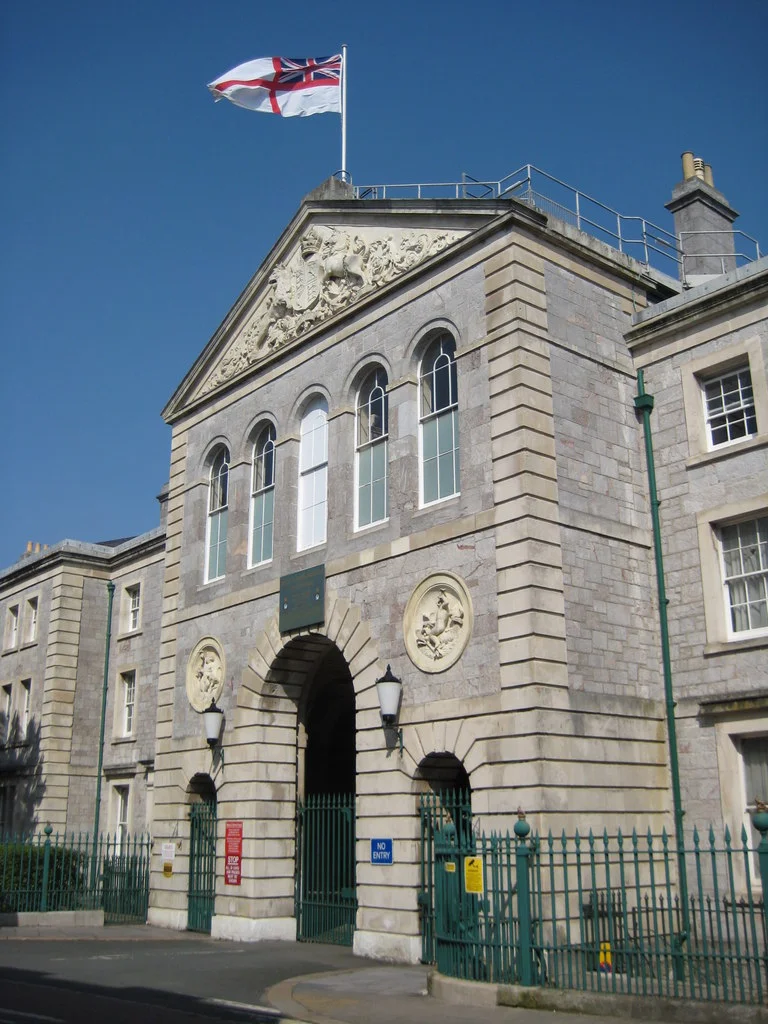
Three identical sets of barracks were built in the 1780s for the new Royal Marine divisions: one at Chatham, one at Portsmouth, one at Plymouth. Today only the Plymouth set still stands. Walk through the granite arch on Durnford Street in Stonehouse and you step into a rectangular parade ground bounded by long Georgian ranges of golden limestone, the same paving and porches that watched Marines drill their way toward the Napoleonic Wars. The commandos who train here call it the spiritual home of the Corps - and for the last forty-five years, every Royal Marine officer's career has touched this courtyard.
The Birth of the Three Divisions
Marines have been quartered somewhere in Plymouth ever since the Corps was founded in 1664, but for more than a century they lodged in whatever scraps of accommodation the town could spare. That changed in 1775, when His Majesty's Marine Forces were reorganised into three divisions and granted something unprecedented in the British military of the time: their own purpose-built barracks. The Marines became the first corps in Britain to be fully accommodated under one roof. Chatham, Portsmouth, and Plymouth each got a matching complex. Chatham's was demolished long ago. Portsmouth's is gone. Plymouth's east block, completed in the 1780s, is now thought to be one of the earliest surviving barracks for a large unit of men anywhere in England.
A Georgian Courtyard, Slowly Filling In
The original 1780s plan was strict and symmetrical. A long barrack range on the east side housed the private Marines. Two shorter blocks to north and south held the officers - the south block including grander houses at each end for the commandant and his deputy. The west side was simply railings and a gate, with a small clock-and-cupola guard house in the middle. Outside the quadrangle stood a canteen and an infirmary. Then the world kept demanding more Marines. During the Napoleonic Wars the barracks pushed south into newly purchased land. In 1805 the town's old Assembly Rooms, a public ballroom that had stood since 1760, were absorbed into the complex; the Longroom served in turn as officers' mess, as a school for the children of non-commissioned officers, and from 1859 as the hospital infirmary. Today, two centuries on, that same building is the gymnasium where Royal Marines lift weights.
Colonel Greene's Crimean Expansion
The Crimean War of the 1850s triggered the biggest reshaping of the site. Colonel Godfrey Greene, an Army engineer, oversaw the work. Around 1860 the east barracks was lengthened northward to cram in more men, and the south block stretched westward to make room for more officers. The old north range was demolished entirely and rebuilt longer and further north, giving the site the slightly irregular footprint it still has today. Between 1867 and 1871 came the most theatrical addition: the great archway block on Durnford Street that finally closed off the west side of the parade ground. It contains six houses for senior officers, administrative offices, and - above the central entrance arch - a chapel that began life as a schoolroom. A rare 1830s racquet court survives nearby, converted into a theatre during the same Victorian rebuild.
From Divisional Home to Commando Headquarters
The whole divisional system that had given the barracks its identity was swept away during the Second World War. Plymouth, Portsmouth, and Chatham were no longer the home depots of separate Royal Marine divisions; the Corps was being reorganised around the new commando units that had been raised for amphibious raids on occupied Europe. Some elements of 41 Commando stayed at Stonehouse after the war. In 1961 the barracks became home to 43 Commando, and when 43 disbanded in 1968, the site took on the role it still holds today: headquarters of 3 Commando Brigade, now operating as the UK Commando Force. Every commando-trained Royal Marine of the modern era passes through here at some point.
Saved, Again
For a decade now, Stonehouse has been living on borrowed time. In September 2016 the Ministry of Defence announced the site would be sold off and a replacement Marine superbase built elsewhere in Plymouth. A Better Defence Estate put the disposal date at 2023. Then it slipped to 2027 when the superbase plan was shelved. Then to 2029. Then to at least 2031. The Royal Citadel up on Plymouth Hoe was on the same list, and was likewise reprieved. For the moment, the parade ground stays the parade ground, the gymnasium still rings with the same Marines' boots that have echoed off these granite walls since George III's last decades, and the spiritual home of the Royal Marines stays exactly where it has always been.
From the Air
RM Stonehouse sits at 50.367 deg N, 4.162 deg W, on the Stonehouse peninsula between Stonehouse Creek and the inner Plymouth Sound. From the air, look for the rectangular parade ground tucked between Durnford Street and the waterfront, just east of the Royal William Yard. Best viewed from 3,000-4,000 ft on departure from Plymouth airspace, with the brick-and-limestone Georgian quad clearly distinguishable from the surrounding Victorian terraces. Exeter (EGTE) is the nearest active airport.
Nearby Stories
- Davidstow Circuit 3.7 km away
- Golden Hind 3.9 km away
- Powderham Castle 4.4 km away
- Fowey Lifeboat Station 5.1 km away
- Okehampton Castle 12 km away
- Battle of Plymouth (1652) 19 km away
- Goonhilly Satellite Earth Station 44 km away
- German Submarine U-672 73 km away