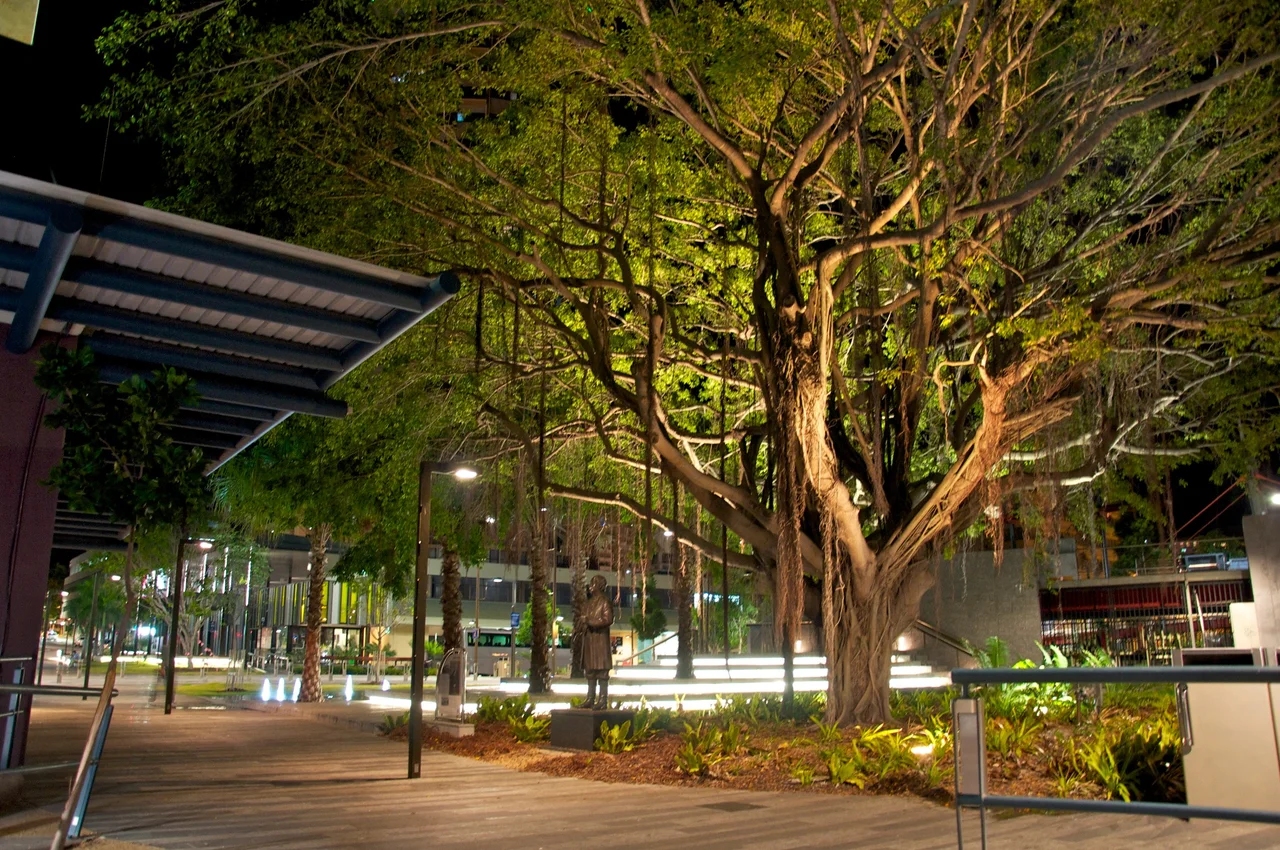

Robert Towns
In June 2020, someone climbed the bronze statue on Townsville's Pioneers Walk and painted its hands red. The figure was Robert Towns - sea captain, sandalwood trader, whaler, bank president, and the man the city is named after. The red paint was not vandalism so much as an argument made in pigment: that the hands of Townsville's namesake were stained by the trade in Pacific Islander labour he helped begin. Towns never lived in the city that bears his name. He visited only once. But his decisions, made from a comfortable house on Sydney Harbour, reached across the Coral Sea and changed tens of thousands of lives.
A Merchant of the Southern Seas
Robert Towns was born at Longhorsley in Northumberland, England, on 10 November 1794, and went to sea as a boy. By 1832 he was sailing into Sydney as the master of his own ship, and in 1843 he settled there for good, founding the trading house of Robert Towns & Co. He had a gift for spotting profit at the edges of empire. His vessels gathered sandalwood from the islands of the New Hebrides, carried tea out of China during the Opium War, and chased whales across the western Pacific long after the industry's peak had passed. By 1857 his firm had cleared profits of nearly a quarter of a million pounds, and he sat on the board - later as president - of the Bank of New South Wales. From the outside, he was a pillar of the colony. The question of who did the work that built his fortune is where his story darkens.
The Search for Cheap Labour
Towns, like many colonial employers, struggled to find workers willing to labour for what he was prepared to pay. He tried importing labourers from India and China; one ship, the Orwell, arrived in 1846 carrying men and women recruited in Calcutta who had been forced to work the pumps of the leaking vessel day and night, underfed and underclothed - one died soon after landing. When British officials blocked further recruitment in Asia, Towns turned to the islands of Melanesia. He had noticed that the South Sea Islanders who crewed his sandalwood ships worked hard and could be paid little. It was a short, cold step from observing their usefulness to deciding to bring them to Australia in numbers.
Townsvale and the First Voyage
The American Civil War had choked off the world's cotton supply, and Queensland wanted to grow its own. In 1863 Towns bought land on the Logan River south of Brisbane, named it Townsvale, and set out to plant cotton. To work it, he sent the ship Don Juan to the islands under recruiter Henry Ross Lewin - a man whose name became a byword for the brutality of the trade. The Don Juan returned to Brisbane in August 1863 with 73 South Sea Islanders aboard; one of them died on arrival, worn out by the voyage. Towns wanted adolescent boys, and though he denied it, kidnapping was reported in the gathering of them. Over the next two years he brought around 400 more Melanesians to Townsvale. This was the beginning of "blackbirding" in Queensland - the coercion, deception, and outright abduction of Pacific Islanders for colonial labour.
The People Behind the Numbers
Between 1863 and 1904, roughly 63,000 Islander men, women, and children were brought to work Queensland's plantations and ships. Behind that figure are individual lives: people taken from Vanuatu, the Solomons, and the Loyalty Islands, often lured aboard with trinkets or seized by force, set to cut cane and pick cotton far from home. Many were paid in goods rather than coin - one of Towns' agents claimed they were "savages who did not know the use of money," a justification for cheating them even after the law required cash wages. Some never returned. Their descendants, the Australian South Sea Islander community, still carry this history, and it was on their behalf that Towns' statue was marked in red. Towns himself died in Sydney in 1873 after a series of strokes. His grave-marker was later moved to Castle Hill, looking down over the city that bears his name - and over the people whose story it can no longer be told without.
From the Air
The Robert Towns monument stands on Castle Hill above Townsville at approximately 19.255 degrees S, 146.823 degrees E, with a related statue on Pioneers Walk along The Strand. The pink granite dome of Castle Hill (286 m) is the obvious visual landmark, with Cleveland Bay and Magnetic Island to the north. The nearest airport is Townsville (ICAO YBTL), about 5 km west of the city centre, with RAAF Base Townsville adjacent. Cairns (YBCS) lies roughly 250 km to the north. Clear, dry conditions prevail through the winter months from May to October.
Nearby Stories
- Ayr 13 km away
- SS Yongala 34 km away
- Great Palm Island 35 km away
- Bindal People 50 km away
- Cardwell UFO Festival 83 km away
- Hinchinbrook Island 113 km away
- Porcupine Gorge 215 km away
- Samarai 998 km away