
Roche's Point Lighthouse
On 4 June 1817 - the same year Jane Austen died and Britain was struggling to recover from twenty years of Napoleonic war - a light came on at the entrance to Cork Harbour, and it has never properly gone off since. The original tower was deemed too small almost immediately, and replaced in 1835 by the present 49-foot stone column. The second-order Fresnel lens installed in 1876 is still there. The lighthouse has been converted from oil lamps to electricity to LED, has watched the Lusitania survivors come in past it in 1915, has heard depth charges drop on UC-42 in 1917 just off its rocks, and has guided every ship that ever entered Cork Harbour for two centuries. In 2017, for its bicentenary, 1,500 people climbed its narrow stairs in a single day.
Argand to LED
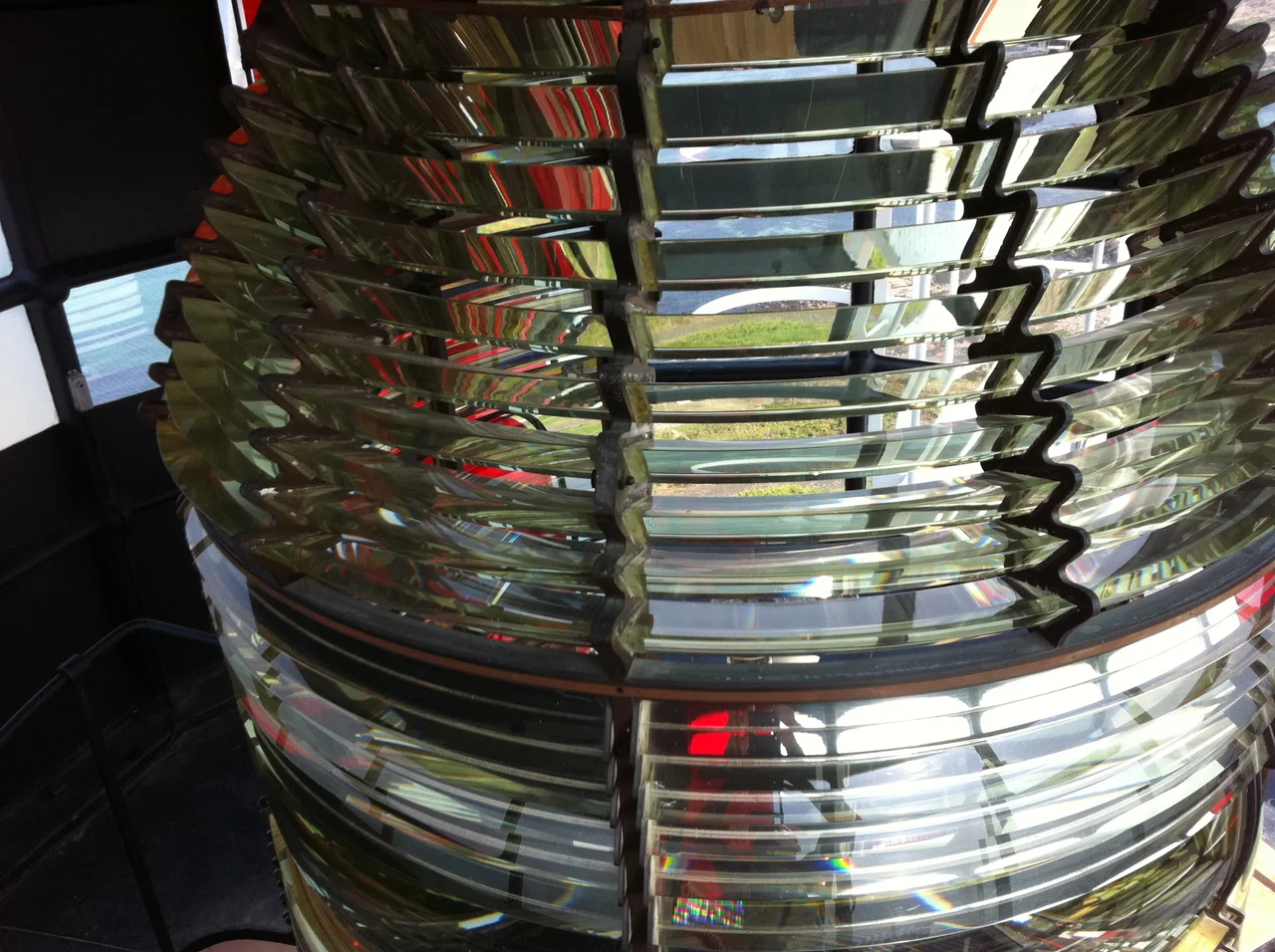
The original optical apparatus at Roche's Point in 1817 was state of the art: ten Argand oil lamps - the breakthrough Swiss design that produced ten times the light of an ordinary candle - each paired with a polished catoptric reflector that focused the beam outward. In 1876 the apparatus was upgraded to a second-order Fresnel lens, the elegant stepped-glass invention of the French physicist Augustin-Jean Fresnel that allowed a thin lens to concentrate light as effectively as a far thicker conventional one. That same Fresnel lens is still in service today. In 1970 the oil burner was retired in favour of an electric bulb. In February 2018 - delayed by three Atlantic storms named Ophelia, Brian and Caroline - an LED bulb developed by the General Lighthouse Authorities' R&RNAV project was placed at the heart of the historic lens. The new bulb uses a fraction of the electricity, lasts roughly a decade, and preserves the long-range character of the original optic. At some other Irish lighthouses, the traditional Fresnel has been removed entirely. At Roche's Point, the lens stays.
The Light's Character
Every lighthouse has a 'character' - a unique rhythm of flashes and timings that lets mariners identify it at night. Roche's Point originally flashed an 'occulting 20s' character - on for 15 seconds, off for 5, repeating. On 15 August 1993 the character was changed to Fl WR 3s - one white-or-red flash every three seconds. The light has red sectors built into the main beam, illuminating only when a ship is approaching certain hazards: the Daunt Rock near Roberts Cove (where SS Libau scuttled herself in 1916), and the Cow and Calf Rocks immediately below the lighthouse. From April 1978 onward, the light has been exhibited in conditions of poor visibility while the fog signal sounded - a small change that probably saved lives. Apart from the engine house and one adjacent building, all the former keepers' cottages were sold off at public auction when the lighthouse was automated.
Bells, Sirens, Diaphones
For 147 years the lighthouse made sound as well as light. A fog bell was installed in 1864. It was replaced on 1 December 1898 by a siren that could be heard further. In 1949 came a diaphone - the great deep two-tone foghorn invented in Canada and beloved of coastal towns from Newfoundland to Northumberland - sounding one two-second blast every thirty seconds. When the lighthouse was automated in 1995 the diaphone gave way to an electric fog signal, model ELG 300-04, paired with a fog detector that would switch it on if visibility fell below three nautical miles. The electric signal carried four nautical miles. Then, on 11 January 2011, despite much opposition, the Commissioners of Irish Lights discontinued all fog signals across Ireland. The reasoning was modern: every ship now has radar and GPS. Roche's Point fell silent. Older mariners say they still listen for it on bad nights and find the absence unnerving.
Jim Power and the Two Hundred
Jim Power was the last lighthouse keeper at Roche's Point before automation, and after the keepers' service ended he stayed on as the lighthouse attendant - one man with a key, looking after the equipment that now ran itself. On 4 June 2017, exactly 200 years after the light first came on, Irish Lights threw an open day. Fifteen hundred visitors climbed the narrow stairs to the balcony at the top of the tower. Former keepers came back for the day, including Power. They told stories of storm watches and rescue calls and the long quiet nights when the light just turned and turned. The lighthouse keeper as a job has ended everywhere in Ireland, replaced by remote monitoring and once-a-year maintenance visits. But on that one day in 2017, Roche's Point briefly looked like what it used to be: a small community on a windy headland, run by people who knew every step of the stair.
What the Tower Saw
From this headland, almost every important moment of Cork Harbour's modern history has passed within view. The convoys for the West Indies assembling in 1779. The Royal Navy frigates of the Napoleonic Wars. The emigrant ships leaving Queenstown for America in the late 19th century. The Titanic stopping briefly in 1912. The Lusitania survivors being towed in past these rocks in May 1915. The Treaty Ports handover ceremonies of 1938. The Allied convoys of the Second World War passing further out to sea, denied this harbour. The Irish Naval Service patrol ships heading out today on fishery protection and search-and-rescue. The lighthouse is the still point. Everything else changes around it.
From the Air
Roche's Point Lighthouse stands at 51.793 degrees N, 8.255 degrees W on the eastern headland of the entrance to Cork Harbour. The 49-foot white tower is unmistakable from the air, perched on the cliff edge above the Cow and Calf Rocks. Fort Davis lies 2 km north on the same headland; Camden Fort Meagher is directly across the harbour mouth at Crosshaven about 1.5 km west-northwest. Cork Airport (EICK) is 18 km north-northwest. Best viewed from 1,000 to 3,000 feet on a coastal track approaching Cork Harbour from the south. The lighthouse is a key visual landmark for VFR navigation along the south coast of Ireland.
Nearby Stories
- Walter Siepmann 6.3 km away
- Gaeltacht na nDéise 11 km away
- Fermoy 12 km away
- Canovee 14 km away
- Rathcoole Ambush 16 km away
- SS Folia (1907) 20 km away
- Cloghan Castle, Lough Hyne 35 km away
- SM U-27 91 km away