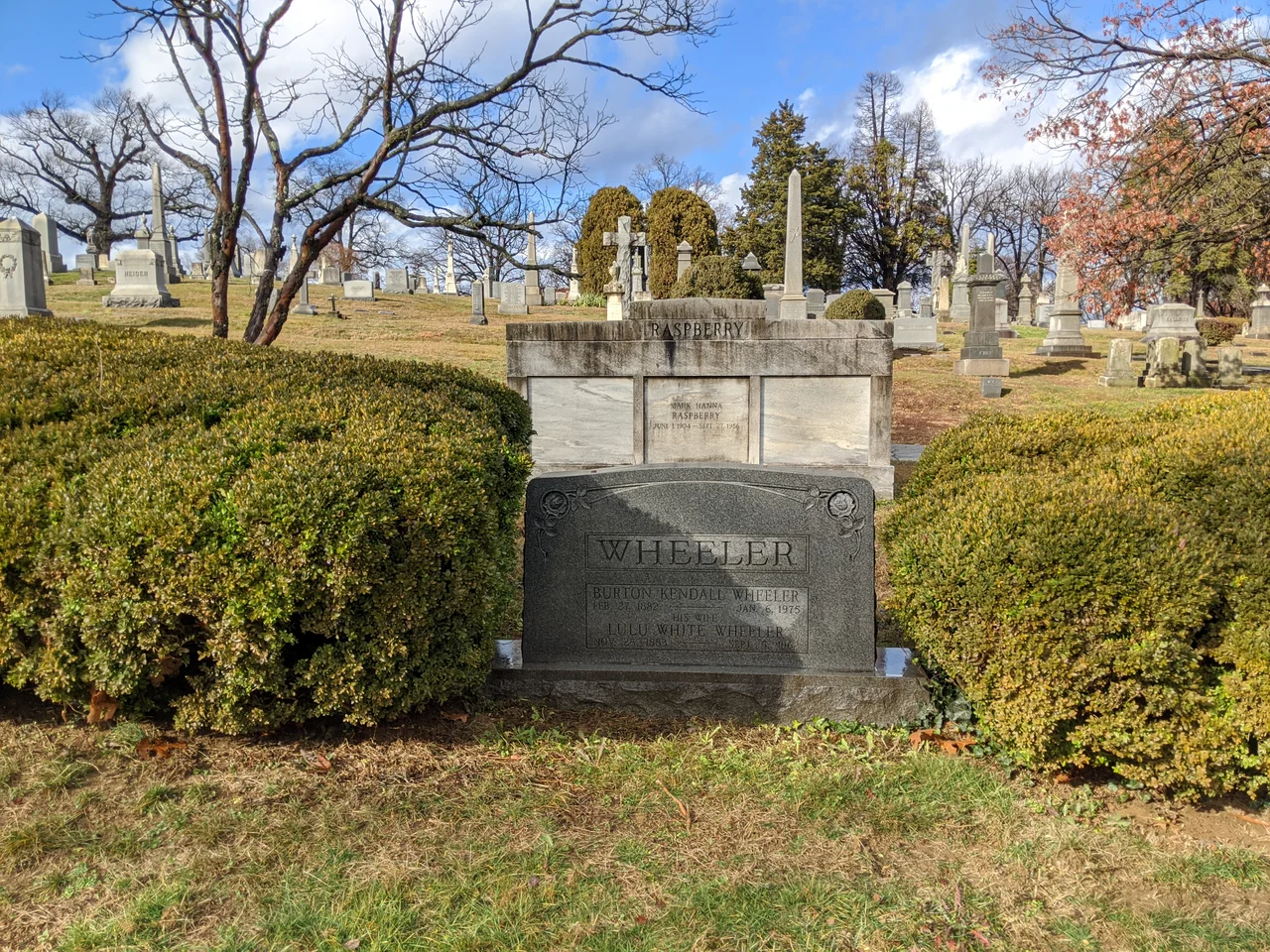

Rock Creek Cemetery
Marian Hooper Adams swallowed potassium cyanide in December 1885, leaving her husband Henry Adams - grandson of one president, great-grandson of another - a widower at forty-seven. He grieved by commissioning a monument. He gave the job to Augustus Saint-Gaudens, the country's finest sculptor, with the instruction that the figure should suggest the contemplative Buddhist concept of nirvana and should not be allegorical in any obvious way. Stanford White designed the granite setting. What Saint-Gaudens delivered, completed in 1891, is a seated hooded figure of indeterminate gender, eyes half closed, neither man nor woman, neither suffering nor at peace. Adams refused to title it. Visitors called it Grief. Saint-Gaudens himself called it The Mystery of the Hereafter and the Peace of God that Passeth Understanding. It sits in Rock Creek Cemetery, hidden behind a screen of hollies, and it is one of the most powerful things to look at in Washington.
Older Than the District
Rock Creek Cemetery predates the city around it by seventy-two years. The churchyard of St. Paul's Episcopal Church was established in 1719, when this rolling land north of the Potomac was still part of colonial Maryland. When Washington was carved from Maryland and Virginia in 1791, the cemetery found itself inside the new federal district. In 1840, Congress formally recognized and expanded it. The vestry of St. Paul's chose the era's rural cemetery style for the expansion - the same landscape philosophy behind Mount Auburn in Cambridge and Laurel Hill in Philadelphia, in which a cemetery was meant to function as both burial ground and public park, with curving paths, mature trees, and views across rolling ground. Eighty-six acres of it sit today in the Petworth neighborhood, just across the street from the Soldiers' Home where Lincoln once spent his summers. The cemetery's church grounds were added to the National Register of Historic Places on August 12, 1977, as Rock Creek Church Yard and Cemetery.
The Adams Memorial
If the cemetery has a single reason to visit it, the Adams Memorial is it. Saint-Gaudens spent three years on the figure, refining the drapery and the half-closed eyes until what he produced was almost not a portrait at all but a kind of held breath in bronze. Henry Adams, who returned to the bench in front of it again and again over the remaining decades of his life, called the experience of sitting before it the most important thing in his life. Mark Twain visited and wrote that the sculpture's expression contained 'all the wisdom and pathos of the world.' Eleanor Roosevelt came here repeatedly during her husband's presidency to grieve in private. The original bronze remains in the cemetery; a replica sits in the Smithsonian American Art Museum. Adams's grave and his wife's lie unmarked at the foot of the granite block - their names never appeared on the monument, by design.
A Catalog of Americans
The headstones nearby read like an annotated index of American history. John Marshall Harlan, the 'Great Dissenter,' wrote the lone opinion against Plessy v. Ferguson in 1896 - the case that approved 'separate but equal.' He is buried here, sixty years before Brown v. Board of Education proved him right. Harlan Fiske Stone, Chief Justice; Willis Van Devanter and Stephen Johnson Field, Associate Justices - all rest within a short walk. So does Patricia Roberts Harris, the first African-American woman to serve in a presidential cabinet. Abraham Baldwin, who signed the Constitution. Hugh McCulloch, Lincoln's Treasury Secretary. Postmaster General Montgomery Blair, who tried to keep Fort Sumter supplied in 1861. Richard Lawrence is here too - the man who pointed two pistols at President Andrew Jackson in 1835 at the East Portico of the Capitol; both misfired, and Jackson beat him with a cane. Lawrence spent the rest of his life in asylums and died in 1861. He is buried in the same cemetery as the federal officials he tried to overthrow.
Inventors, Writers, Newscasters
Emile Berliner, the German immigrant who invented the gramophone and patented the disc record in 1887, lies among the same oaks as Charles Francis Jenkins, an American pioneer of motion-picture projection and television. Alice Roosevelt Longworth - Theodore Roosevelt's eldest, the woman who wore pants in 1903 and outlived nine presidents - rests near the family plot. Gore Vidal, the novelist who turned American history into a personal grudge match, is buried next to his partner of fifty-three years, Howard Austen. Upton Sinclair, author of The Jungle, lies under a simple stone. Tim Russert, the longtime moderator of Meet the Press who died at NBC's Washington bureau in 2008, joined the cemetery's reporters' corner alongside journalist Roscoe Drummond and broadcaster Fulton Lewis. George McGovern, the South Dakota senator who lost forty-nine states to Richard Nixon in 1972, was interred here in 2012. And Opha May Johnson - the first known female United States Marine, enlisted on August 13, 1918 - has a marker that almost no visitor finds without looking for it.
A Garden of Bronze
Beyond the Adams Memorial, the cemetery is a sculpture park of unusual depth. Gutzon Borglum - the man who would later carve Mount Rushmore - made Rabboni in 1909, a bronze of the resurrection scene at the empty tomb. James Earle Fraser, designer of the Buffalo nickel, made the Frederick Keep Monument in 1920. His wife and former student, Laura Gardin Fraser, made the Hitt Memorial in 1931. William Ordway Partridge produced the Kauffmann Memorial in 1897, known as The Seven Ages of Memory. Brenda Putnam, Vinnie Ream, Mary Washburn, and Adolph Weinman are all represented. The Heurich Mausoleum holds Christian Heurich, the German-born brewer who lived to be 102 and ran his Washington brewery from 1872 until shortly before his death in 1945. The cemetery is the kind of place you mean to walk through in an hour and end up wandering all afternoon, finding that nearly every shaded path opens onto someone you've heard of.
From the Air
Rock Creek Cemetery sits at 38.9478 degrees N, 77.0131 degrees W in northern Washington, D.C., bounded by Rock Creek Church Road NW, Webster Street NW, and Hawaii Avenue NE. From the air the 86-acre site reads as a rolling green wedge of mature deciduous canopy between the Soldiers' Home grounds to the west and the Catholic University campus to the east. Best viewed at 1,500 to 3,000 feet AGL; the entire site lies within the Washington FRZ and SFRA. Nearest airports are Ronald Reagan Washington National (KDCA) 6 nm south, College Park (KCGS) 3 nm northeast, and Washington Dulles (KIAD) 24 nm west.
Nearby Stories
- Gunston Hall 1.1 km away
- 2023 Baltimore Shooting 4.9 km away
- Battle of Middleburg 6.6 km away
- Crownsville Hospital Center 10 km away
- Battle of Loudoun Heights 13 km away
- First Battle of Rappahannock Station 20 km away
- Howard County, Maryland 21 km away
- Harriet Tubman Underground Railroad 50 km away