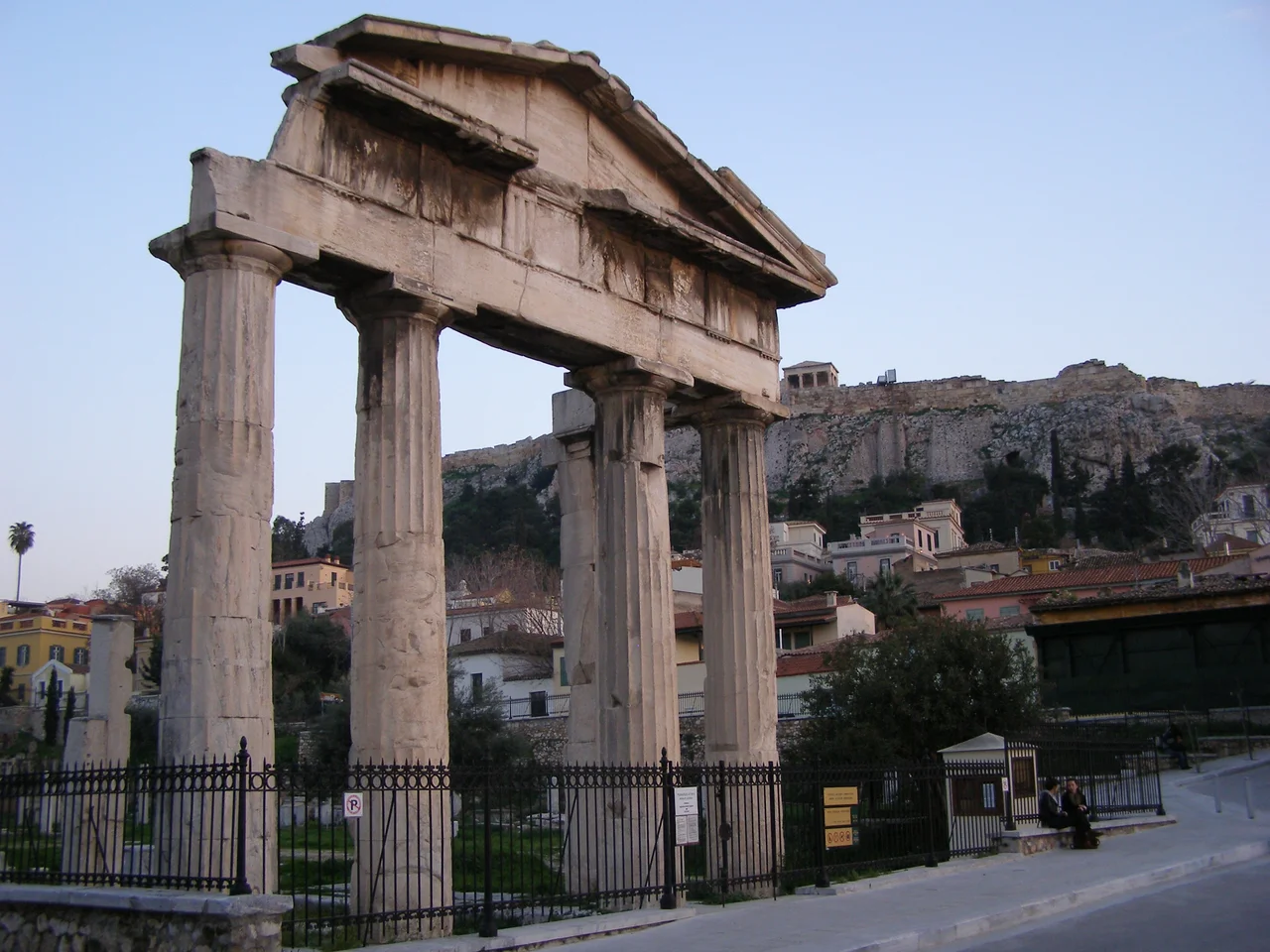

Roman Agora
Julius Caesar made a promise to Athens in 51 BC, and a dead man's word took marble shape decades later. The Roman Agora rose just east of the old marketplace where Socrates had once argued, a new square of shops and colonnades built to keep a conquered city buying and selling. Caesar never saw it. His heir, Augustus, paid the bill. The gateway that still stands at its western edge was finished in 11 BC, four Doric columns of Pentelic marble carrying an inscription that names the people who dedicated it to Athena the Leader.
A Promise Kept in Stone
Rome did not simply seize Athens; it courted her. The Roman Agora was financed by money first pledged by Julius Caesar and then delivered by Augustus, a gesture of patronage toward a city Rome admired even as it ruled. The work fell to a local man, Eucles of Marathon, who oversaw construction sometime between 27 and 17 BC, with the great western gate completed in 11 BC. The Athenians dedicated that gate to Athena Archegetis, Athena "the Leader," the goddess who had always watched over their city. Even under Roman coin, the old protector kept her place. The marble came from Mount Pentelicus, the same quarries that built the Parthenon five centuries earlier, so that Rome's marketplace shared its very stone with the Acropolis above.
The Heart of the Market
Step through the Gate of Athena Archegetis and you entered the commercial heart of Roman Athens: an open courtyard ringed by a peristyle, a covered walkway of columns that gave shoppers shade from the Attic sun. Shops lined the western side behind a marble colonnade. A fountain stood to the south. To the east, an Ionic gateway, the East Propylon, opened the square toward the rest of the city. This was where Athenians came to buy oil and grain, to trade and gossip and complain about prices, generation after generation. The old Agora to the west had been a place of philosophy and politics. This new one was unapologetically about business.
The Tower That Told Time
At the agora's eastern edge stands one of the ancient world's most remarkable survivors: the Tower of the Winds, an octagonal marble clock tower that still rises nearly intact. Each of its eight faces carries a carved relief of a wind god, and beneath them once ran sundials, a weathervane, and a water clock for the hours when the sun gave no shadow. It was, in a sense, the timepiece of the marketplace below, telling merchants and shoppers when to open, trade, and close. Nearby stood a set of public latrines, the vespasianae, a reminder that even a marble forum had to serve the ordinary needs of a working crowd.
Reading the Walls
The agora has never been fully excavated, but what survives still speaks. One inscription records an Agoranomion, the office of the market officials who policed weights, measures, and fair dealing. Another, carved into the propylon of Athena Archegetis, preserves a decree from the reign of the emperor Hadrian setting out the tax obligations of oil merchants. It is an extraordinary thing to read: a piece of Roman commercial law, frozen in stone, that once governed the men selling olive oil a few steps away. Walk this square today and the columns are broken, the shops are gone, but the bureaucracy of buying and selling is still legible in the marble, the oldest small print in Athens.
From the Air
The Roman Agora lies at 37.974 degrees N, 23.726 degrees E in the Plaka district of central Athens, immediately north of the Acropolis and east of the Ancient Agora. Recommended viewing altitude 1,500 to 3,000 feet AGL. The unmistakable landmark is the Acropolis crowned by the Parthenon just to the south; the octagonal Tower of the Winds marks the agora's eastern corner. Nearest airport is Athens International (Eleftherios Venizelos, LGAV), about 17 nm east. Athens enjoys excellent visibility most of the year, though summer haze and occasional Saharan dust can soften the view.
Nearby Stories
- Great Sand Beach 5 km away
- Battle of Delium 7.7 km away
- Tower of Aliartos 9 km away
- HMHS Britannic 10 km away
- Saronic Gulf 15 km away
- Sousaki Volcano 17 km away
- Sanctuary of Apollo Maleatas 24 km away
- Skyros 66 km away