.jpg)
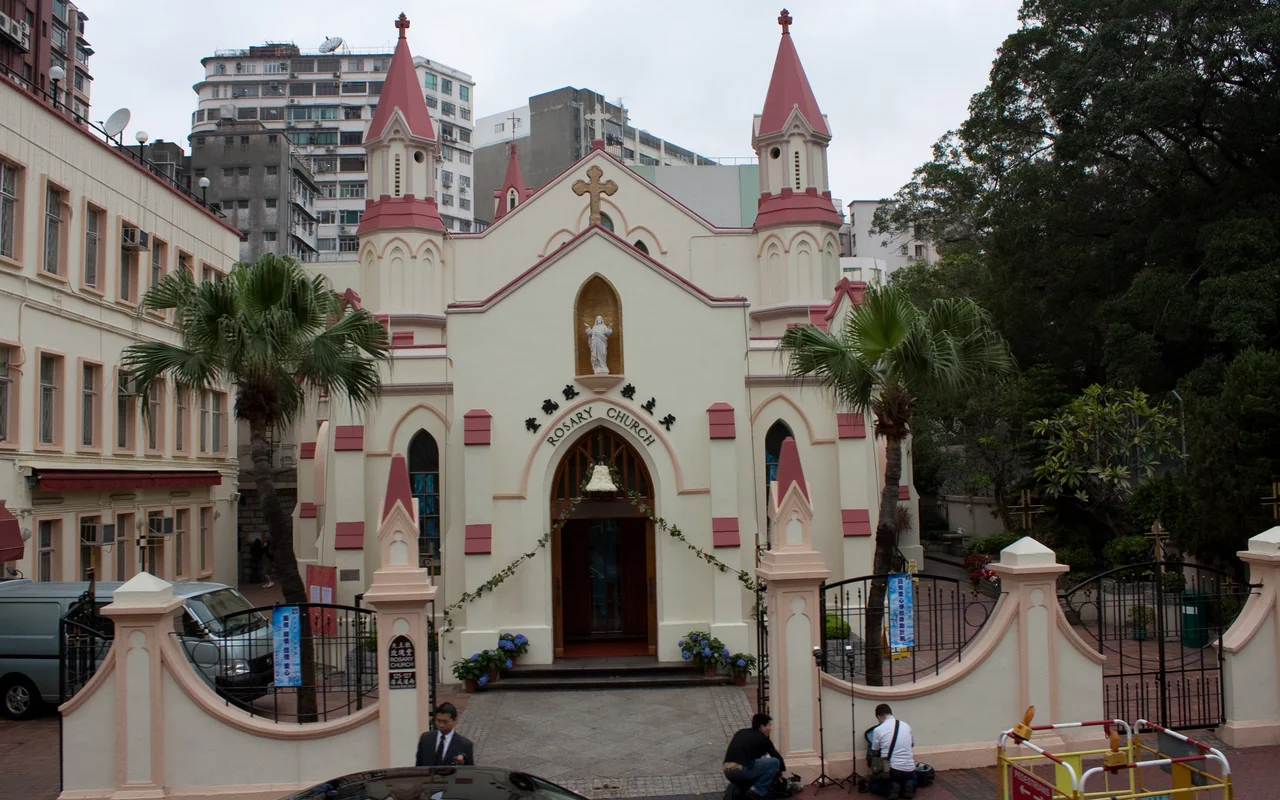
Rosary Church
Dr. Anthony Gomes, a Portuguese Catholic, made his donation of $20,000 in 1903 without insisting on his own name above the door. He asked only that the church be consecrated in memory of his parents and brother — and that it honor Our Lady of Pompeii, Queen of the Most Holy Rosary. That act of private grief translated into public permanence: the Rosary Church at 125 Chatham Road South is still standing, still holding services, still the oldest Catholic church in Kowloon. The original intention shaped everything that followed.
Soldiers, Settlers, and a Foundation Stone
The Boxer Rebellion of 1900 set events in motion. As violence spread across northern China, the British positioned Indian battalions in Kowloon as a precautionary measure, and roughly 200 Catholic soldiers among them needed a place to worship. The civil Catholic population was also growing. Together, these pressures made the case for a permanent church in Tsim Sha Tsui unmistakable. When Dr. Gomes committed his $20,000 in 1903, the project became financially viable. Fr. De Maria, then Pro-Vicar Apostolic of Hong Kong, laid the foundation stone on 10 December 1904. The firm of Palmer and Turner — architects who would leave their mark across colonial Hong Kong and Southeast Asia — designed the building. Construction finished in 1905. On 23 May of that year, the completed church was consecrated to Our Lady of Pompeii, exactly as the benefactor had specified.
Gothic Stone in a Colonial City
Palmer and Turner gave the Rosary Church a Gothic exterior fitted to its tropical setting. The original plan drew on the Roman Basilican model, a longitudinal nave with side aisles leading to an apse — one of the most durable forms in Western ecclesiastical architecture, adapted here for the subtropics. The soaring ceiling, visible in photographs of the interior, creates the vertical drama characteristic of Gothic design: the eye is drawn upward, away from the heat and noise of Chatham Road outside. The church forms part of a building cluster with St. Mary's Canossian College and St. Mary's Canossian School next door, creating a Catholic institutional enclave in Tsim Sha Tsui that has persisted for more than a century. The street, the institutions, the architectural language — all unchanged in their essentials.
Unbroken Through the Occupation
When Japanese forces occupied Hong Kong in December 1941, the fate of religious institutions across the city was uncertain. Many were commandeered, damaged, or forced to close. The Rosary Church was different: the Japanese army left it untouched, and services continued throughout the occupation. At the time, the parish was led by Horace De Angelis, an Italian priest — Italy and Japan were wartime allies, which likely shielded the church from the disruptions that affected British-affiliated institutions. Whatever the reason, the congregation maintained its rhythm of worship through years when little else in Hong Kong was normal. The building and its community came through the war intact.
A Heritage Designation a Century in the Making
The Hong Kong government classified the Rosary Church as a Grade II Historic Building in 1990, acknowledging its architectural and historical significance. In 2010, the classification was upgraded to Grade I — the highest level available for buildings not declared monuments — recognizing the church's importance to Kowloon's Catholic heritage and its survival as one of the oldest examples of Gothic ecclesiastical architecture in the territory. The grade reflects both what the building is and what it has endured: more than 120 years of services, an occupation, decades of rapid urban transformation around it, and the slow accumulation of a community that continues to gather beneath those vaulted ceilings. Dr. Gomes's donation, made in memory of the people he loved, turned out to be one of the most durable investments in Kowloon's history.
From the Air
The Rosary Church stands at 22.3026°N, 114.176°E in Tsim Sha Tsui, on the Kowloon Peninsula. From the air at 2,000–3,000 feet, the church is embedded within the dense urban grid of southern Kowloon, roughly 2.5 nautical miles northeast of Hong Kong International Airport (VHHH) across Victoria Harbour. Chatham Road South runs north-south immediately adjacent to the building. The church's Gothic spires are modest against the surrounding high-rises but distinctive in their form. Victoria Harbour and the Hong Kong Island skyline provide orientation to the south. Kai Tak, the former airport site, lies about 1.5 nautical miles to the northeast.
Nearby Stories
- Lok Ma Chau Loop 2.3 km away
- Portas do Cerco 2.3 km away
- Kweilin Incident 17 km away
- Wanshan Archipelago Campaign 34 km away
- Nanxiong Formation 115 km away
- Battle of Nanpeng Island 148 km away
- Heyuan 169 km away
- Cape Maobitou 632 km away