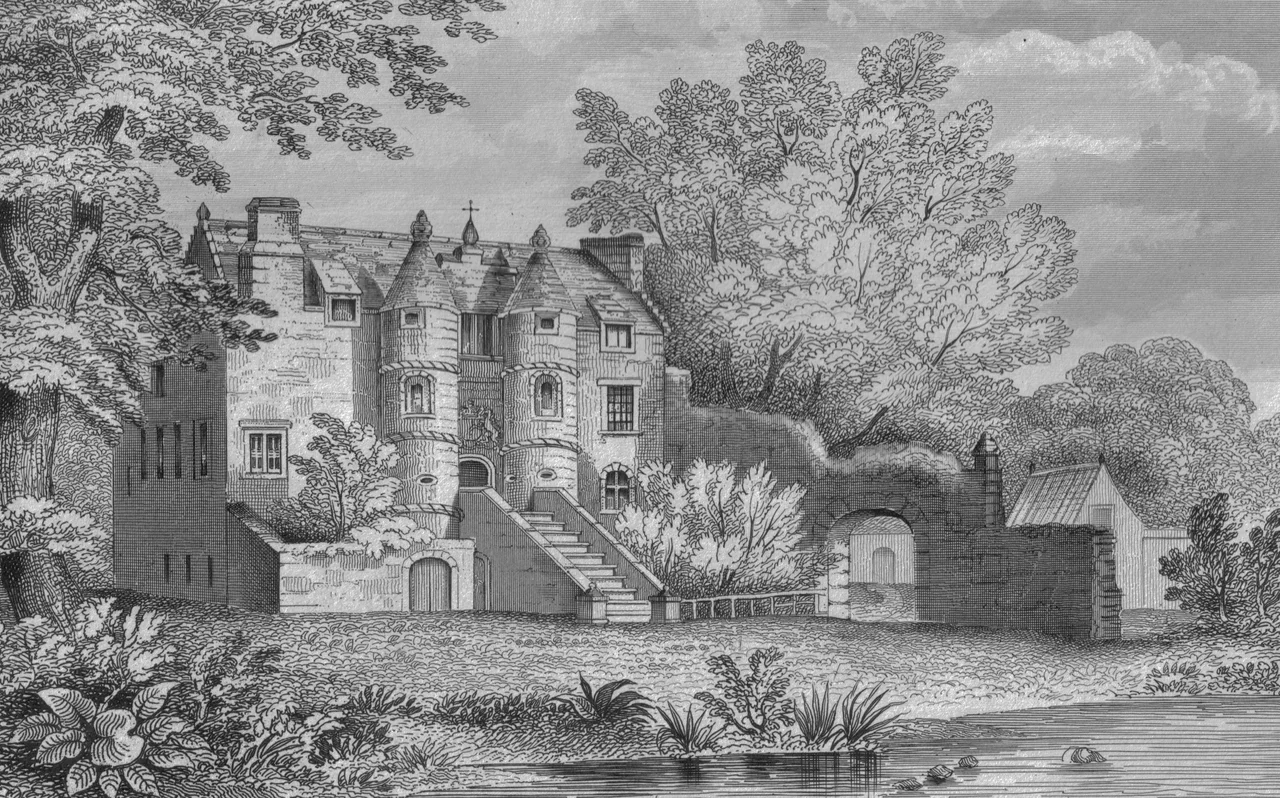

Rowallan Castle
The earliest piece of lute music in existence is said to have been written here. Whether or not that is true - and the claim has the soft edges of family legend rather than musicological certainty - it tells you something about how Rowallan Castle has carried itself across the centuries. This is a place where stories accumulate. A future queen of Scotland may have been born within its walls. A 1691 tax record shows twenty-two hearths. A 16th-century oak door from the castle is preserved at the Royal Scottish Museum. A fox once lived in a tree in the garden, watched the world from its perch, and outsmarted the local hunt. Some castles you visit. Rowallan you listen to.
On the Banks of the Carmel
Rowallan Castle stands on a low eminence above the Carmel Water, north of Kilmarnock, on land that once carried the name Craig of Rowallan. The original castle is thought to date to the thirteenth century. Family tradition has it that Elizabeth Mure - Muir - first wife of Robert the High Steward and mother of the future Robert II of Scotland, was born here. In 1513 John Mure of Rowallan was killed at the Battle of Flodden alongside thousands of other Scots, and the Rowallan Estate took its present shape that same year. About 1690 the estate passed to the Campbells of Loudoun, who held it into the nineteenth century. The southern front of the castle was erected around 1562 by John Mure of Rowallan and his Lady, Marion Cuninghame, of the family of Cuninghamhead, an event recorded on a marriage stone at the top of the wall: Jon.Mvr. M.Cvgm. Spvsis 1562.
The Hebrew Inscription
Over the doorway of the porch, carved in Hebrew characters, runs a verse from Psalm 16: The Lord is the portion of mine inheritance and of my cup. Doctor Bonar, moderator of the Free Church of Scotland, was the scholar who deciphered and translated it. Hebrew inscriptions on Scottish castles are rare enough to be noted in every account of the building. The Royal Arms of Scotland, fully blazoned, are carved over the main entrance alongside the shields of the Cumin family, from whom the Mures claimed descent. The crest of the Mures was a Moor's head - a likely rebus on the family name, although some have read it as a reference to a feat performed in the crusades against the Saracens. By the time the Hearth Tax records were compiled in 1691, the castle had twenty-two hearths and eighteen other dwellings attached to the estate.
The Tree Fox
Some stories from a castle's past are domestic and small, and they are often the ones that survive longest. Archibald Adamson recorded that a fox once lived in a tree in the old garden at Rowallan. The fox would watch the world go by from its perch and was sufficiently shrewd to leave the housekeeper's chickens alone. When the local hunt eventually arrived, the fox ran to cover in the tree, to the amazement and consternation of the hunters and hounds. The housekeeper dislodged the poor animal. It escaped the hunt anyway, and was back in its tree the following day as if nothing untoward had happened. Near the castle, overlooking a chasm of the Carmel, stood a stately marriage tree on a bank called Janet's Kirn - Scots for churn. Under it, Dame Jean Mure of Rowallan was married to William Fairlie of Bruntsfield in a carefully planned elopement, the suitor having brought a minister with him.
The Woman's House
One room of the castle was known as the Woman's House. Researchers have called this a quite rare phenomenon, evoking what they describe as a lost age of gender separation, defined by specialist work with clothes and linen and carrying the potential to inform an understanding of the role of women here and in wider society. The 10th Countess of Loudoun, Edith Rawdon-Hastings, was especially fond of Rowallan and spent considerable sums repairing the castle in the nineteenth century. Without her efforts the building would not have survived. Architect Charles Rennie Mackintosh is said to have modelled his Scotland Street School in Glasgow on Rowallan Castle and Falkland Palace - a quiet but enduring tribute from one of the great figures of the Glasgow Style to a small Ayrshire tower house.
Lorimer's Edwardian Castle
A second castle on the Rowallan grounds was built between 1902 and 1906 by the architect Sir Robert Lorimer for Archibald Corbett, a property developer and Liberal politician who had purchased the estate. The original sixteenth- and seventeenth-century Rowallan Castle was retained alongside the new house. In the twentieth century the castle passed to Historic Scotland's care, but in June 2015 the agency granted Scheduled Monument Consent for the castle to be converted for use as guest accommodation, and the property returned to private ownership. The 1970 case of the 3rd Baron Rowallan - whose marriage to April Ashley, a transsexual woman, was annulled under then-current UK law - served as a precedent until the Gender Recognition Act of 2004 finally provided legal recognition. The case is not the castle's, but it is part of how the Rowallan name reached the modern era.
From the Air
Rowallan Castle sits at 55.65°N, 4.49°W, just north of Kilmarnock on the Carmel Water. Recommended viewing altitude 2,000-3,000 feet. The castle stands in private grounds with the Edwardian house and golf course adjacent. Nearest airports: Glasgow Prestwick (EGPK) about 14 nm southwest and Glasgow (EGPF) about 19 nm north-northeast. The Carmel Water flows southwest from here to join the River Irvine near Crosshouse.
Nearby Stories
- Clydebank 0.4 km away
- Dunoon 5.5 km away
- HMS Dasher (D37) 6.1 km away
- New Lanark 6.3 km away
- Falkirk Wheel 11 km away
- Drumlanrig Castle 11 km away
- Ailsa Craig 18 km away
- Maybole Castle 18 km away