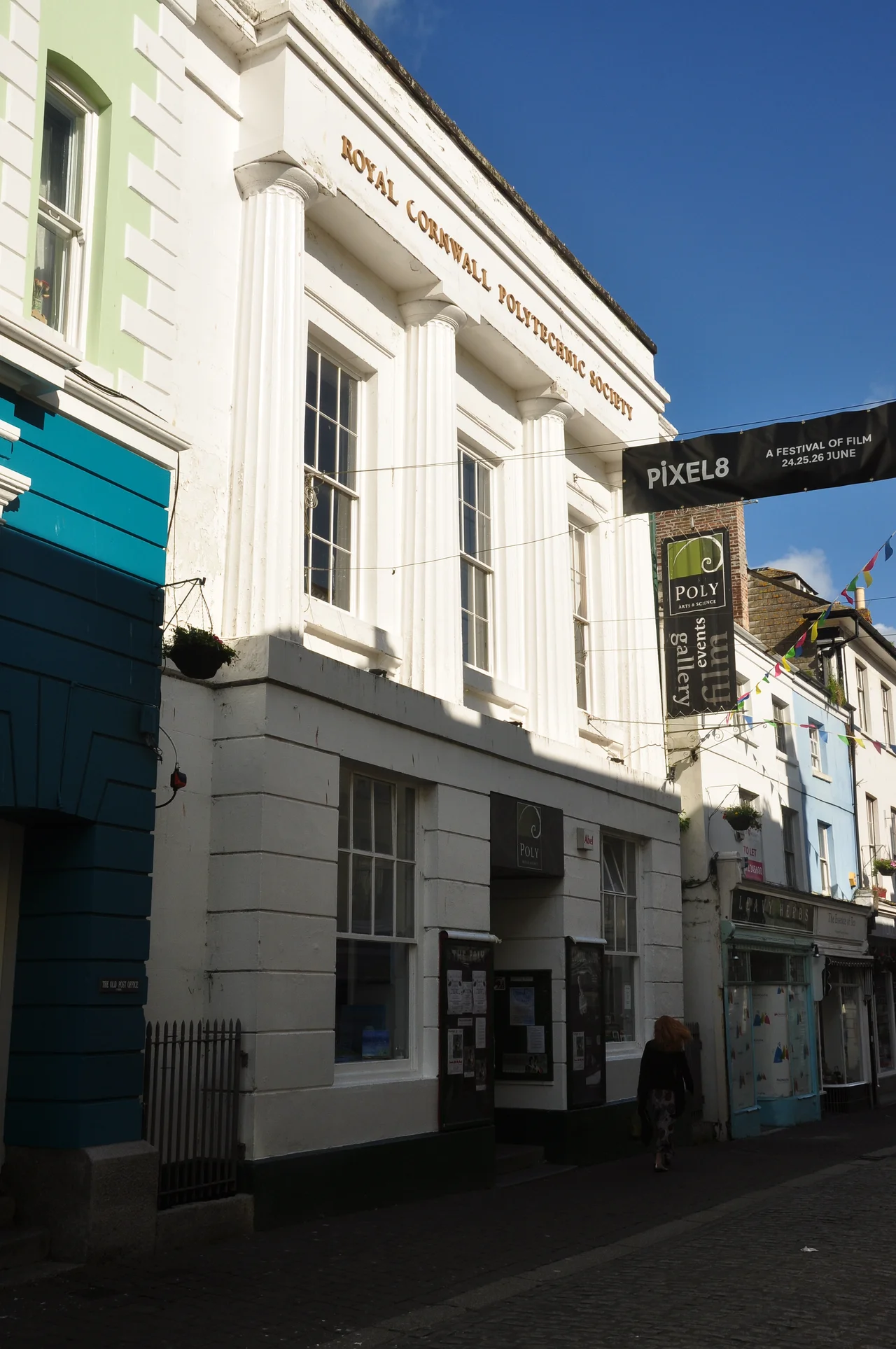

Royal Cornwall Polytechnic Society
The word 'polytechnic' had never been used in Britain before 1832. That year, the Fox family of Falmouth, Quaker industrialists who ran the Perran Foundry, decided their workmen's inventions deserved a serious institutional home. They founded the Cornwall Polytechnic Society, the first body in Britain to take that word for itself. It meant 'of many arts and techniques'. Three years later, King William IV granted it Royal Patronage, and the Royal Cornwall Polytechnic Society became the senior member of a movement that would eventually produce dozens of polytechnics across the country. The original is still operating, in the same building on Church Street, Falmouth, that it built for itself in 1835. It now runs an arthouse cinema and a theatre, but in the 19th century it was something stranger: the place where Cornwall went to find out what the future looked like.
The Fox Family Project
The founding Fox family was a Quaker dynasty whose business interests extended into shipping, foundry work, mining and gardens. They were related, in the unmistakable Cornish way, to nearly every other significant Falmouth family of the 19th century. Their Perran Foundry built marine engines, mining machinery and components for steam locomotives. They wanted a forum where their workers could present and discuss inventions: an audience for the practical creativity that the Industrial Revolution had unleashed. Robert Were Fox the younger, a Fellow of the Royal Society and an inventor of compasses for measuring magnetic dip at sea, was central to it. So was his brother Charles, a Quaker scientist who later developed Trebah Garden. Their sister Anna Maria Fox was equally active in promoting the Society, and her portrait still adorns the 1897 Annual Report. The Foxes turned an industrial circle into an institution.
The Polytechnic Hall
In 1835 the Society built itself a permanent home: the Polytechnic Hall at 24 Church Street, Falmouth, designed by George Wightwick. It was specifically constructed for 'objects connected with the sciences, arts and literature,' but expressly not for theatrical performances; that restriction was only lifted in 1889 when the Society relented and permitted 'dramatic plays.' By 1837 there were local committees in Falmouth, Penryn, Truro, Redruth, Camborne, St Day, Helston, Penzance, Hayle, St Austell, Liskeard and Bodmin, plus a Ladies Committee. The total membership across these committees was 98. The Society had become a county-wide network for the transmission of scientific ideas, with the Falmouth hall as its centre.
The Man Engine and the Nobel Demonstration
The Poly's 19th-century role in Cornish mining was substantial. The Society was instrumental in developing the 'Man Engine,' a system that used the reciprocating motion of a pumping engine to carry miners up and down a shaft on linked platforms. Before man engines, miners climbed wet wooden ladders for hours to get to and from their working faces. The Society also worked on better drilling machinery, mine ventilation, and the welfare of miners and fishermen. In 1865 the Poly awarded its first silver medal for an explosive. The recipient was Alfred Nobel. The medal was for his new compound, nitroglycerine. The demonstration took place at Falmouth Docks: a small charge blew up a three-hundredweight wrought iron anvil; a larger charge scattered forty to fifty tons of rock. The Society also recognized Prentice's guncotton in the same period. Cornwall was where these new explosives got tested. The Poly was where they got their first medals.
Decline, Wartime, Revival
The Society's scientific impetus faded somewhere in the late 19th century, paralleling the long decline of Cornish mining from the 1850s. The building stayed. Members ran exhibitions and lectures with shrinking ambition. From 1911 a license for 'Cinematograph Shows' brought films in, an arrangement that continued until 1931. During the First World War the Hall was variously a canteen, a dance hall, a concert venue and a hospital. The Second World War repeated the pattern, with the building used as a canteen and dance hall for HM Forces in 1942. By 1949 the structure was in a dangerous condition. The novelist Howard Spring, who lived in Falmouth from 1947 to 1965, joined the Society in 1947 and gave it a new lease of life, becoming president in 1953 and serving for eight years. A Falmouth Arts Centre was created in 1954 to give the Society a clearer public mission.
Save Our Poly
In January 2010 the trading company that ran the Poly's cinema programme went into administration. The Society was close to bankruptcy. What followed was the kind of community-led rescue that defines the institution's modern character: a 'Save Our Poly' campaign produced a totally new Board and a revitalised programme. In 2011 the Society formally adopted 'The Poly' as its working name, keeping 'Royal Cornwall Polytechnic Society' for legal purposes. In 2015 a new digital cinema system was installed. The Poly today shows independent films, hosts plays, comedy, talks and exhibitions, and owns the largest single collection of paintings and drawings by Henry Scott Tuke, the Falmouth-based painter of luminous seaside scenes. Over 200 works of his hang in or are owned by the Society.
First and Possibly Last
There is a curious tail to this story. The polytechnic movement that began with the Falmouth Society spread across Britain over the next 150 years, with polytechnics established in Plymouth, London, Manchester, Glasgow and dozens of other cities. In 1992 all of them were converted into universities. Plymouth Polytechnic became the University of Plymouth. The London Polytechnic became the University of Westminster. The Royal Cornwall Polytechnic Society did not convert. It remained what it had always been: a learned society, an arts venue, a place where the people of Falmouth came to think about technique and culture together. As far as anyone can tell, this makes it not only the first polytechnic in the English-speaking world but, since 1992, the last one. The building on Church Street is older than nearly anything else in the polytechnic story. It is also still here.
From the Air
The Poly's main building sits in central Falmouth at 50.154°N, 5.068°W, on Church Street within the tight grid of streets a few hundred yards back from the harbour front. From the air at 2,000 feet it appears as part of the dense Victorian streetscape between Arwenack Street and The Moor, indistinguishable from the buildings around it; the institution is much better identified by its location relative to Pendennis Castle (about 1 nm east on the headland) and the docks (immediately southeast). Newquay Cornwall Airport (EGHQ) is 19 nm north-northeast; Land's End (EGHC) is 23 nm west. The Carrick Roads anchorage provides the most striking landmark in the area, with its sheltered moorings between Pendennis and St Anthony Head. Best visual context for the Poly is in the wider sweep of central Falmouth between the harbour and the western shoreline.
Nearby Stories
- Morvah 2.9 km away
- Carnewas and Bedruthan Steps 6.1 km away
- Liskeard 7.5 km away
- Battle off Lizard Point 14 km away
- Polperro 17 km away
- MV Cita 47 km away
- HMS Affray 86 km away
- 1979 Fastnet Race 96 km away