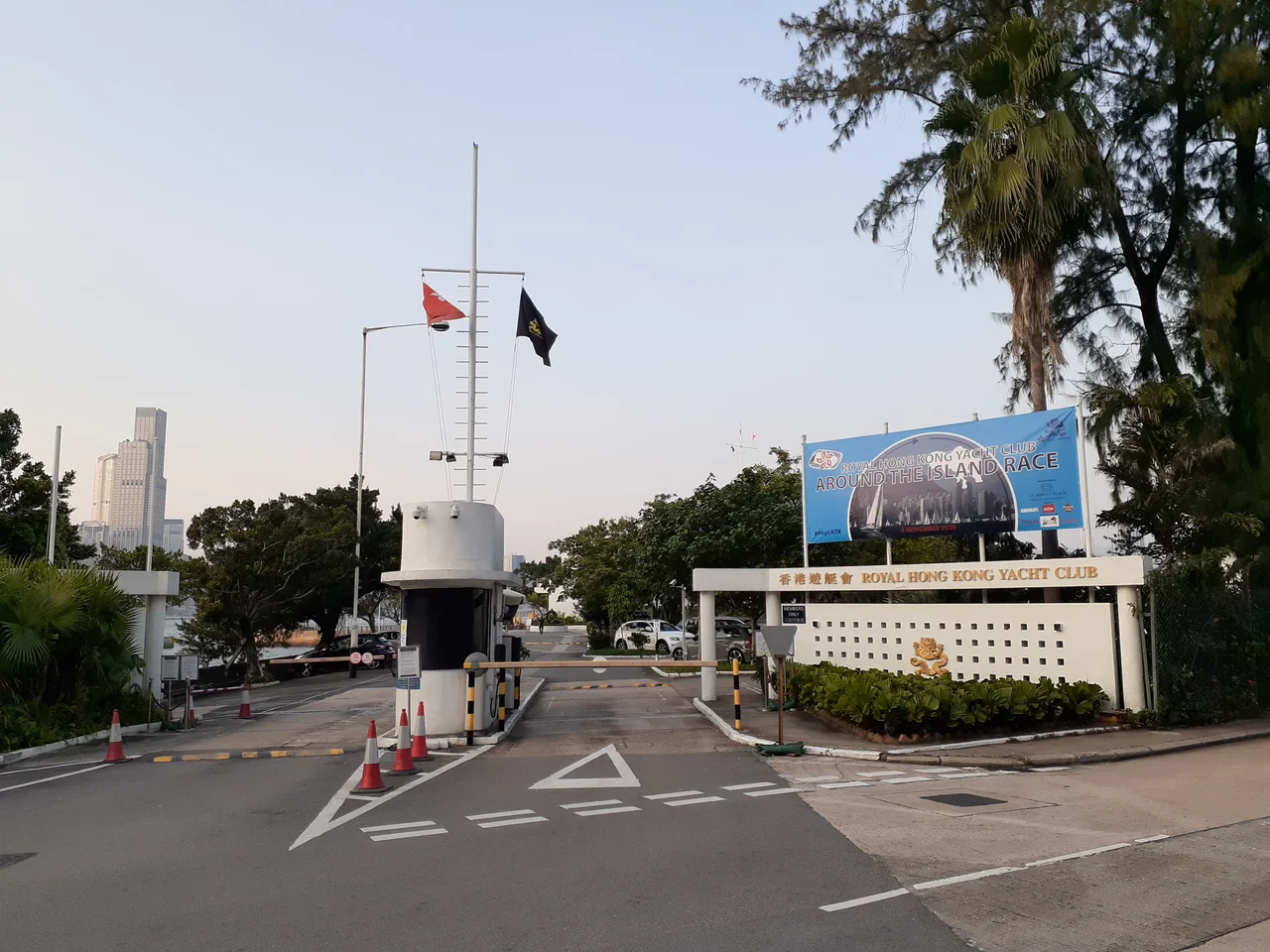

Royal Hong Kong Yacht Club
Two votes. After Hong Kong's handover to China in 1997, the members of the Royal Hong Kong Yacht Club voted on whether to drop the word "Royal" from their name. A majority favored removing it — but the club's rules required a 75 percent supermajority, and the motion fell two votes short. A second vote failed the same way. What emerged from the deadlock was a solution that only Hong Kong could produce: the English name stayed "The Royal Hong Kong Yacht Club," while the Chinese name became simply "Hong Kong Yacht Club," omitting 皇家 (*Wong Ka*), meaning "Royal," entirely. One club, one membership, two names — an elegant piece of institutional diplomacy that captured something true about the city itself.
From Regatta Club to Royal Warrant
The club traces its origins to 1849, when the Victoria Regatta Club was formed in the harbor town that Hong Kong was still becoming. The club was absorbed into the Hong Kong Boating Club, which in 1889 merged into the Hong Kong Corinthian Sailing Club. At the general meeting of October 1893, the membership resolved to apply for Admiralty permission to use a royal name and fly the blue ensign. The warrant was granted by the Lords of the Admiralty on 15 May 1894. The formal authorization transformed a local sailing society into something with institutional weight. It was the kind of credential that mattered in a colonial city where institutional prestige translated directly into social standing.
Exclusion and Its Long Unraveling
The club's early decades were not open ones. Membership was restricted to British subjects, with military personnel prominent on the board. Europeans had exclusive access until the 1950s, a policy that reflected — and reinforced — the racial hierarchies of colonial Hong Kong. Women fared no better: full membership was barred to them until 1977, when Patricia Loseby became the first female member. The timeline is worth pausing on. Patricia Loseby joined in 1977 — eight years after men landed on the moon, three years after Richard Nixon resigned. The exclusion was not ancient history. Today membership is open to all, and the club has outlasted the attitudes that once defined its character, if not always their consequences.
Three Homes Across the Harbour
The club's main clubhouse sits on what was once Kellett Island, now absorbed into Causeway Bay through land reclamation and forming the western edge of the Causeway Bay Typhoon Shelter. The club relocated there in 1938; the current building was constructed in 1939 on the foundations of a former Naval Powder Magazine, designed in International Modern style by G.G. Wood and J.E. Potter of Leigh & Orange, and formally opened on 26 October 1940 by Acting Governor Lieutenant General E.F. Norton. The club also operates a facility on Middle Island, accessible only by sampan, and a third location at Shelter Cove in Hebe Haven, Sai Kung. The former headquarters on Oil Street in North Point — opened in 1908 in Arts and Crafts style by Governor Sir Frederick Lugard — now houses the Oi! arts center. The building has been a Grade II historic structure since 1995.
Still Flying the Blue Ensign
The clubhouse at Kellett Island has been a Grade III historic building since January 2010, its International Modern facade a quiet landmark on the Causeway Bay waterfront. From the water, the building presents a composed, horizontal face to Victoria Harbour — understated compared to the tower blocks behind it, but anchored by a century and a half of institutional continuity. The typhoon shelter shelters the club's boats as it has sheltered the boats of Hong Kong fishermen for generations. The commodore's suggestion that the club apply the "one country, two systems" principle to its own name proved prescient: Hong Kong's layered identity, the persistence of colonial-era forms alongside their quiet revision, is right there in the two names on the letterhead.
From the Air
The Royal Hong Kong Yacht Club's main clubhouse is located at 22.2844°N, 114.1821°E at Kellett Island in Causeway Bay, on the north shore of Hong Kong Island. From the air at 2,000–3,000 feet, the typhoon shelter forms a distinctive enclosed harbor visible within the denser urban fabric of Causeway Bay. Hong Kong International Airport (VHHH) lies approximately 14 nautical miles to the west-northwest. Victoria Harbour provides clear east-west orientation. The former Oil Street clubhouse (now Oi! arts center) is in North Point, about 1.5 nautical miles to the east. Middle Island, the club's offshore facility, is visible south of the island between Repulse Bay and Deep Water Bay.
Nearby Stories
- Lok Ma Chau Loop 2.3 km away
- Portas do Cerco 2.3 km away
- Kweilin Incident 17 km away
- Wanshan Archipelago Campaign 34 km away
- Nanxiong Formation 115 km away
- Battle of Nanpeng Island 148 km away
- Heyuan 169 km away
- Cape Maobitou 632 km away