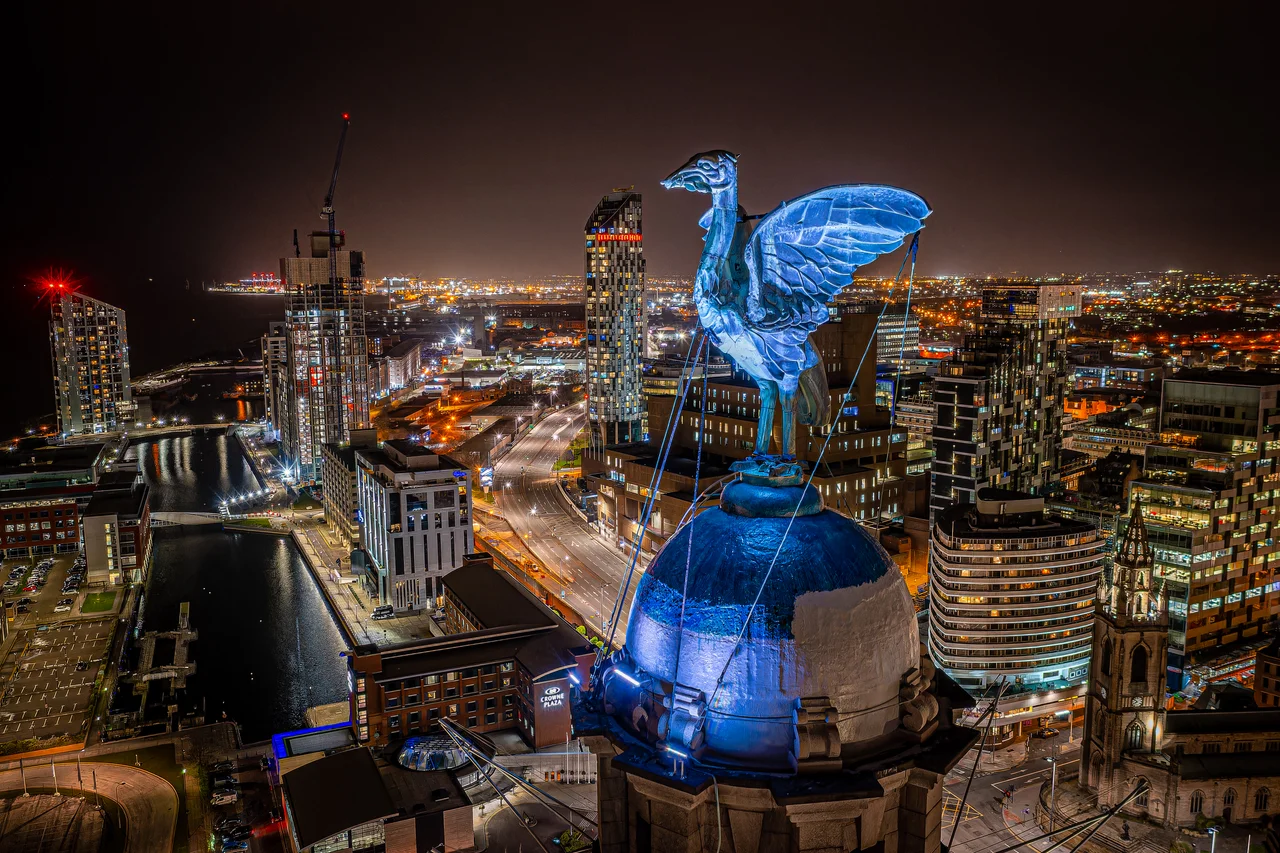

Royal Liver Building
Bella faces the sea. Bertie faces the city. The two enormous copper Liver Birds perched on the twin clock towers of the Royal Liver Building have looked in opposite directions since 1911, and Liverpool likes to say that if they ever turn to face one another the city will fall. Whoever named them - Bella outward over the Mersey, watching for sailors coming home; Bertie inward over Liverpool, watching the pubs do not close too early - knew their job. Eighteen feet tall in beaten copper, designed by the German sculptor Carl Bernard Bartels, they were the first thing emigrants saw arriving in Liverpool and the last thing they saw leaving. They still are.
An Insurance Company Builds a Wonder
The Royal Liver Friendly Society had been founded in Liverpool in 1850 as a working-class mutual: members paid in a penny a week to insure their families against the catastrophe of losing a wage-earner. By 1907 the society had over six thousand staff and needed a head office to match its ambitions. The Liverpool architect Walter Aubrey Thomas was commissioned. He designed something audacious - a ten-storey clock-towered monument in reinforced concrete, a material still so new that critics declared the building could not be built. The foundation stone was laid on 11 May 1908. Just three years later, on 19 July 1911, Lord Sheffield opened the finished structure. It stood 98.2 metres to the tops of the spires and 103.7 metres to the tops of the birds. For 29 years it was the tallest building in Europe, finally surpassed by Milan's Terrazza Martini Tower in 1940. It was also among the first buildings anywhere in the world to be built with reinforced concrete - the construction method that would, in time, build everything else.
The Three Graces
By 1916 the Royal Liver Building had two younger siblings beside it on Pier Head. The Cunard Building rose immediately to its south, the headquarters of the great Atlantic shipping line. The Port of Liverpool Building - the city's harbour authority headquarters - was already there to the south of that. The three of them, lined up along the waterfront, became the Three Graces. No other British port-city has a waterfront quite like it: three grand civic buildings of the early twentieth century in three contrasting styles, each one a public statement of confidence in trade. UNESCO recognised the entire Liverpool maritime mercantile city as a World Heritage Site in 2004. (It was struck off the list in 2021 over the city's proposed waterfront development.) The Three Graces still face the river. They still photograph as if they had been designed by one architect on the same morning. They were not - Walter Aubrey Thomas, Willink and Thicknesse, and Briggs Wolstenholme Hobbs and Thornely shared the work over fourteen years - but the effect is of a single composition.
George's Clock
The four clock faces are each 7.6 metres in diameter - bigger than the dials of the Great Westminster Clock at the Palace of Westminster in London, which most people call Big Ben. The Liver Building clocks are the largest electrically driven clock dials in the United Kingdom. There are no numerals on the faces, only twelve facets indicating the hours, which gives them their abstract, almost industrial elegance from a distance. Three of the four faces are on the riverside tower - looking west, north, and south. The fourth is on the landward tower, looking east. One mechanism drives all four. The clocks were made by Gent and Co. of Leicester. They were started at the precise moment King George V was crowned, on 22 June 1911 - which is why they were originally called George Clocks. The faces are illuminated at night. The whole building is floodlit. From the Wirral side of the river the two clock towers glow above the dark water like a pair of small moons.
Bella, Bertie, and Carl Bernard Bartels
The German-born sculptor Carl Bernard Bartels won the commission to design the two Liver Birds in 1909. He had emigrated to Britain in 1887 and was working in London when the Liver Building competition was held. His design - long-necked, eagle-bodied, with seaweed in their beaks, a reference to the mythical creature on Liverpool's medieval seal - was hammered out of copper sheet over wooden formers and stands eighteen feet high. The seaweed was the genuine touch: medieval Liverpool seals show a cormorant with a sprig of laver weed, the bird's identity blurring into the city's name. Bartels was interned during the First World War as an enemy alien and deported in 1918, his contribution to the building deliberately erased for decades. His role was only properly rehabilitated in 2011, on the centenary of the building's opening, when a memorial plaque was installed in his honour. The birds he designed have been called the most iconic civic emblems in Britain. They look out from the towers in their original copper, weathered to the green of old verdigris.
From Insurance to Visitors
Royal Liver Assurance remained headquartered in its building for exactly a century. In 2011 - one hundred years after the opening - the company merged into the Royal London Group and moved out. The building was put on the market in October 2016, sold the following year to Corestate Capital and Everton FC majority shareholder Farhad Moshiri for £48 million. In 2019 a new visitor experience called Royal Liver Building 360 opened in the West Clock Tower, giving the public regular access to the rooftop and clock chamber for the first time in 108 years - before that the only public access had been during the annual Heritage Open Days each September since 1994. In 2025 the building changed hands again, sold for £60 million to Princes Group - a major food and beverage company that had been a long-term tenant. The Liver Birds did not notice. They have been watching the city and the sea for over a century, and they have not turned to face one another yet.
From the Air
The Royal Liver Building stands on Pier Head on the Liverpool waterfront at 53.406°N, 2.996°W. Best viewed at 2,000-4,000 ft along the Mersey. Liverpool John Lennon Airport (EGGP) is 5 nm south-southeast. Look for the three large waterfront buildings - the Three Graces - with the Liver Building northernmost, distinguished by its two clock towers each capped with the green copper Liver Birds. The river is to its west, the Albert Dock complex is just to its south.
Nearby Stories
- RAF Wrexham 3.3 km away
- Birkdale Palace Hotel 3.7 km away
- Turton Tower 4.1 km away
- Tatton Park 5.6 km away
- Abergele Rail Disaster 9.6 km away
- Diglake Colliery Disaster 13 km away
- Ysbyty Ifan 16 km away
- Celtic Array 62 km away