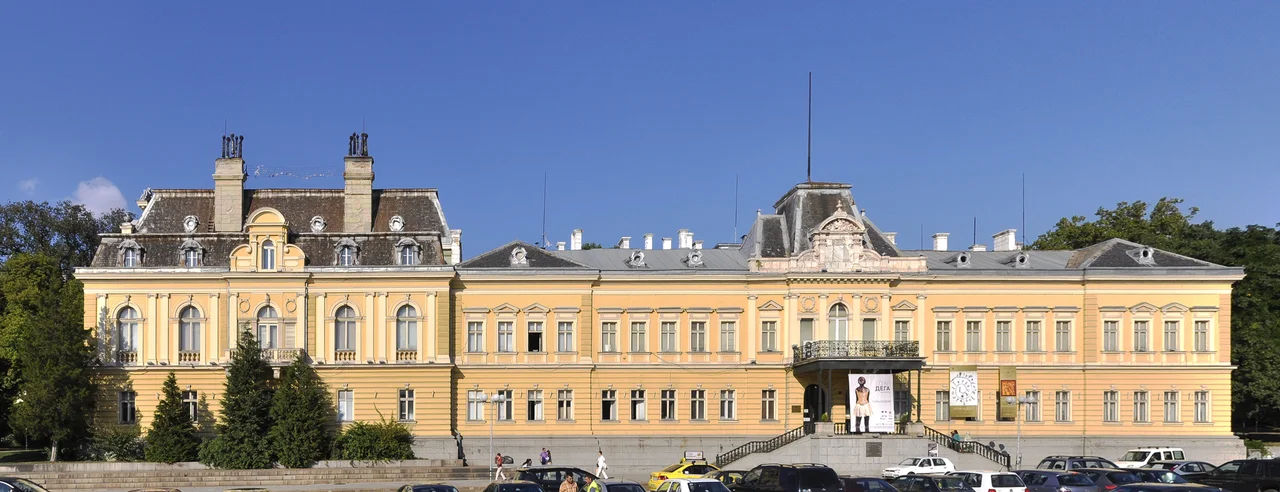

Royal Palace, Sofia
When Alexander of Battenberg arrived in Sofia in 1879 to assume his throne as the first prince of newly autonomous Bulgaria, the building he was given for a residence had been an Ottoman konak only a year earlier. The hilltop site at the heart of the new capital had hosted Ottoman governors since the 16th century, with dungeons in the basement and underground tunnels connecting it to the Pasha's house and the Chelebi Mosque. The Russian army hastily refurbished the building. The young prince moved in. Within a year, it became clear that an Ottoman administrative office, no matter how lavishly decorated, was not a fit residence for a European royal house. The whole thing came down.
Rumpelmayer's Princely Palace
The Austrian architect Viktor Rumpelmayer led the reconstruction from 1880 to 1882. The old konak was almost entirely demolished, but its foundations were retained and an enlarged eastern wing for receptions was added. The new palace blended Austrian Neo-Baroque with French Rococo Revival, the architectural language of central European royalty. The princely family did not actually live there year-round. In summer they retreated to Euxinograd on the Black Sea coast. From 1903 onward they spent more and more time at the Vrana hunting lodge on Sofia's outskirts, especially after Vrana's 1909 expansion. The Sofia palace was for state business and the social season.
From Prince to Tsar
In 1908, Prince Ferdinand I declared Bulgaria's independence from the Ottoman Empire and proclaimed himself Tsar of the Bulgarians. The Prince's Palace became the Tsar's Palace. Ferdinand was a complex figure, born a Catholic German prince of the House of Saxe-Coburg and Gotha, with two successive Catholic wives. Bulgaria was overwhelmingly Eastern Orthodox. To resolve the contradiction, in 1893 Ferdinand had agreed that his eldest son Boris would be raised Orthodox, a constitutional requirement and one of the conditions Tsar Nicholas II of Russia had set for restoring Bulgarian-Russian diplomatic relations. Pope Leo XIII excommunicated Ferdinand for the decision. In 1912, when Boris came of age, the palace added an elaborate Orthodox chapel.
The Palace That Never Was
Ferdinand had grander ambitions. Architect George Fingov drew up a Secession-style design with a decorative cast-iron fence on stone columns. The renowned architect Nikola Lazarov designed a successor building intended to rival the Tuileries, Versailles, and the Belvedere in Vienna. The plans included a 570-square-meter royal apartment for the king, a similarly grand suite for Queen Eleanor, a steam-heated basement, refrigeration facilities, a throne room, a concert hall, separate Orthodox and Catholic chapels, a smoking lounge, a flag room, a library, and dozens of servant quarters. The First World War interrupted everything. The site sat empty for decades. In 1934 it was repurposed for a royal nursery.
The King's Garden, Lost
In front of the palace stretched the King's Garden, a 35-acre expanse established in 1880 by Alexander of Battenberg and cultivated personally by Ferdinand and a team of architects and gardeners. It was famous in Sofia for its botanical variety and rare plant species, a small green world in the heart of the capital. After the communist coup of 1944 and the abolition of the monarchy in 1946, the King's Garden was destroyed. In its place rose the Monument to the Soviet Army, a granite pillar topped with bronze soldiers, marking the territory in unambiguous terms. Elements of Fingov's original Secession-style fence design were salvaged and incorporated into the Lozenets residence, where they survive.
What the Palace Is Now
Today the building houses the National Gallery and the National Ethnographic Museum, splitting the palace down the central entrance. The left wing holds the Bulgarian art collection, including extensive holdings of Bulgarian National Revival icon painting. The right wing displays ethnographic material on Bulgarian folk culture. The square in front, once the King's Garden, is now the much smaller Battenberg Square. Tsar Boris III, who took the throne after Ferdinand's 1918 abdication, died here in 1943 under circumstances that have never been fully explained. His ten-year-old son Simeon II inherited the throne and was forced into exile when the monarchy was abolished. Simeon eventually returned to Bulgaria after 1989 and served as prime minister from 2001 to 2005, a former boy-king turned democratic politician.
From the Air
Located at 42.6965 N, 23.3268 E on Battenberg Square in central Sofia, just east of the National Theatre. The building is a major Sofia landmark, with its yellow and white late 19th-century Neo-Baroque facade. Sofia Airport (LBSF) lies 10 km east. Plovdiv Airport (LBPD) is 130 km southeast. The Vitosha Mountain rises immediately south of Sofia, a major visual landmark.
Nearby Stories
- Battle of the Gates of Trajan 1.3 km away
- Battle of Kresna Gorge 65 km away
- Battle of Plovdiv (1878) 70 km away
- Battle of Kosturino 114 km away
- New Europe Bridge 129 km away
- Old Bazaar, Skopje 136 km away
- Trapezitsa Fortress 142 km away
- Trajan's Bridge 193 km away