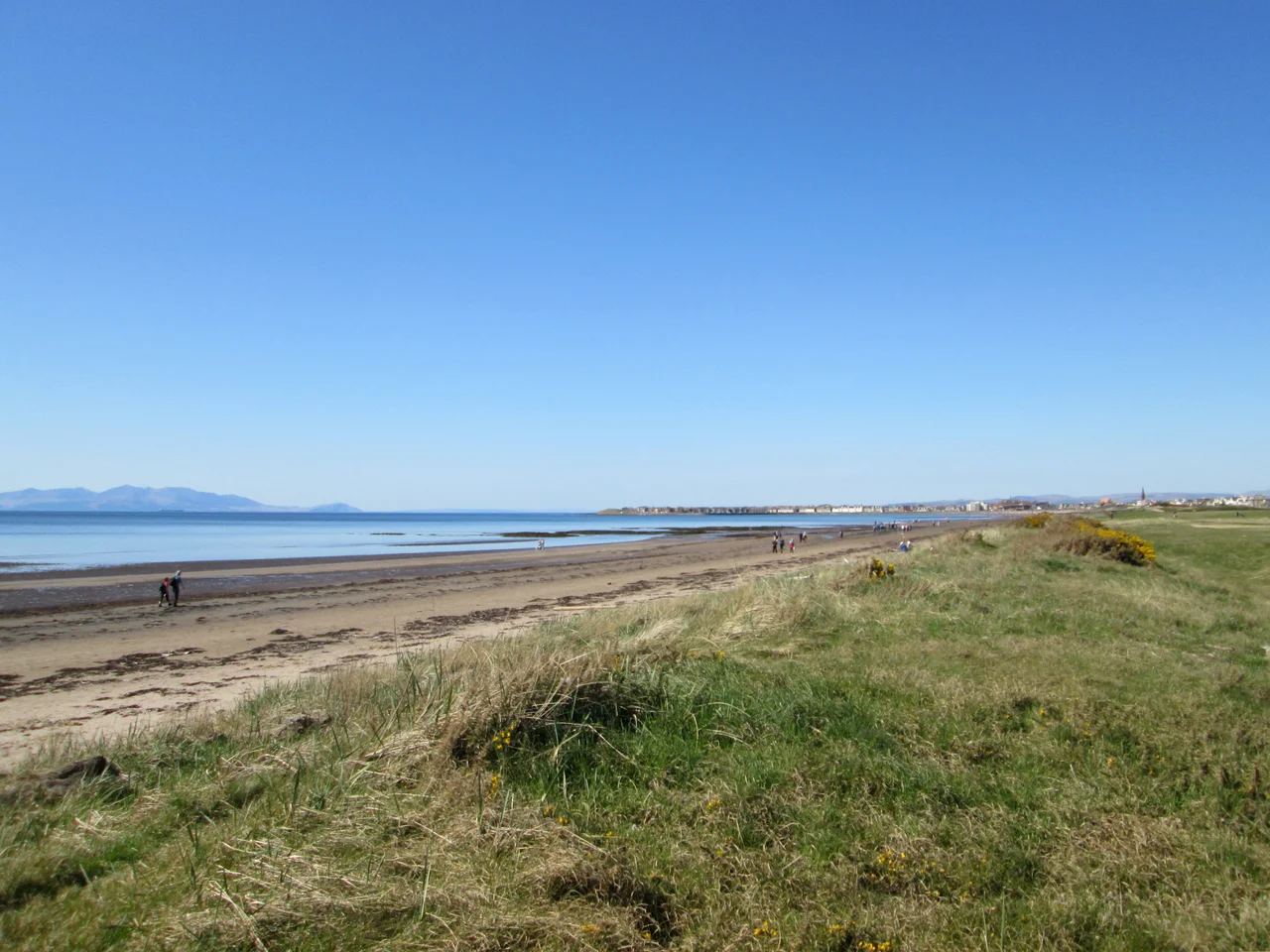

Royal Troon Golf Club
The eighth hole at Royal Troon is one hundred and twenty-three yards long. It is called the Postage Stamp. From the elevated tee a player looks down at a tiny green pinched between sandhills and bunkers, the Firth of Clyde stretching beyond it, the wind doing whatever the wind decides to do. Major champions have walked off that green with double bogeys and the bewildered look of people who have just been mugged by geometry. Two holes later, the eleventh - called the Railway - asks a blind tee shot over gorse, with out-of-bounds running along the railway line on the right and a small green that falls away at the back. They are the most famous pair of consecutive holes in championship golf, and they are why the Open Championship keeps coming back to this stretch of South Ayrshire sand.
Five Holes to Forty-Five
Royal Troon began in 1878 with five holes scratched out of the dunes south of the town. By 1884 the original course had grown to eighteen, designed by the club's first professional George Strath in partnership with Willie Fernie, who had won the 1883 Open Championship. Charlie Hunter, the greenkeeper at the neighbouring Prestwick Golf Club, helped them lay it out. When Strath left in 1887, Fernie took over as head professional and held the post until his death in 1924 - thirty-seven years of shaping a course he had helped to design. He laid out what would become Troon's New Course; Alister MacKenzie redesigned it in 1921, and it was renamed shortly after in honour of the 6th Duke of Portland, one of the region's largest landowners and an early patron. Today the club has forty-five holes across three layouts - Old, Portland, and the nine-hole par-3 Craigend - on a links that runs along the Firth of Clyde.
Royal in 1978
The Open Championship arrived at Troon in 1923 and has returned ten times. The course was granted its Royal designation in 1978, the year of its centenary. The clubhouse, built in 1886 to a design by Henry Edward Clifford, holds an astonishing collection of historical golf artifacts - silver-headed clubs, championship belts, photographs of players in tweed plus-fours from a vanished century. James Montgomerie, father of the modern champion Colin Montgomerie, served as Secretary in the 1980s. The course has lengthened over the decades to keep pace with the modern game. The 1950 Open played at 6,583 yards. The 2024 Open played at 7,385 yards, a difference of more than eight hundred yards in the same routing. Players go further now; the wind off the Firth still does not care.
The Vote
On 1 July 2016, a few weeks before the Open Championship returned to Troon, the club's members voted overwhelmingly to admit women as members for the first time in its history. The R&A had already made clear that clubs which excluded women would lose their place on the Open rota. Royal Troon's vote ended the controversy before the championship arrived, but it also closed a long chapter. In 2020 the club hosted the Women's British Open - the only major it has held in a year without a men's equivalent, and the eleventh Open Championship of any kind to be contested on its fairways. The same dunes, the same gorse, the same Postage Stamp. Different competitors, finally.
The Railway and the Stamp
The par-5 sixth, called Turnberry, runs six hundred and one yards along the railway line - until 2023 it was the longest hole in Open Championship history, eventually surpassed by the par-5 fifteenth at Royal Liverpool. Two holes later comes the Postage Stamp eighth, where a slightly mishit ball funnels into the Coffin bunker and disappears. Then the eleventh, the Railway, which the statisticians sometimes claim is the hardest hole in major championship golf - a blind drive over gorse to a fairway that tightens as it goes, an approach to a green that runs away, out-of-bounds an inch from your left shoulder. Players who emerge with par on the Railway look back at it the way climbers look back at summits. The 1962 through 1989 Opens played it as a par-5, which softened the brutality. Now it is a long par-4. The course architects took the kindness away.
From the Air
Royal Troon Golf Club occupies the links along the Firth of Clyde immediately south of the town of Troon, at 55.53 N, 4.65 W. Recommended viewing altitude: 1,500-3,000 ft AGL for the best sense of the dune system. The course runs north-south along the coast; the Old Course holes border the water, while the Portland is set slightly inland. The Old Course's eighth hole - the Postage Stamp - sits about midway along the seaward run. Nearby aerodromes: Glasgow Prestwick Airport (EGPK) is roughly three miles south; Glasgow Airport (EGPF) is twenty-five miles northeast.
Nearby Stories
- Kilbirnie 4.2 km away
- East Kilbride 5.4 km away
- Knockshinnoch Disaster 7.3 km away
- Machrie Moor Stone Circles 9.4 km away
- Kenmure Castle 16 km away
- Ballantrae Lifeboat Station 20 km away
- Loch Fyne 38 km away
- SM UB-85 46 km away