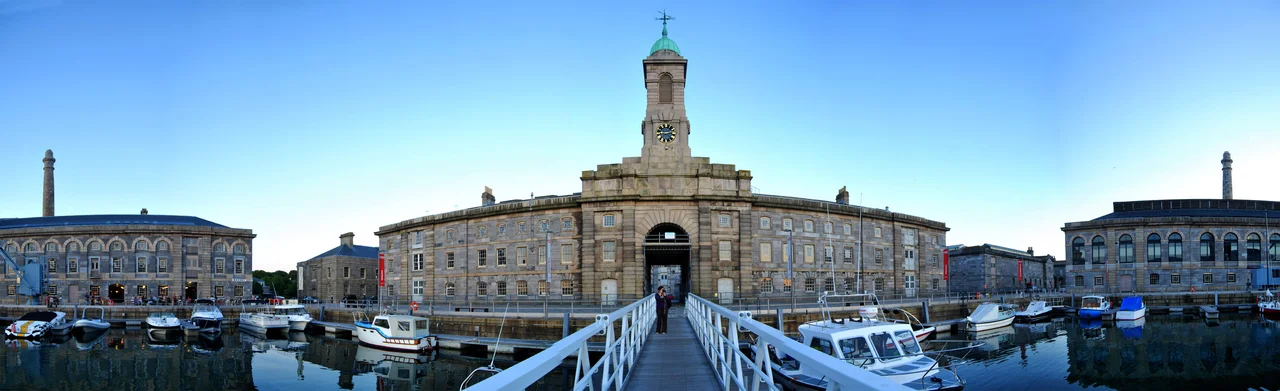

Royal William Victualling Yard
Up to a hundred bullocks a day were slaughtered behind the colonnade. Twenty-seven sets of millstones, driven by a pair of steam engines, ground 270,000 pounds of flour every week. A great square dock cut into the limestone allowed Royal Navy hoys to load barrels of salt beef, biscuit, rum and spirits directly from the storehouses into their holds, then row out into the Sound to provision the warships at anchor. This was the Royal William Victualling Yard, opened in 1831, designed by Sir John Rennie, named for King William IV - the only English king to have served as a working sea officer before taking the throne. A 13-foot statue of William stands above the granite triumphal arch at the gate, watching over what is now a complex of restaurants, apartments and art studios.
Centralising a Scattered Operation
Before the Royal William, Plymouth's naval supply system was scattered across the harbour. The Commonwealth government in the 1650s had built victualling storehouses on Lambhay Hill beside the old Hoe Fort (soon rebuilt as the Royal Citadel), with brewing and baking taking place at various ad hoc sites and a wharf at Sutton Pool that only worked at high tide. When the Royal Navy Dockyard was established at Devonport in 1690, the supply premises expanded too: a new Victualling Office at Lambhay in 1707, then brewing operations across the Hamoaze at Southdown from 1729, where a cooperage made the barrels and bakeries turned out 50 tons of bread a week. By the early nineteenth century the whole thing was a logistical mess. In 1821 the Admiralty decided to centralise everything onto one site.
Convict Labour at Cremill Point
The Admiralty chose Cremill Point on the Stonehouse peninsula, partly for its great depth of water and partly because it sat almost equidistant from the Dockyard, the Hamoaze, and the open Sound. The site had to be levelled out of stubborn limestone bedrock, and the work was largely done by convicts - the Crown's standard labour force for the dirtiest and most dangerous public works of the period. Work on the first building, the Clarence Store, began in late 1827. By the following year the boundary walls and the great square basin were being cut into the rock. In July 1831 the Victualling offices and stores were moved over from the old Lambhay premises into the new yard, although construction of the surrounding buildings continued until the mid-1830s. The whole complex was named in honour of William IV, the sailor king, who had himself served at sea as a midshipman.
Clarence, Melville, and Mills Bakery
Six buildings, all built of Devon limestone with granite detailing, arrange themselves around the basin. Clarence, the first to be built, was originally a liquid store: one floor of spirits, one of vinegar, one of beer. Iron roofs, doors and window frames were specified throughout, because the Admiralty had calculated quite reasonably that storing tons of naval rum demanded fire-resistant construction. Melville, the second building, was the administrative nerve centre - a great quadrangular storehouse whose central cupola still holds the yard's original quarter-chiming clock, built in 1831 by Benjamin Lewis Vulliamy of London. The Mills and Bakery range, its northern face dominated by 27 sets of millstones, produced flour through to 1925 and continued as a clothing and equipment store until two separate fires (in 1929 and 1960) damaged the building. The Brewhouse, despite being built in 1832, was never actually used for brewing - by the time it was finished, ships were carrying fresh water in iron tanks and the daily beer ration had been quietly abandoned.
The Triumphal Arch and the Slaughterhouse
The main gate, begun in 1830, is pure imperial theatre. A granite triumphal arch, topped by the 13-foot statue of William IV and decorated with the crossed-anchor device of the Victualling Commissioners, frames the entrance. Behind a long colonnade to the left, a triangular yard housed the slaughterhouse: cattle pens along one side, slaughtering floor on the other, office at the far end. Live bullocks entered through their own arched gateway just north of the main gate, and up to a hundred a day were killed here to provide fresh meat for vessels anchored in the Sound. Salted meat for ships going to sea was brought in by sea from the main Victualling Yard at Deptford in London - a clear division of labour between the two great supply depots of the British Navy.
A Second Life After the Navy
The Royal Navy quietly withdrew over the second half of the twentieth century and the yard was eventually handed to Urban Splash, a Manchester regeneration developer, in the early 2000s. The Clarence and Brewhouse conversions won a RIBA South West regional award and a 2006 RIBA Conservation Award. Today Clarence holds 52 apartments, Mills Bakery 86, and in 2023 work was underway to create another 40 flats within the Melville block. Ocean Studios, an arts venue, opened in the eastern half of the Brewhouse in 2015. Restaurants, a hotel, offices, retail premises, a gym and a cinema occupy the rest. The Vulliamy clock above the Melville cupola still chimes the quarters. The triumphal arch still frames every entry through the gate. And the great square basin where the navy's hoys once loaded provisions is now a public marina where you can sit on the quayside and eat a meal worth more than a Georgian seaman's monthly wage.
From the Air
The Royal William Victualling Yard occupies the western tip of the Stonehouse peninsula at 50.362 deg N, 4.165 deg W, jutting into the Hamoaze opposite Cremyll on the Cornish bank. From the air the regular Georgian limestone quadrangles around the central square basin make it one of the most architecturally distinctive sites in the entire Plymouth area. Best viewed from 2,000-3,000 ft, ideally on departure from the Plymouth area toward the Sound. Exeter (EGTE) is the nearest active airport.
Nearby Stories
- Davidstow Circuit 3.7 km away
- Golden Hind 3.9 km away
- Powderham Castle 4.4 km away
- Fowey Lifeboat Station 5.1 km away
- Okehampton Castle 12 km away
- Battle of Plymouth (1652) 19 km away
- Goonhilly Satellite Earth Station 44 km away
- German Submarine U-672 73 km away