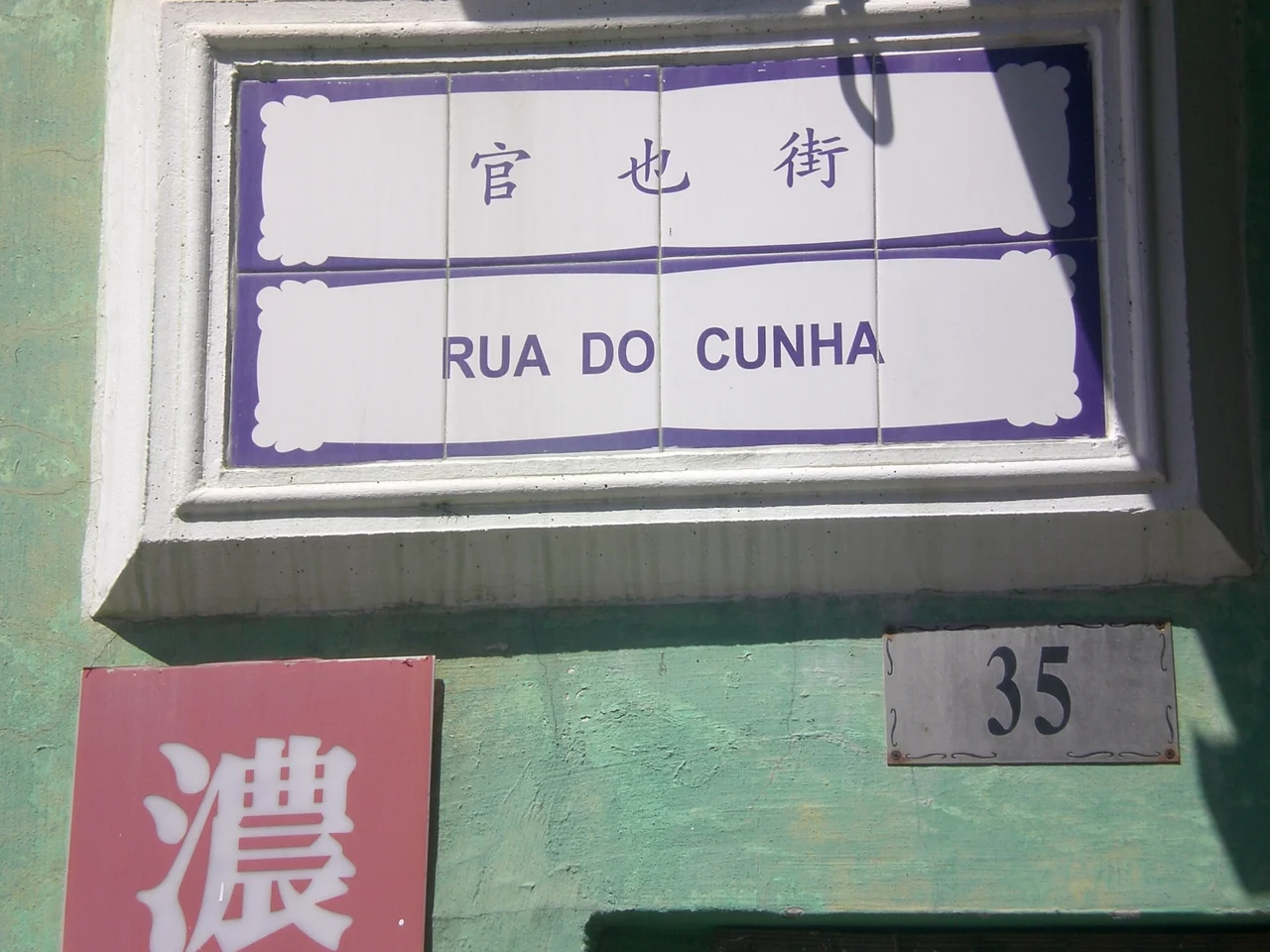

Rua do Cunha
Pedro Alexandrino da Cunha arrived in Macau in 1850 as the 81st Portuguese Governor of the territory, a naval captain who presumably had ambitions for his posting. He died of cholera 37 days later, one of the first victims of the disease in Macau. The street in Taipa that bears his name outlived him by more than 170 years. It is now the most-visited lane in Vila da Taipa — a narrow pedestrian corridor where the smell of toasting almond cakes drifts out of half a dozen shops at once and the restaurants have been serving the same neighborhood for decades.
The Street That Feeds the Island
Rua do Cunha runs through Vila da Taipa, the old town center of Taipa, which was its own island before land reclamation merged it with neighboring Coloane to create the Cotai Strip. The street itself has the scale of the neighborhood it serves: narrow, pedestrian, lined with low shophouses whose owners stand in doorways calling to passers-by. The foot traffic mixes local residents with visitors who have crossed from Macau peninsula or arrived from the casino hotels a few kilometers south on Cotai. The lane smells of sugar and butter and roasting nuts, and the rhythm is unhurried in a way that the Strip is not. Buying almond cakes here — wrapped in paper and boxed for carrying — is one of the few Macau experiences that has remained essentially the same for decades while the landscape around it was transformed out of all recognition.
What Gets Sold Here
The souvenir shops on Rua do Cunha specialize in the sweets and snacks that define Macanese food culture. Almond cakes — thin, crumbly discs with an intense, slightly savory nuttiness — are the most famous export, sold by weight in plain bags or gift-boxed for travelers. Phoenix egg rolls are the closest equivalent to a Macanese wafer cone: crisp cylinders of egg and sugar, fragile enough to shatter if you grip them too hard. Coconut flakes and peanut candy fill the rest of the shop displays, alongside dried beef jerky and other confections that occupy the border territory between snack and souvenir. The shops on the lane are essentially competing against each other in real time, which keeps the products fresh and the prices comparable. The ritual of walking Rua do Cunha and sampling from several shops — a flake here, a broken edge of egg roll there — is as much part of the experience as any purchase.
Tables That Have Been Here a While
Among the restaurants on Rua do Cunha, two have become reference points. O Santos has been in continuous operation since 1989, serving the kind of Portuguese food that developed in Macau over the centuries of colonial contact — dishes that absorbed Chinese ingredients and techniques without losing their European backbone. O Galo is a comparable institution, named for the ceramic rooster that has become the symbol of Portuguese popular culture. Both restaurants are small and unpretentious, with menus that change with the kitchen's mood and wine lists that favor Portuguese table wines over anything designed to impress. The food at both places is built around bacalhau, grilled piri piri chicken, and African chicken — the last of these a Macanese invention that combines Portuguese and Mozambican influences, seasoned with coconut milk and chili and cooked until the skin crisps over the charcoal. Getting a table at either restaurant on a weekend requires patience or a reservation.
A Name and Its Shadow
It is unusual to walk a street every day without thinking about the person it is named for, and Rua do Cunha's eponym is almost certainly unknown to most of the people who buy almond cakes there. Pedro Alexandrino da Cunha's tenure lasted 37 days. He arrived during a cholera epidemic, contracted the disease, and died. Whether he had time to form any impression of Macau, or to issue any orders, or to do anything at all beyond arriving and dying, is not recorded. The territory that named a street for him has since been handed from Portugal to China, built an international airport on land that did not exist in 1850, and constructed a casino resort district that generates more gambling revenue than Las Vegas. The street survives all of it — narrow, fragrant, largely unchanged in character, doing what it has done for generations: feeding people.
From the Air
Rua do Cunha is located at approximately 22.1537°N, 113.5569°E in Vila da Taipa, on the island of Taipa in Macau. From the air the old town of Taipa is recognizable by its grid of low-rise Portuguese colonial shophouses, distinct from the high-rise casino towers of the Cotai Strip immediately to the south. Macau International Airport (VMMC) is approximately 2.5 km to the east on Taipa. Approach from the east or northeast at 1,000–1,500 feet for a view of the old town and the contrast between Vila da Taipa's street-scale neighborhood and the casino mega-resorts beyond. Hong Kong International Airport (VHHH) is approximately 60 km to the northeast across the Pearl River Delta.
Nearby Stories
- Tai Tau Chau (Southern District) 0.7 km away
- Lai Chi Wo 3 km away
- Wanshan Archipelago Campaign 3.2 km away
- Pearl River Delta 3.7 km away
- Battle of Yamen 13 km away
- Jiangmen 15 km away
- Hong Kong 12 32 km away
- Battle of Nanpeng Island 114 km away