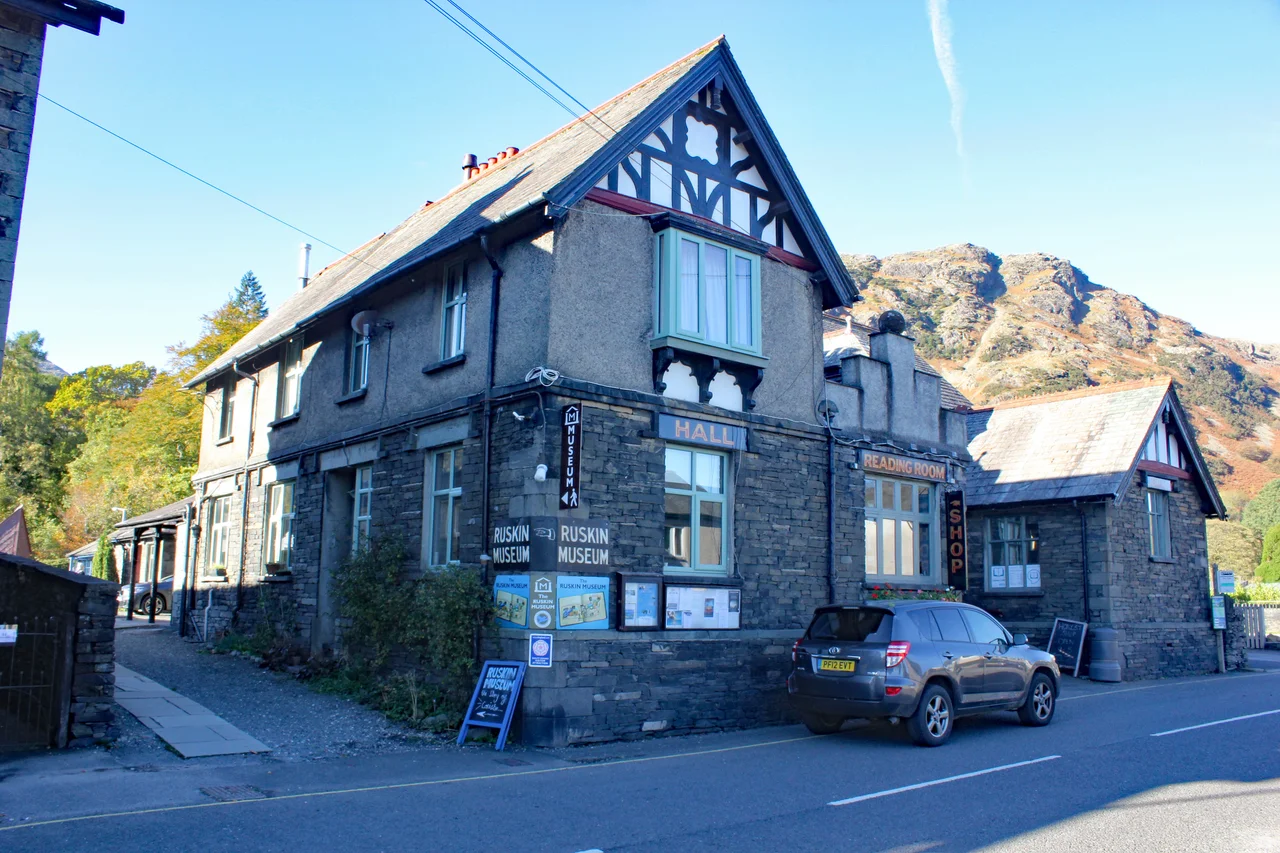

Ruskin Museum
When Bluebird K7 was finally hoisted onto a low-loader and driven back into Coniston on 9 March 2024, it had been twenty-three years and one day since the boat was lifted from the lake bed. The crowd that gathered outside the Ruskin Museum that morning was small but pointed. After a long, public, and at times bitter dispute over who owned the restored hydroplane, a court order had decided in the museum's favour. The wing built specifically to house Bluebird back in 2010 had been waiting empty for fourteen years. Now it had its centrepiece. Within a month, more than six thousand people had come to see the boat - more visitors than the museum had seen for it at any time since the 1960s.
A Memorial Built by a Friend
The Ruskin Museum opened in 1901, founded by the artist and antiquarian W. G. Collingwood, who had spent years working as secretary to the art critic John Ruskin. Ruskin had lived at Brantwood on the eastern shore of Coniston Water from 1872 until his death in 1900, and is buried in Coniston churchyard. Collingwood's museum was both a memorial to his friend and employer and a local museum for the village - rolled together in a single small building. It is constituted as a charity called The Coniston Institute and Ruskin Museum. The collections cover Ruskin's life and work, the copper and slate mines of the surrounding fells, geology, lace making, farming, and the children's author Arthur Ransome, whose Swallows and Amazons drew partly on Coniston Water.
Riverdale's Miniature Village
Walk into the museum garden and you find Riverdale - more than sixty miniature buildings handmade by a local builder, John Usher (1940-1993). Houses, bridges, farm structures, all in slate and stone, each modelled on the kind of vernacular Lakeland architecture that surrounds Coniston in life-size. Usher built them at his home, Brow Head, and after his death the largest collection was rehomed at the museum in 1999. It is the kind of detail that gives a country museum away as something more particular than the standard pattern: someone here cared not just about famous men but about how local builders thought, and what they made for love.
The Long Wait for Bluebird
The Donald Campbell story haunts the building. Campbell died on Coniston Water on 4 January 1967, attempting a new world water speed record in Bluebird K7 after already breaking 320 mph. The wreck stayed on the lake bed for thirty-four years before a private diver, Bill Smith, raised it in 2001. On 7 December 2006, Donald's daughter Gina Campbell, on behalf of the Campbell Family Heritage Trust, formally donated the recovered material - the boat, parts both recovered and unrecovered, even Donald's clothing and overalls - to the Ruskin Museum. Smith agreed to organise the restoration at no cost. "I've decided to secure the future of Bluebird for the people of Coniston, the Ruskin Museum and the people of the world," Gina said at the time. The museum built a dedicated wing to receive the boat, finished in 2010.
Court, Custody, Return
What followed turned into one of the long, painful disputes that small museums and dedicated restorers sometimes generate. By September 2021 the BBC reported that relations between the museum and the Bluebird Project had broken down so completely that dismantling the restored boat looked, briefly, like the only resolution. The Ruskin Museum served legal papers on Bill Smith and Bluebird Project Ltd in February 2023. A court order eventually ruled that the boat and its associated parts belonged to the museum under the 2006 Deed of Gift, with Smith and the Bluebird Project paying their own legal costs and an agreed £25,000 to the museum. Bluebird arrived back in Coniston on 9 March 2024, after twenty-three years away. The museum has announced plans to run K7 on Coniston Water in 2026 - the first time the boat will move under its own power on the lake since 1967. The Ruskin Museum's larger story - of the 1980s rescue from "at risk" status, the £850,000 lottery-funded extension reopened by Culture Secretary Chris Smith in May 2000, and the 2017-18 copper-tiled kiosk by architect Takeshi Hayatsu - now folds neatly around that single returning artefact.
From the Air
The Ruskin Museum stands in Coniston village at 54.37 N, 3.08 W, on the western side of Coniston Water in the southern Lake District. From altitude the village sits at the northern tip of the lake, with the Old Man of Coniston (803 m) rising immediately to its west. Nearest airfield is Walney Island (EGNL), about 25 km south on the Furness coast; Carlisle Lake District (EGNC) lies 70 km north. Recommended viewing altitude 3,000-5,000 ft AGL. The Coniston Fells west of the lake produce strong westerly turbulence in bad weather; the museum itself is hard to spot from the air, but the long thin lake and the village's neat grid of streets are clear markers.
Nearby Stories
- Morecambe Bay 4.1 km away
- Caldbeck 8 km away
- Pendragon Castle 8.1 km away
- Egremont Castle 8.5 km away
- Upper Teesdale 13 km away
- Solway Firth 13 km away
- Malham Cove 21 km away
- Santon Railway Station 70 km away