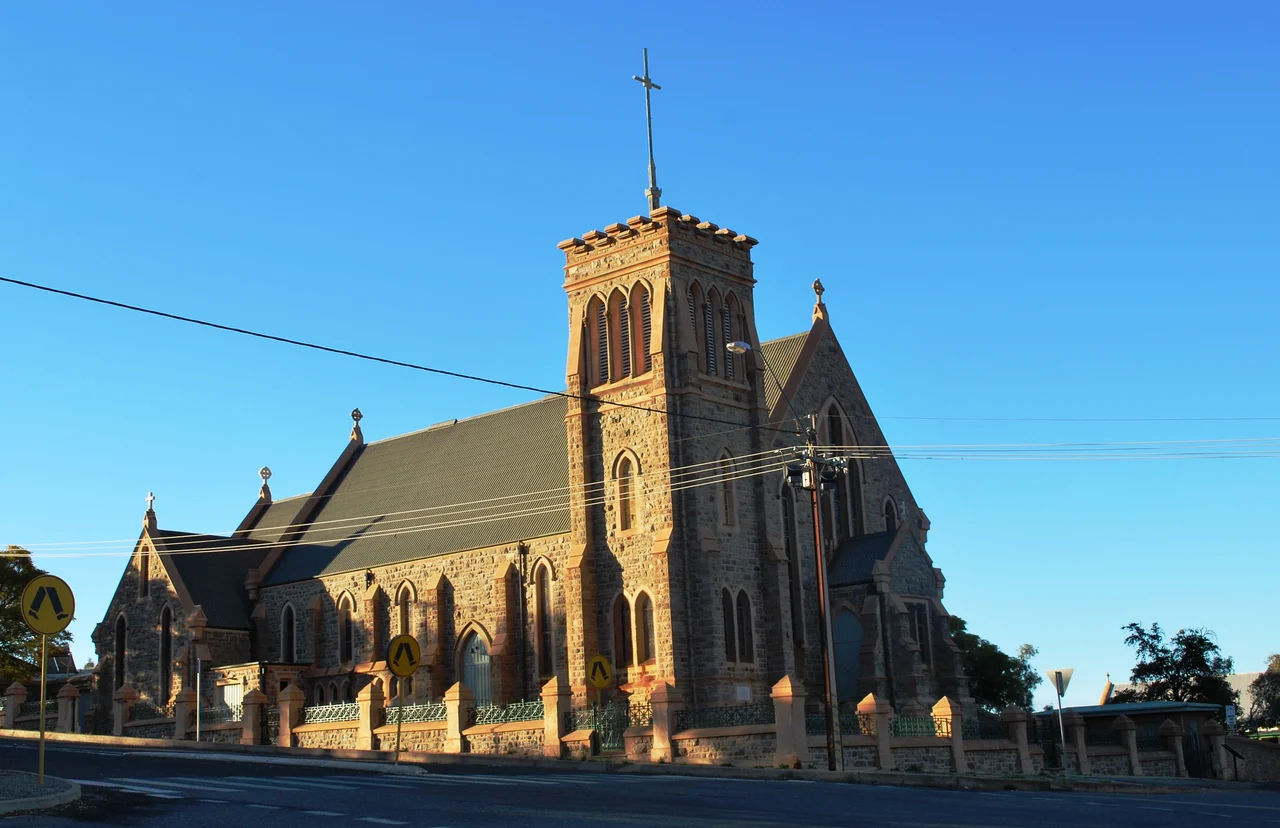

Sacred Heart Cathedral, Broken Hill
The stone that built this cathedral came out of the ground a few streets away, hauled up as waste from the silver mines that gave Broken Hill its reason to exist. The North mine donated its leftover quarry stone, and out of that rubble rose a Gothic cathedral. There is something fitting about it: in a city carved from a single mineralised ridge, even the house of worship is made of the mine. The Sacred Heart Cathedral is the seat of a Catholic diocese that sprawls across a slice of outback New South Wales bigger than many nations on Earth.
A Diocese Carved From the Outback
The Diocese of Wilcannia was created in 1887 by Pope Leo XIII, stitched together from land taken off three neighbouring dioceses — Armidale, Bathurst and Goulburn — to serve the scattered, remote settlements of the Far West. John Dunne was consecrated as its first bishop, charged with ministering across enormous distances of semi-arid country where a priest might ride for days between congregations. That same year, on 7 August 1887, a modest first church opened: Sacred Heart, built of iron and stone in a Gothic style behind the bishop's residence, and pressed into service as the young diocese's makeshift cathedral. The combination of materials was unusual — corrugated iron and quarried stone in the same Gothic frame, a frontier improvisation born of what the outback could supply. That little building still stands today, tucked behind the later cathedral and repurposed as a hall.
Eight Hundred Voices
By June 1903 the diocese had outgrown its iron church. More than 800 people gathered on the site to debate building something worthy — a true cathedral that could also serve as the city's parish church. The momentum was there, and so was the land: the Sisters of Mercy donated a corner of their convent grounds for it. The architect W. T. Knox was engaged to draw up the plans, working under Bishop Dunne's supervision. On 6 December 1903, the bishop laid the foundation stone. The new cathedral would take shape from the most local material imaginable — silver quarry stone, the rock left over from the surrounding silver mines, gifted to the diocese by the North mine of Broken Hill.
The Stone of the Mines
There is a quiet poetry in the building's fabric. Broken Hill exists because of what lies beneath it — one of the world's richest deposits of silver, lead and zinc — and the cathedral is literally built from the byproduct of digging it out. The men who extracted that ore lived hard, dangerous lives underground; the same stone they helped wrench from the earth was raised, on the surface, into arches and a tower meant to lift the eye toward something beyond the daily grind of the mine. In a company town defined by extraction, the cathedral turned waste rock into permanence.
Consecration on the Plains
Bishop Dunne opened and consecrated the completed cathedral on 2 July 1905, at a final cost of £7,000. Around 1,500 people packed in for the occasion — a remarkable crowd for a remote mining city — and the guests reflected how far the outback diocese had come: the Archbishop of Melbourne, Thomas Carr, and the Coadjutor Archbishop of Sydney, Michael Kelly, both travelled to be there. More than a century on, the cathedral remains the seat of the Bishop of Wilcannia-Forbes and the spiritual anchor of an immense, sparsely peopled diocese. It still stands on its convent corner, weathered silver stone against a hard blue outback sky, the most enduring thing the mines ever produced.
From the Air
Sacred Heart Cathedral sits at 31.953°S, 141.458°E in central Broken Hill, just north and west of the Argent Street commercial core and close beneath the Line of Lode ridge. From the air the cathedral's tower and steep roofline make it one of the more identifiable individual buildings in the city grid, with the mullock-heaped Line of Lode as the master landmark to the east and south. Recommended viewing altitude is 1,500 to 2,500 feet AGL; local field elevation is roughly 1,000 feet. Broken Hill Airport (YBHI) lies about 4 nautical miles to the southwest. Skies are usually clear with long visibility; expect heat haze on summer afternoons.
Nearby Stories
- Mount Gipps Station 5.4 km away
- Radium Hill 33 km away
- Honeymoon Uranium Mine 35 km away
- Menindee, New South Wales 44 km away
- Mutawintji National Park 64 km away
- Kinchega Woolshed 70 km away
- Kinchega National Park 86 km away
- Mount Chambers Gorge 178 km away