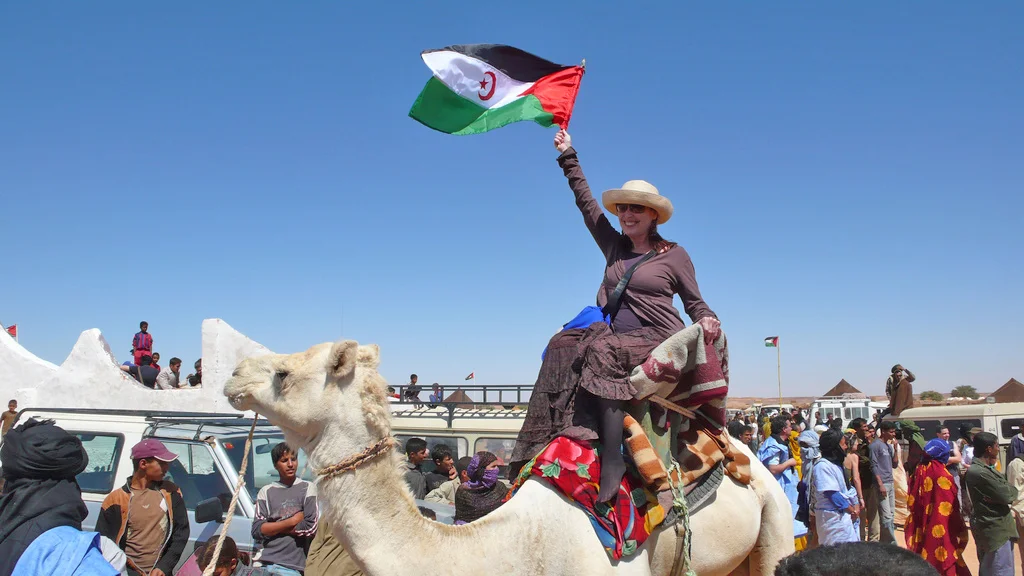

Sahara International Film Festival
The grand prize is not a statuette. It is a living, white female camel, and the audience that chooses the winner sits on the sand under the stars, in a refugee camp at the southwest edge of the Algerian desert. This is FiSahara, the Sahara International Film Festival, the only film festival in the world held in a refugee camp. Each spring it brings cinema, music, and the eyes of the outside world to the Sahrawi people, who have lived in exile here for more than four decades. The films flicker against a desert screen; beyond it stretches the homeland the audience cannot return to.
A Screen in the Sand
FiSahara was created in 2003 by Spanish civil society and the Sahrawis living in the camps, a partnership born of a long and largely forgotten conflict. When Spain decolonized Western Sahara in the mid-1970s and Morocco moved in, around 50,000 Indigenous Sahrawis fled into the harsh desert near Tindouf and built camps that became, against all expectation, permanent. The festival grew out of an old colonial bond turned to solidarity: Spain was the former colonial power, and Spanish donors and filmmakers became among the Sahrawis' most committed allies. The Peruvian director Javier Corcuera helped organize the first edition. The aim was never charity for its own sake. It was to entertain, to educate, and to break the silence around a people the world had stopped watching.
The White Camel
Most festivals hand the winner a trophy and a handshake. FiSahara gives a camel. The White Camel — al-Jamal al-Abyad — is the festival's top prize, and the audience itself decides who wins, voting for the best film. The prize is exactly what it sounds like: a white female camel, traditionally given to the refugee family who hosted the winning film's director or actors during the festival. The winner also takes home a trophy shaped like a white camel and a desert rose, the crystalline mineral formation that blooms beneath the Saharan sand. In a place where wealth has always been measured in livestock and hospitality, no prize could be more fitting, or more generous.
When the Stars Came to the Desert
The festival has drawn famous names willing to trade red carpets for sand. Spanish cinema sent some of its biggest stars — Penélope Cruz, Javier Bardem, Pedro Almodóvar — to lend their fame to the Sahrawi cause. Musicians came too, among them Manu Chao, Fermín Muguruza, Iván Ferreiro, El Chojin, and Tomasito, playing concerts under the open sky. In 2010 FiSahara forged a twinning agreement with the San Sebastián Human Rights Film Festival, linking the camps to one of Spain's established cultural institutions. But the celebrities were never the point. They were the megaphone. Each star who flew into the desert carried images of the camps back out to audiences who might otherwise never have known the Sahrawis existed.
More Than a Movie
FiSahara is film, but it is also workshops and round tables, camel races and a traditional Sahrawi cultural fair, concerts and activities for children who have known no home but the camps. For the families who host the visiting filmmakers, the festival is a few days when the world arrives at their door and treats them not as victims but as hosts, as people with a culture worth showing and a story worth telling. The Sahrawis call their struggle one of patience, and FiSahara is patience made visible: a community that has waited more than forty years for a referendum on its future, choosing each year to gather in the dark, watch the screen light up, and refuse to be forgotten.
From the Air
FiSahara takes place in the Sahrawi refugee camps near Tindouf in southwestern Algeria, in the broad area around 27.6°N, 8.1°W, close to the Western Sahara border. From the air the camps appear as sprawling low-rise settlements on flat, pale desert hardpan, with little vegetation and few landmarks. The nearest airport is Tindouf (DAOF), the gateway used by international festival delegations and the UN MINURSO mission. Terrain is open Saharan desert with excellent dry-weather visibility and frequent dust haze in harmattan conditions. Recommended viewing altitude FL200–FL300 for context of the camp clusters against the surrounding sand.
Nearby Stories
- Bir Lehlou 142 km away
- Erg Iguidi 193 km away
- Tifariti 245 km away
- Ait Benhaddou 350 km away
- Tiris Zemmour 388 km away
- Marrakech 410 km away
- Costa Teguise 475 km away
- Erg Chech 619 km away