
Bir Lehlou
On the night of February 27, 1976, a voice crackled across medium and short wave from a tiny oasis in the eastern desert of Western Sahara. It announced the birth of a country. The Sahrawi Arab Democratic Republic had no recognized borders, no foreign embassies, no army to speak of yet, and most of its claimed territory was already slipping under Moroccan control. But here at Bir Lehlou, where a well of sweet water gives the place its name, El-Ouali Mustapha Sayed proclaimed the republic into existence. He would be dead within months. The republic he declared still endures, and Bir Lehlou is where its story begins.
The Sweet Well
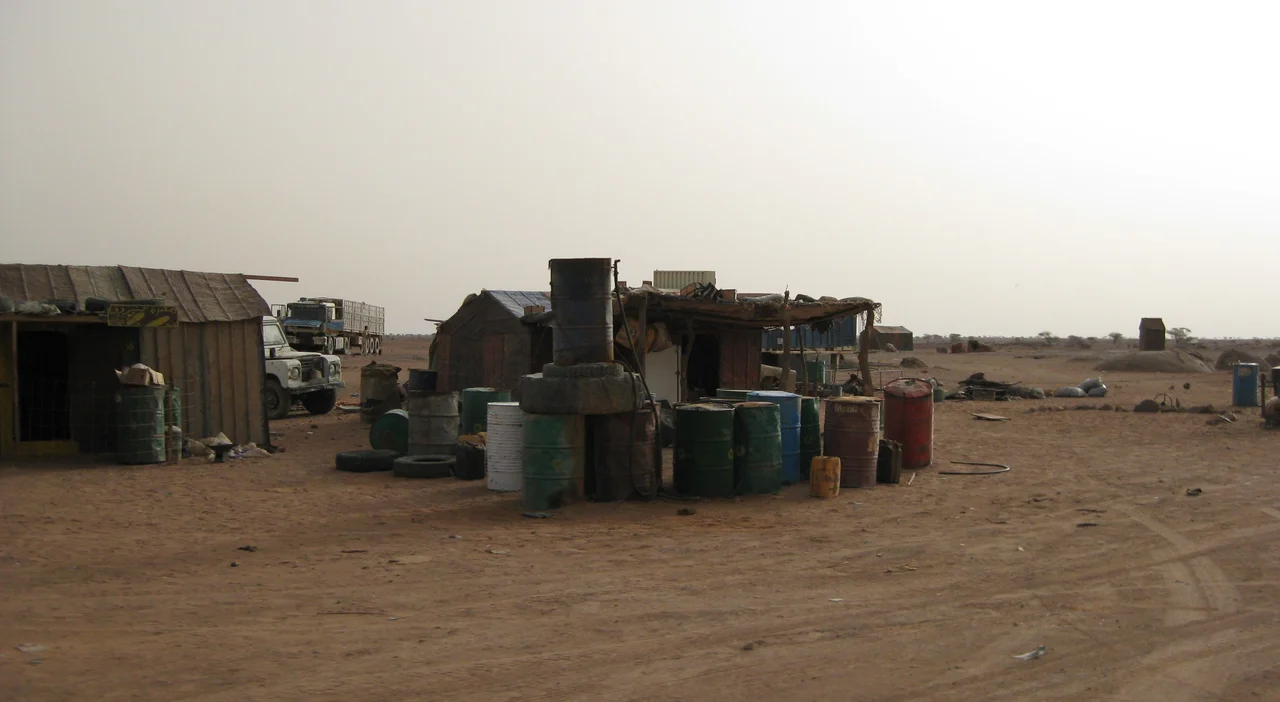
The name says what mattered most in the desert. "Bir Lehlou" comes from Maghrebi Arabic and means "the sweet water well" — sweet meaning drinkable, non-salty, the difference between life and death in a place this dry. For the Sahrawis, the nomadic people who have crossed this terrain for centuries, a well of good water was reason enough for a town. Today Bir Lehlou is a modest settlement of low buildings near the Mauritanian border, holding a pharmacy, a school, and a mosque. It sits east of the great sand-and-stone wall that Morocco built to divide the territory, in the zone the Polisario Front controls. For a few critical years, this unremarkable oasis carried an extraordinary weight.
A Republic Declared in Exile
Spain abandoned its Saharan colony in 1975, and almost at once Morocco and Mauritania moved to claim it. Tens of thousands of Sahrawis fled east into the Algerian desert near Tindouf, where they built refugee camps that still stand half a century later. Their leadership chose Bir Lehlou as the temporary capital of the new republic, to be held until the historic Sahrawi capital of El-Aaiún could be reclaimed. Here the SADR's National Secretariat gathered. Here, beginning in late 1975, the National Radio of the SADR broadcast across the airwaves in Hassaniya Arabic and in Spanish, a thin but defiant signal from a government that most of the world did not recognize. Bir Lehlou was the address of a nation that existed mostly in the hearts of its scattered people.
The Young Founder
El-Ouali Mustapha Sayed was not yet thirty when he proclaimed the republic. A co-founder of the Polisario Front and its driving force, he had spent his short adult life organizing resistance to colonial and then foreign rule. Some accounts name Bir Lehlou itself as his birthplace, binding the man to the town that announced his cause to the world. He served as the republic's first president for only a matter of weeks. In June 1976 he was killed during a raid deep inside Mauritania, becoming the movement's first and most enduring martyr. The republic he helped create kept his memory at its center, and the oasis where his declaration was read aloud became a place of pilgrimage and remembrance.
Anniversaries in the Desert
Long after the government's working capital moved to Tifariti in 2008, Bir Lehlou kept its symbolic role. The Sahrawis return here to mark their republic's birthday. In February 2010, the town hosted the 34th anniversary of the proclamation, with ambassadors from African and South American nations standing in the desert dust. Slowly, the place has filled in: a primary school opened in 2005, named for a Spanish colonel and historian who became the first foreigner granted honorary Sahrawi nationality; the school later gained an extension, and a new mosque, inaugurated during National Unity Day in 2011. The future presses in too. Climate scientists project that by mid-century this corner of the Sahara could grow hotter still, its weather coming to resemble present-day Kuwait. Bir Lehlou remains what it has always been — a well, a town, and a promise not yet kept.
From the Air
Bir Lehlou lies in north-eastern Western Sahara at roughly 26.35°N, 9.57°W, east of the Moroccan Western Sahara Wall and near the Mauritanian border, within Polisario-controlled territory. From the air it appears as a small cluster of low structures amid open Saharan desert — sparse, flat, with little vegetation and an oasis well at its heart. Terrain is heavily mine-affected in this border zone; this is for overflight observation only. Nearest significant airport is Tindouf, Algeria (DAOF) to the north-northeast, where the Sahrawi refugee camps and the UN MINURSO mission operate. Recommended viewing altitude FL200–FL300 in clear, dry conditions; expect dust haze during harmattan winds.
Nearby Stories
- Tifariti 40 km away
- Sahara International Film Festival 157 km away
- Sahrawi refugee camps 180 km away
- Tindouf 198 km away
- Tiris Zemmour 225 km away
- Tenoumer Crater 345 km away
- Costa Teguise 425 km away
- Tourine Ambush 456 km away