
Tindouf
Tindouf is the kind of place you reach only on purpose. It sits in the extreme southwest corner of Algeria, a Saharan town pressed up against the border with Western Sahara, and getting there overland means running a gauntlet of military checkpoints where you will be stopped, questioned, and asked for papers permitting you to be in the region at all. Few outsiders come. Those who do find something unusual: a town where the locals are a minority in their own home.
A Town Outnumbered
The arithmetic of Tindouf is startling. Of roughly 160,000 people in and around the town, only about 60,000 are native Algerians. The rest are Sahrawi refugees living in the camps that ring the town - a displaced population more than twice, perhaps three times, the size of the entire population living in the Polisario-controlled Free Zone of Western Sahara across the border. Tindouf and its surrounding camps form the base of the Polisario, the nationalist movement that has fought for an independent Sahrawi state for half a century, tolerated and quietly backed by Algeria. The result is a remote garrison town that doubles as the de facto capital of a nation in exile.
As Close as You Can Get
For anyone curious about Sahrawi culture, Tindouf is paradoxically the place to find it - because the homeland itself is sealed off. The Free Zone led by the Polisario lies behind a border barrier and vast minefields, a fortified line that separates it from the Moroccan-occupied parts of Western Sahara. The living, politicized Sahrawi culture is therefore concentrated not in Western Sahara at all, but here, in the camps outside an Algerian frontier town. It is culture in exile: the songs, the tea, the desert hospitality, all preserved and performed by a people waiting to go home.
Visiting the Camps
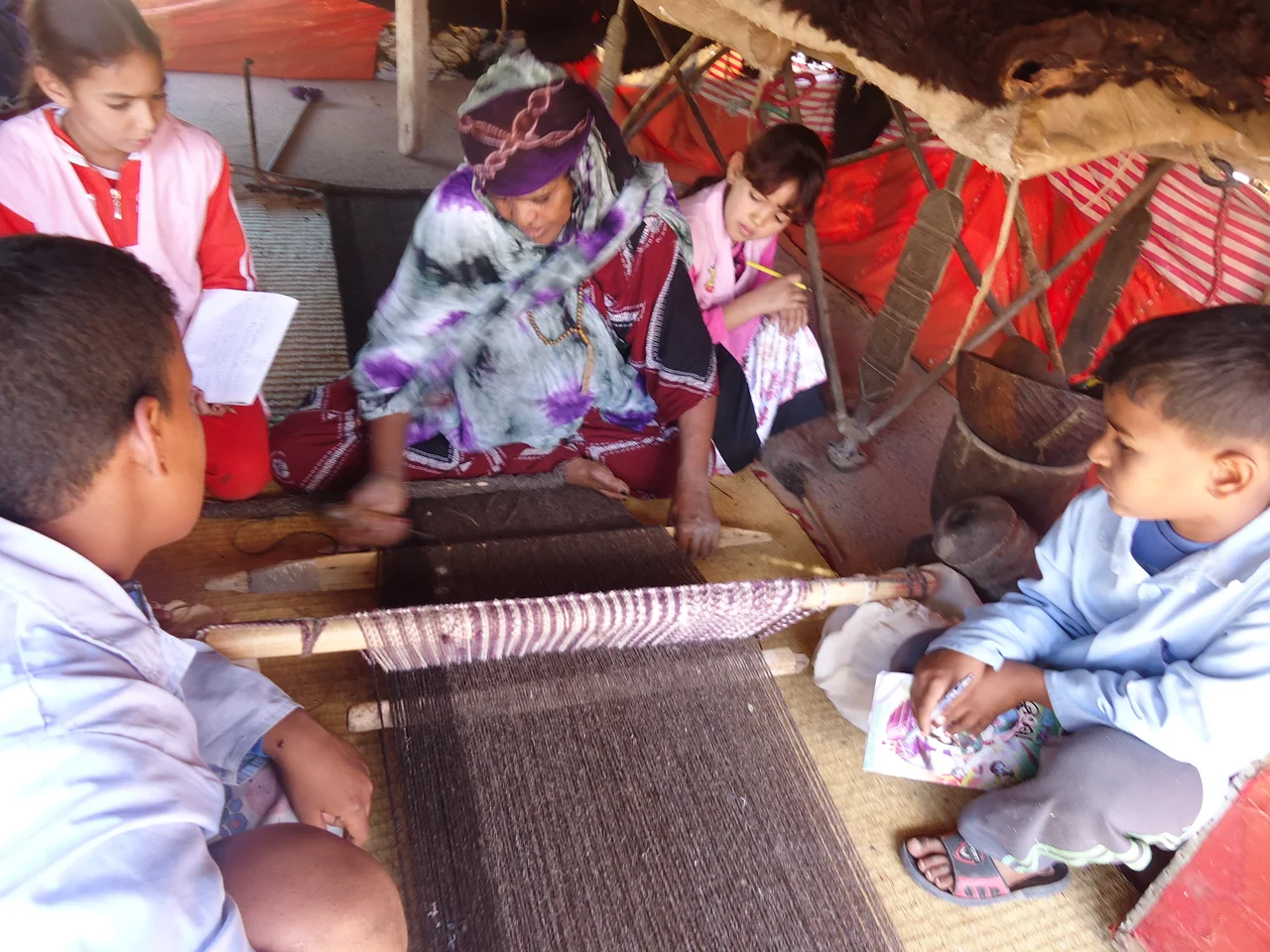
You do not simply wander into the camps. The Polisario, unofficially in charge of them, organizes the visits, and the most practical way in is to attend one of the cultural events held in the area - festivals that have, over the years, drawn international guests, including the occasional Spanish actor flying the Sahrawi flag in a gesture of solidarity. Organized trips typically bundle everything together: registration, a return flight from Madrid, the Algerian visa, local transport, meals, and - most memorably - accommodation with Sahrawi families. You sleep in their tents, drink their tea, and see the camps not as a spectacle but as someone's home.
The Long Way In
Reaching Tindouf is itself the adventure, and the warnings are not idle. Travelers who have made the overland drive describe it as a once-in-a-lifetime undertaking precisely because of the friction: the checkpoints, the documents, the sheer remoteness of a town sitting hundreds of kilometers from anywhere across open Sahara. This is not casual tourism. It is a deliberate journey to one of the most politically charged corners of North Africa, where a frozen conflict has shaped daily life for fifty years and where the desert's silence carries the weight of a still-unsettled question: who does this land belong to?
From the Air
Tindouf lies at 27.68°N, 8.13°W in extreme southwest Algeria, near the Western Sahara border. It is served by Tindouf Airport (DAOF). From altitude, look for the town and the grid-like Sahrawi refugee camps spread across the surrounding hammada plain, with the long Western Sahara border berm to the west. Conditions are typically clear with excellent visibility; blowing sand and extreme summer surface heat are the main concerns over otherwise featureless desert terrain.
Nearby Stories
- Bir Lehlou 142 km away
- Erg Iguidi 193 km away
- Tifariti 245 km away
- Ait Benhaddou 350 km away
- Tiris Zemmour 388 km away
- Marrakech 410 km away
- Costa Teguise 475 km away
- Erg Chech 619 km away