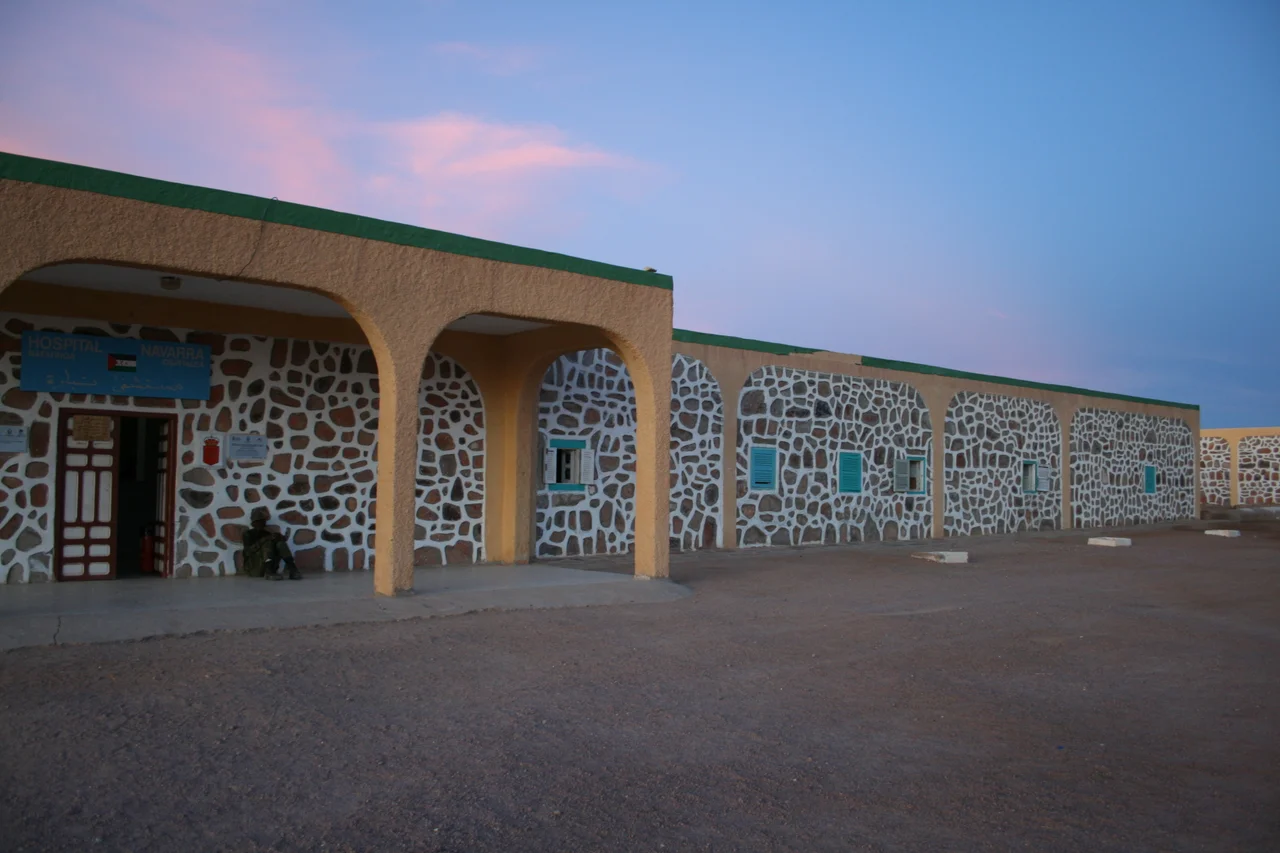

Tifariti
In August 1991, just weeks before a ceasefire was due to silence the guns, Moroccan aircraft came back to Tifariti and destroyed almost everything that aid workers had spent years building — the hospital, the wells, the administrative offices meant to welcome refugees home. Dozens of civilians were killed. The buildings had been raised in hope of a United Nations referendum that would let the Sahrawis choose their future. The referendum never came. And yet Tifariti did not stay a ruin. Today this oasis east of the Moroccan Wall serves as the working capital of the Sahrawi Arab Democratic Republic, rebuilt by a people who refuse to disappear.
Encampment at the Oasis
Before it was a capital, Tifariti was simply a good place to stop. The Sahrawis, a nomadic desert people who have controlled this terrain since medieval times, used the oasis as a seasonal camp, watering their herds and moving on. Fixed buildings were rare; the pastoral life left little reason to build in stone. The desert here is rugged and nearly bare of vegetation. In 1912 a French Foreign Legion column trying to reach its forces in Morocco was wiped out by Sahrawi fighters near Tifariti, an early sign that outsiders did not pass through this land unchallenged. The Spanish later turned the oasis into a forward desert outpost. By 1975, on the eve of war, around 7,000 people lived here.
The War Years
When Spain withdrew and Morocco advanced in 1975, Tifariti emptied. Refugees streamed past it on their way to the camps near Tindouf in Algeria; some accounts counted 15,000 Sahrawis gathered around the town in January 1976. The oasis changed hands more than once, occupied briefly by Moroccan forces, then retaken. Through the 1980s, Morocco built its great defensive wall — the Berm — to the north, and the ground around Tifariti was sown with mines. The legacy is lethal and lasting: scattered cluster munitions still lie in the sand, and Western Sahara remains among the most landmine-contaminated places on earth. The 1991 air raids that flattened the new hospital came as the war's last cruel act, days before the ceasefire took hold.
Rebuilt by Solidarity
What rose from the rubble was built with help from far away. The Navarra Hospital, named for the Spanish region whose solidarity groups funded it, opened in 1999, was evacuated in 2001 when war threatened to reignite, and reopened in 2006. Spanish provinces sent money and labor: a district of 150 homes called Solidarity Neighbourhood, inaugurated in 2007, was built with aid from Seville and Málaga. A mosque followed, then a town hall, a small dam, and the cornerstone of a sports complex funded by South Africa. The government quarter came to hold a parliament, a school, a hospital, a mosque, and a museum. In 2008 the SADR moved its working capital here from Bir Lehlou, and Tifariti became the everyday seat of a republic in exile.
Cinema, Art, and Stubborn Hope
A people can be defined by more than their displacement, and the Sahrawis have insisted on it. Since 2007 Tifariti has hosted ARTifariti, an international gathering where artists from many countries create work that stays in the town, in its museum or out in the open desert. A 300-kilometer bicycle race finishes here each year, its route running parallel to the wall that divides the land. There is even an amateur radio club, broadcasting under the call sign S01WS, treating Western Sahara as its own entity on the airwaves. Just northeast lies the Erqueyez Archaeological Park, where more than a hundred caves hold rock paintings and stone tools from the deep prehistoric past — proof that people have found meaning in this desert for thousands of years, long before any wall was drawn across it.
From the Air
Tifariti sits in north-eastern Western Sahara at roughly 26.16°N, 10.57°W, east of the Moroccan Berm in Polisario-controlled territory, about 138 km from Smara and 15 km north of the Mauritanian border. From altitude it appears as a small built-up government quarter amid stark, sparsely vegetated desert; a UN MINURSO airstrip lies nearby. The surrounding terrain is heavily mined — observe from the air only. Nearest major airport is Tindouf, Algeria (DAOF), some 320 km to the north, site of the Sahrawi refugee camps. Recommended viewing altitude FL200–FL300; visibility is excellent in dry weather but degrades sharply in harmattan dust.
Nearby Stories
- Bir Lehlou 69 km away
- Tiris Zemmour 237 km away
- Sahara International Film Festival 249 km away
- Sahrawi refugee camps 294 km away
- Tenoumer Crater 327 km away
- Costa Teguise 367 km away
- Tourine Ambush 385 km away
- Agounit 476 km away