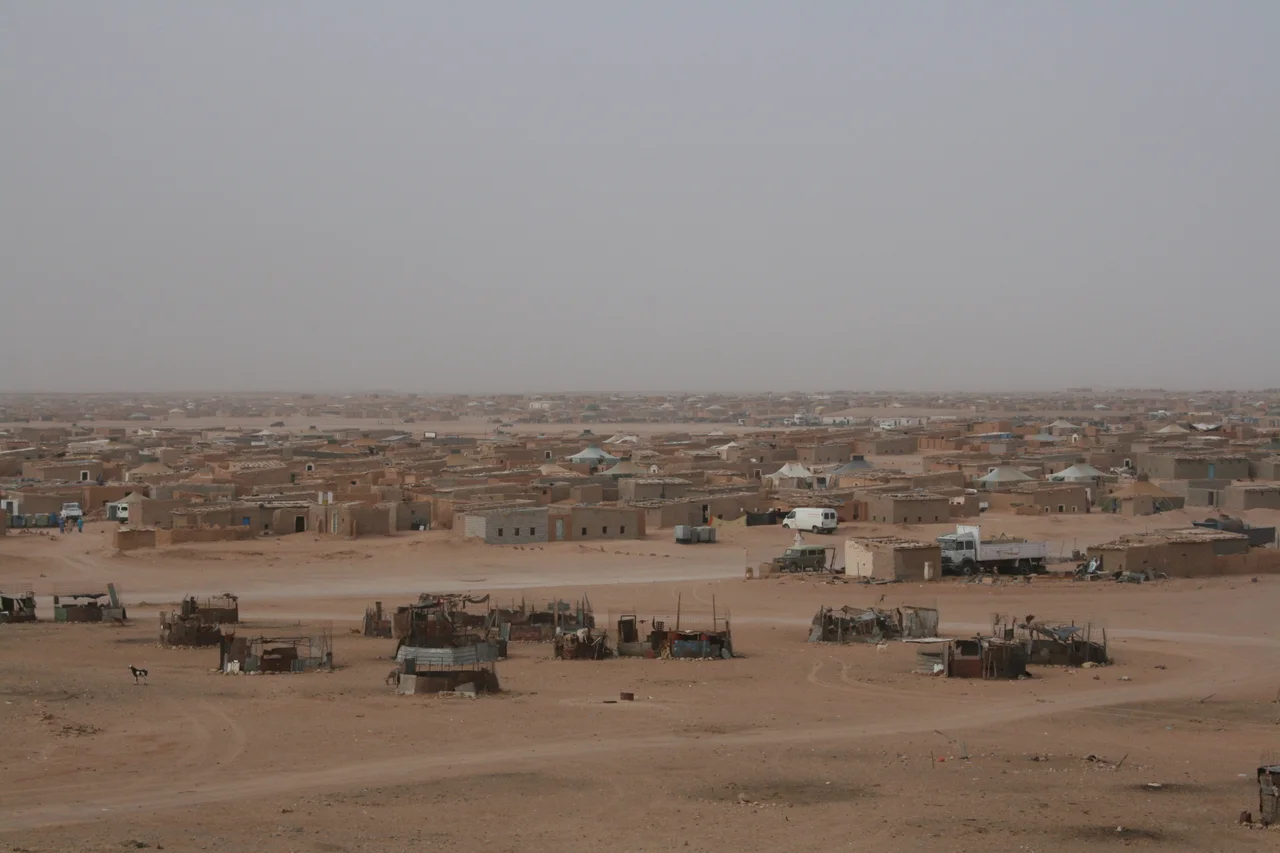

Sahrawi refugee camps
When the Sahrawi crossed the border into Algeria in the winter of 1975, fleeing the war in Western Sahara, they arrived at a place that offered them almost nothing. The Tindouf hammada is a flat, stony plain of the Sahara, treeless and waterless, where summer temperatures climb past 50 degrees and sandstorms can erase the horizon for days. The locals had a name for it: the Devil's Garden. The refugees were meant to stay a few months. They have now been there for fifty years.
A Country Made of Tents
What the Sahrawi did with that emptiness is the heart of the story. They did not simply wait to be rescued. They organized. The five main camps were named for the cities they had left behind in Western Sahara - Dakhla, El-Aaiun, Smara, Awserd, Bojador - so that the map of home was rebuilt in exile. Around the administrative center at Rabouni, the Polisario Front declared the Sahrawi Arab Democratic Republic in February 1976 and set about building the apparatus of a state: a parliament, courts, a police force, schools, and hospitals. Over the decades the camps acquired kindergartens and clinics, even a film school and an arts academy, and most were eventually wired to the electricity grid. It is one of the only places on Earth where an entire government lives as refugees on someone else's land.
The Women Who Ran the Camps
During the war years, from 1975 to 1991, the men went to the front. The camps were left to the women, and the women ran them. They administered the rations, built the schools, staffed the clinics, and governed daily life across a scattered desert society - work that built on a status Sahrawi women had long held in their pre-colonial culture and deepened it. That legacy endures. Education has been a particular point of pride; young Sahrawi have studied at universities abroad, in Algeria, Spain, even Cuba. In 2023 the BBC named the Sahrawi educator and activist Najla Mohamed-Lamin to its list of the world's 100 most influential women - a reminder that this is a community that produces leaders, not just statistics.
Living on the Edge of Possible
Survival here is genuinely precarious. Little or nothing grows; firewood has to be fetched by car from tens of kilometers away. Only some camps have water, and what there is often is neither clean nor plentiful. Food, drinking water, building materials, and clothing all arrive by truck, brought in by international agencies - the World Food Programme, UNHCR, Oxfam, the European Commission's humanitarian arm. The Commission has called the Sahrawi the 'forgotten refugees,' and the phrase stings precisely because it is fair: the world's attention has moved on many times over while the camps remain. When floods tore through the camps in 2006, the homes that dissolved were made partly of the same mud and brick the desert grudgingly allows.
An Economy Improvised
A small cash economy began to stir in the 1990s. Spain started paying pensions to Sahrawi who had been conscripted into its colonial Tropas Nomadas, and money trickled in from relatives working in Algeria and abroad and from families keeping the old Bedouin and Tuareg way of life, herding across Algeria, Mauritania, and the Polisario-held interior of Western Sahara. The Polisario has insisted on hiring locally for building and teaching rather than importing outside labor, arguing that work itself is what keeps a stranded population from sliding into hopelessness. Still, jobs are scarce, and Sahrawi graduates often return from foreign universities to find no place to use what they learned. The private economy stays thin; the camps run, as they always have, mostly on aid.
Still Waiting
The reason the Sahrawi cannot simply go home is the unresolved status of Western Sahara, claimed by both Morocco, which controls most of the territory, and the Polisario, whose self-declared republic holds a thin eastern strip. Between the two runs one of the longest defensive barriers on the planet, a sand berm flanked by minefields. A 1991 ceasefire promised a referendum on independence that has never been held. So the waiting continues, now into a third generation - children born in the camps who have never seen the Atlantic coast their parents describe. Poets among them, like Hadjatu Aliat Swelm, write the longing down. The Devil's Garden was supposed to be temporary. The dignity the Sahrawi have built there is not.
From the Air
The camps cluster on the hammada southeast of Tindouf, Algeria, near 27.60°N, 8.10°W, with the administrative center of Rabouni about 25 km from Tindouf town. The nearest airport is Tindouf (DAOF). From altitude, look for the grid-like clusters of low structures on an otherwise featureless tan plain near the Western Sahara border. Conditions are typically clear with long visibility, but blowing sand and extreme summer surface heat are common; the terrain offers few visual references.
Nearby Stories
- Bir Lehlou 142 km away
- Erg Iguidi 193 km away
- Tifariti 245 km away
- Ait Benhaddou 350 km away
- Tiris Zemmour 388 km away
- Marrakech 410 km away
- Costa Teguise 475 km away
- Erg Chech 619 km away