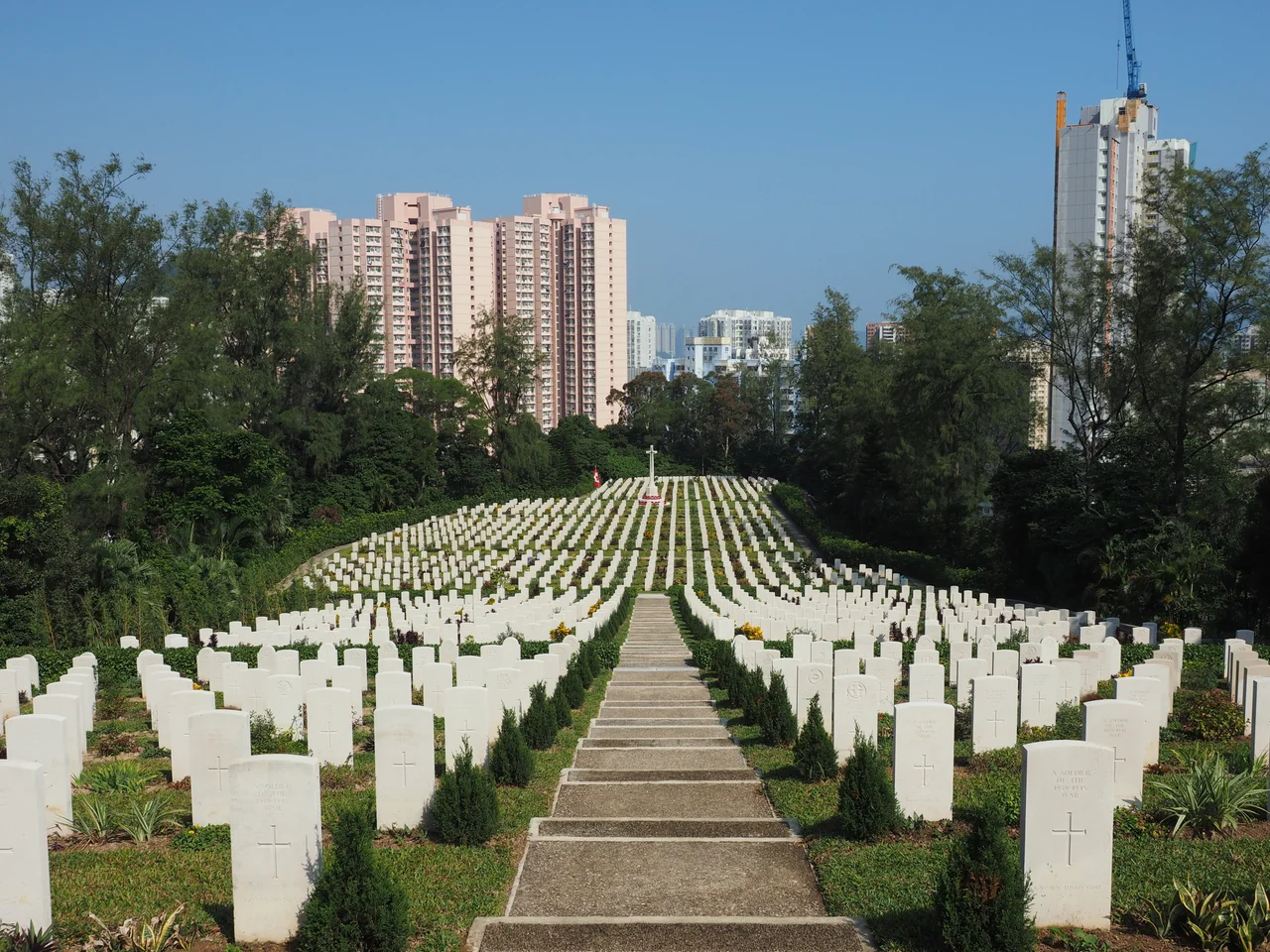

Sai Wan War Cemetery
The inscription above the Cross of Sacrifice is from the Book of Sirach: "Their name liveth for evermore." It is not a boast. It is a promise. On the north slope of Mount Collinson, in a carefully tended garden overlooking what was once the narrows of Lei Yue Mun, that promise is kept for 1,528 men who died defending Hong Kong in December 1941 — or who survived the battle only to die in captivity, disease, or on transport ships crossing a dangerous sea. Sai Wan War Cemetery is the largest of Hong Kong's Commonwealth war cemeteries, and among the most quietly devastating.
Eighteen Days
The attack began on 8 December 1941, less than eight hours after the strike on Pearl Harbor. Japanese forces crossed the Sham Chun River from Shenzhen and poured into Hong Kong's New Territories. The British War Office had privately concluded the colony was militarily undefendable. The garrison was ordered to fight anyway.
Six infantry battalions held the line — British, Canadian, Indian, and a small contingent of Australian troops. The defenders included the 5/7th Battalion of the Rajput Regiment, which suffered the heaviest casualties of any battalion in the battle: 156 killed or died of wounds, 113 missing, 193 wounded. The 2/14th Punjab Regiment lost 55 dead and 69 missing. The Hong Kong and Singapore Royal Artillery, raised from troops across undivided India, lost 144 killed.
Fighting crossed onto Hong Kong Island on the night of 18 December, when Japanese forces crossed the harbour through Lei Yue Mun — the same passage visible, on clear days, from the cemetery's upper slopes. That same night, 20 gunners at the Sai Wan Battery were massacred. Intense combat at Wong Nai Chung Gap, Mount Butler, and Stanley Fort continued until Christmas Day, when the British surrendered. The occupation would last nearly four years.
Known Unto God
The cemetery was built in 1946 and has been maintained by the Commonwealth War Graves Commission since 1953, on land leased for that purpose. Its layout follows the contours of the hillside: British graves at the uppermost level, Canadian and Dutch graves in the middle, and the graves of soldiers from undivided India on the lower slopes — a geography that reflects the multinational reality of the garrison.
Of the 1,528 commemorated here, 444 burials are unidentified. Their headstones carry only the words: "Known Unto God." The phrase, chosen by Rudyard Kipling for the CWGC, is not evasion — it is acknowledgment. These men are not anonymous to history. They simply could not be individually named.
A separate cremation memorial bears panels inscribed with the names of 144 British Indian Army soldiers whose remains were cremated according to their religious customs. The Sai Wan (China) Memorial commemorates 72 casualties of both World Wars whose graves in mainland China could not be maintained. Twenty local Hong Kong soldiers and eight civilians are also buried here. The cemetery holds the graves of 228 Canadians. Dutch servicemen — 77 war graves — rest alongside them.
The Men Behind the Names
Brigadier John K. Lawson, the highest-ranking Allied officer killed in the Battle of Hong Kong, is buried here. He died at his command post at Wong Nai Chung Gap on 19 December 1941, overrun by Japanese forces. During the occupation, Japanese soldiers buried him at the site where he fell. After the war, his remains were reinterred at Sai Wan.
Also buried here are Major General Lancelot Ernest Dennys and Major General Merton Beckwith-Smith, who died in captivity. Their rank reflects a hard truth about this battle: survival did not guarantee safety. Many of the men who endured the fighting succumbed afterward — to disease in prisoner-of-war camps in Hong Kong and Japan, to drowning during transport across dangerous seas, to execution, to maltreatment that ground away at health over months and years.
Company Sergeant-Major John Robert Osborn, who was awarded the Victoria Cross for his actions during the battle — throwing himself on a grenade to save fellow soldiers — has no grave here. His name is engraved on the memorial hall. He died on 19 December 1941 at Mount Butler, killed instantly by the grenade that he sacrificed himself to contain. The Cross of Sacrifice stands at the center of the cemetery as a landmark. Both the cemetery and memorial were designed by architect Colin St Clair Oakes.
A Wall of Flowering Shrubs
The physical experience of Sai Wan is quiet in a way that requires some effort to locate. The cemetery sits above Chai Wan on Cape Collinson Road, surrounded by a wall of flowering shrubs and bushes. Storm-water drainage channels run the length of the property. The stone steps descend from the Altar of Remembrance at the top through a central aisle toward the Cross of Sacrifice, the rows of white granite headstones arranged on either side.
Modern high-rises in Chai Wan have closed the view toward the harbour that once gave this hillside its awful relevance — on a clear day, only Kowloon is visible across the water. But the geography still carries meaning. The narrow passage of Lei Yue Mun, just visible to the north, is where the Japanese crossed on the night that decided the campaign. The men buried on this slope knew this landscape. Some of them died on it.
The CWGC maintains the site with characteristic precision: the grass is cut, the headstones are upright, the panels in the memorial hall are legible. Nearby are the Holy Cross Roman Catholic Cemetery, the Hong Kong Military Cemetery, and the Cape Collinson Muslim and Buddhist Cemeteries — a cluster of memorial spaces on the edge of the city, keeping company with the dead.
More Than the Commonwealth
Sai Wan is primarily a Commonwealth cemetery, but its scope extends further. The panels at the memorial hall entrance carry the names of more than 2,000 servicemen — those who died in the Battle of Hong Kong or subsequently in captivity and have no known grave. Special memorials commemorate 16 World War II casualties from a Kowloon Muslim cemetery whose graves were lost to urban redevelopment. Graves from two other Muslim cemeteries, lost over decades, are also represented here.
POWs who died in Taiwan, far from Hong Kong, were brought to Sai Wan for burial. The cemetery contains 12 World War I burials as well — soldiers from an earlier war, gathered here in this later grief. It is, in the end, a place of convergence: different faiths, different nations, different fates, all arriving at the same hillside above the same harbour, their names kept by an institution whose sole purpose is to ensure that no Commonwealth soldier buried abroad is forgotten. That commitment, made in the aftermath of one world war and renewed after a second, is itself a kind of monument.
From the Air
Sai Wan War Cemetery sits at approximately 22.259°N, 114.234°E on the north slope of Mount Collinson, near Cape Collinson on the northeastern tip of Hong Kong Island. Flying from Hong Kong International Airport (VHHH) eastbound at 1,500–2,000 feet, follow the southern coast of Hong Kong Island. The cemetery is visible as a rectangular walled enclosure of white headstones on the hillside above Chai Wan, just west of Cape Collinson. The Lei Yue Mun narrows — the passage the Japanese crossed on 18 December 1941 — are directly to the north. The Pottinger Peak ridge provides a useful landmark; the cemetery lies on its western slope. Visibility is best in winter and early spring when the subtropical haze is lower.
Nearby Stories
- Lok Ma Chau Loop 2.3 km away
- Portas do Cerco 2.3 km away
- Kweilin Incident 17 km away
- Wanshan Archipelago Campaign 34 km away
- Nanxiong Formation 115 km away
- Battle of Nanpeng Island 148 km away
- Heyuan 169 km away
- Cape Maobitou 632 km away