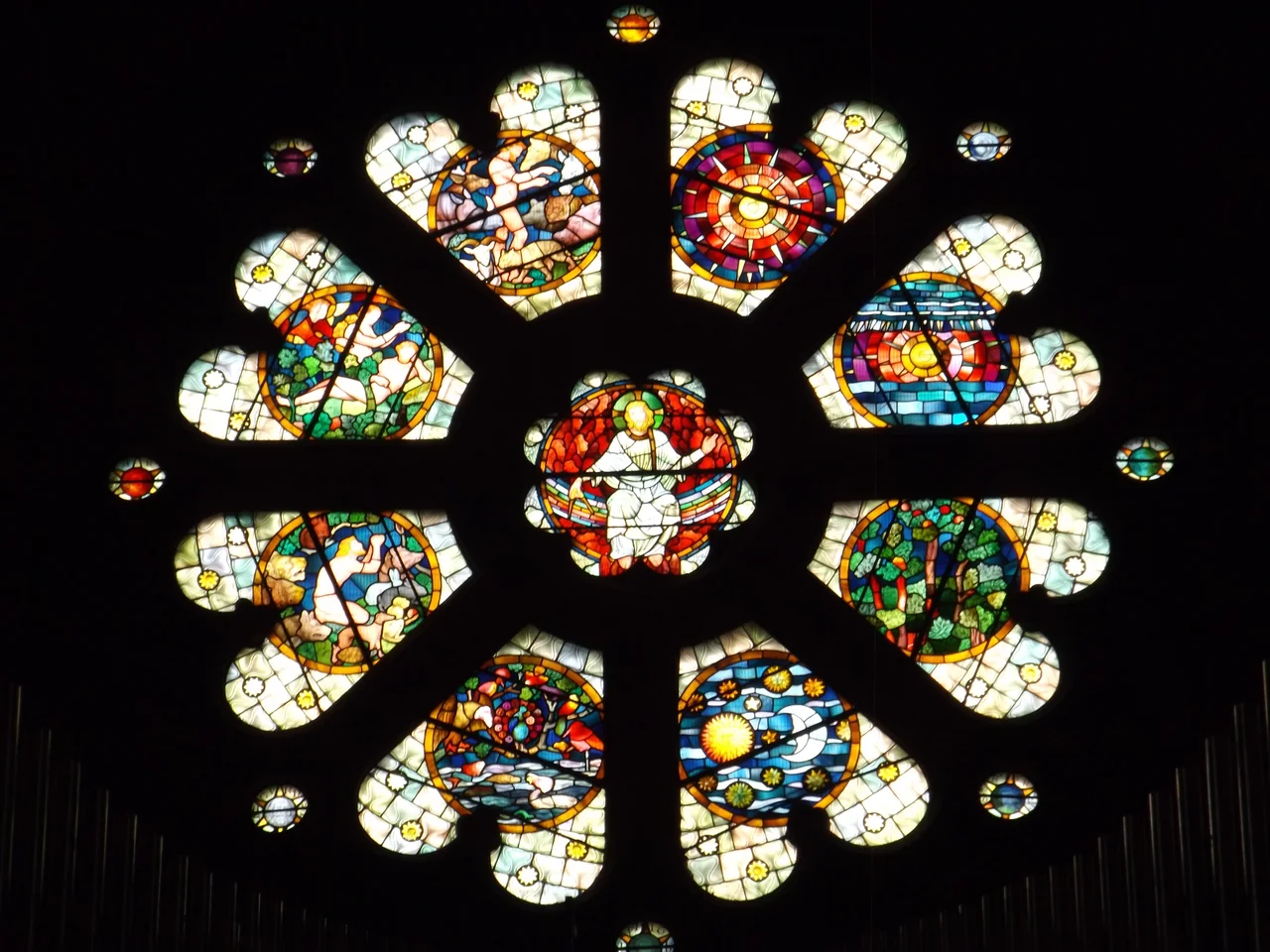

Saint Fin Barre's Cathedral
On the south spire stands an angel with a golden trumpet, watching over Cork city. The local belief is that when the angel raises its second trumpet to its lips and blows, the world will end. The architect William Burges almost certainly intended no such thing - he was illustrating the Book of Revelation, not predicting it - but the city has chosen to enjoy the story anyway. Cork, after all, is a city that has always preferred the version with the better punchline. When vandals broke the trumpets off in 1999, the cathedral made sure the restoration was a civic event. The world, for now, gets to keep going.
Got Cork!
In February 1863, a thirty-five-year-old Victorian architect named William Burges opened the post and wrote two words in his diary: "Got Cork!" He had just won the competition to design the first new cathedral built in the British Isles since Sir Christopher Wren's St Paul's. He had also blown the budget. The Church of Ireland had set £15,000 as the cap; Burges submitted a design he calculated would cost at least double, and went on to spend over £100,000 before he was done. Rival architects protested. The committee chose him anyway. They had seen the drawings - three slender spires rising from a building no larger than a parish church, conjuring monumentality from limited means - and understood that economy was not what they were buying. They were buying a cathedral that could stand alongside the great Gothic churches of France. They got one.
Holy Island
Christians have prayed on this patch of ground for fourteen centuries. The site sits on what was once an inlet in the Great Marsh of Munster - Corcach Mor na Mumhan, the name from which the city takes its own. Around 600 AD, Finbarr, the hermit-monk of Gougane Barra in the western mountains, is said to have come down from his lake and laid the foundation of a small monastery here. A round tower stood on the site by the 7th century. A 1644 visitor described an old tower more than a hundred feet high, attributed by tradition to the saint himself. In 1690 a 24-pound cannonball fired from nearby Elizabeth Fort during the siege of Cork crashed into the medieval church; the cannonball was rediscovered during the 1865 demolition and now sits inside the cathedral like a relic of the city's older quarrels. The Doric replacement church built in 1735 was so unloved that one critic called it "a shabby apology for a cathedral which has long disgraced Cork." The Victorians had had enough.
Burges in stone and glass
Burges treated Saint Fin Barre's as a complete artistic universe. He designed not only the building but the mosaic floor, the altar, the pulpit, the bishop's throne, the stained glass schemes, the carved tympanum showing the Resurrection, the dozens of biblical figures flanking the entrances - even the planned furniture for centuries he would never see. Sculptor Thomas Nicholls modelled the gargoyles, paid £1,769 for his work. Robert McLeod was paid £5,153 for the carving. Burges himself took ten per cent for design, double his usual fee, because he involved himself in every choice. The shell of the building is local limestone from Little Island and Fermoy; the interior walls are Bath stone; the red marble columns came from Little Island, the purple-brown stone from Fermoy. When Burges died in 1881, the cathedral had been consecrated for eleven years but was still unfinished. Workmen kept building from his notebooks - the Book of Furniture, the Book of Designs - into the twentieth century. The 1915 chapter house was built to specifications Burges had drafted four decades earlier.
The angel and the trumpet
High on the south side stands a gilded angel holding two trumpets. It is the resurrection angel from the Book of Revelation, awaiting the moment to blow the seventh trumpet that signals the end of days. Cork takes a quiet pride in being one of the few cities to have an officially designated agent of the apocalypse on its skyline. In 1999, vandals broke off the trumpets. The restoration, completed as part of a £5 million programme at the turn of the century, was treated by Corkonians as the recovery of something between a saint's relic and a piece of municipal furniture. The angel is now back at full strength. The diocese, asked occasionally about the legend, points out that Burges intended biblical scholarship, not eschatological forecasting. The city smiles, nods, and continues to keep an eye on the trumpets just in case.
What rings in Cork
Listen on a Sunday morning and you will hear a ring of thirteen bells, the heaviest cast in Gloucester in 1751 by Abel Rudhall and the lightest added only in 2008. The northwestern tower holds twelve bells in a diatonic ring, plus a sharp second bell tuned for an additional eight. When the original cathedral was demolished, the bells were taken down, then hung again before consecration - but the spires weren't finished yet, so for years they couldn't be properly rung. A 1902 appeal raised the money to hang them higher. The current organ, with its 4,500 pipes and a 32-foot pedal trombone, was reconstructed by Trevor Crowe in a €1.2 million project completed in 2013. Each of the three spires is crowned by a Celtic cross - a touch insisted upon by the building committee against Burges's wishes, an implicit statement that this Anglican cathedral belonged to Ireland as much as to England. The crosses won. The world keeps turning. The angel still hasn't blown its trumpet.
From the Air
Saint Fin Barre's Cathedral stands at 51.8944 N, 8.4806 W on the south bank of the River Lee, immediately south of central Cork. The three Gothic spires - two on the west front and one over the crossing - are the dominant skyline marker of the south side of the city, visible for miles. From cruising altitude in clear weather the cathedral reads as a slender vertical mass set against the bend of the river, with Elizabeth Fort half a kilometre to the east. Cork Airport (EICK) lies 7 km south of the cathedral; Shannon (EINN) is roughly 110 km north. Recommended sightseeing altitudes are 1,500-3,000 ft AGL for spire detail.
Nearby Stories
- Ballyvourney 1.6 km away
- Castlemartyr 3.9 km away
- Ballybeg Priory 4.1 km away
- Kilbrittain 5.2 km away
- Shanbally Castle 10 km away
- Skibbereen 17 km away
- Castleisland 22 km away
- SM U-27 118 km away