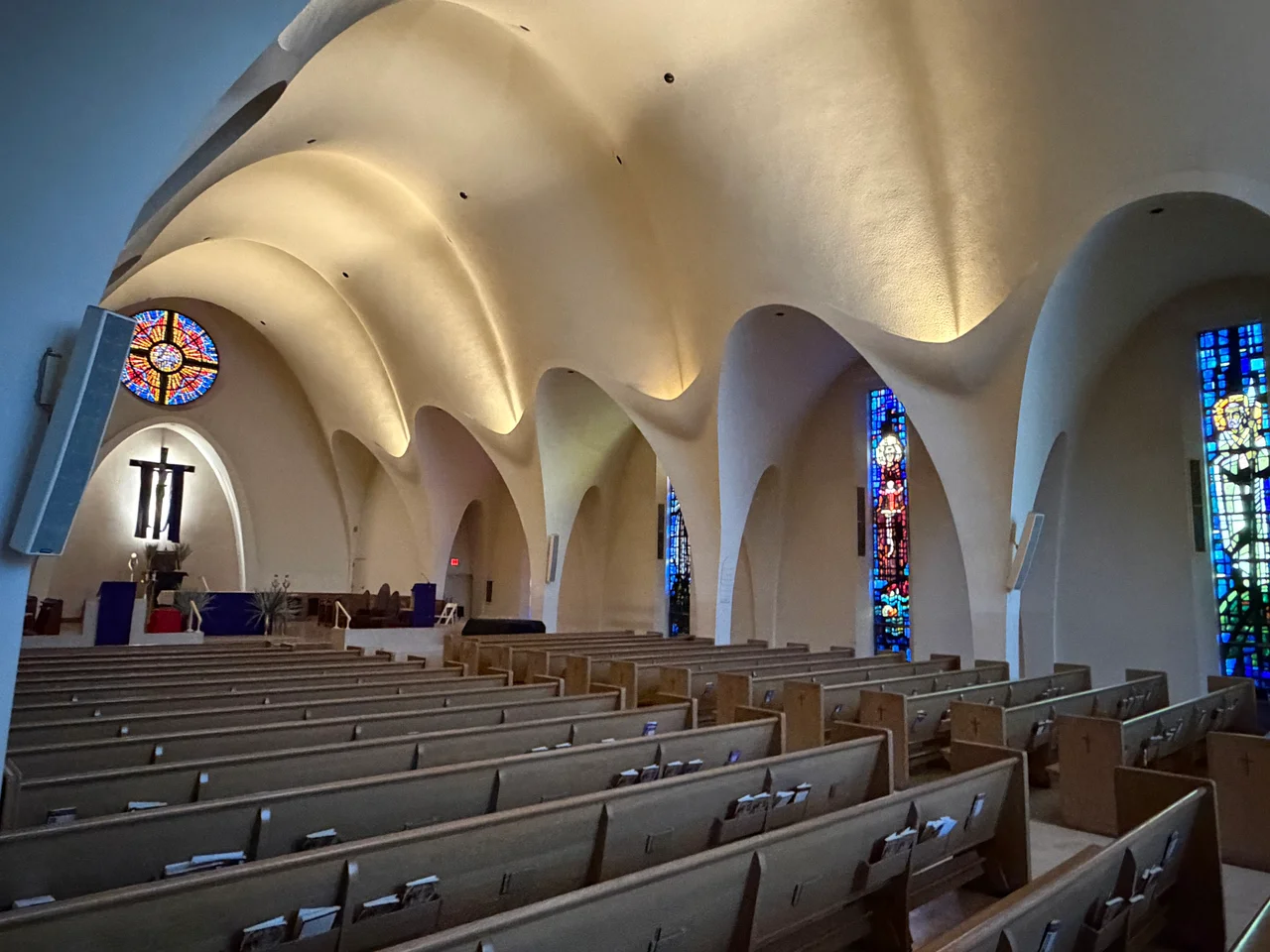

Saint Stephen Martyr Catholic Church (Washington, D.C.)
At 10:30 on the night of November 22, 1963, the telephone rang at the rectory of Saint Stephen Martyr Catholic Church on Pennsylvania Avenue NW. The caller was Ralph Dungan, special assistant to the president, and he needed candlesticks. By morning, President Kennedy's body would lie in repose in the East Room of the White House, and the staff hurriedly assembling the catafalque needed four large wooden candlesticks and two prie-dieux for the priests who would maintain a vigil through the night. Father John Wintermyer, an assistant pastor, said yes. The candlesticks and the kneelers were driven over from the parish where Kennedy regularly attended Mass during his presidency. They flanked the closed coffin in every photograph taken in the East Room that weekend. In January 1964, the White House sent six small bronze plaques back, to be affixed in commemoration. The parish keeps them still.
A West End Parish
Saint Stephen's was founded on August 4, 1867, the ninth Catholic parish in a city whose Catholic population was growing faster than its churches could be built. Reverend C.I. White of St. Matthew's bought a corner lot at 24th Street and Pennsylvania Avenue from a Dr. Newman for $8,575 and began raising money to put a building on it. Adolf Cluss - the German-born architect responsible for some of Washington's most distinctive Victorian buildings, including the Smithsonian Arts and Industries Building and the original Eastern Market - designed the red brick original. The cornerstone went down on June 3, 1866; the basement hosted its first Mass on October 27, 1867; and the consecrated church opened on December 27, 1868. The parish school for boys opened in 1872 with about fifty pupils aged five to thirteen.
The Kennedy Pew
John and Jacqueline Kennedy attended Mass at Saint Stephen's regularly during his presidency, drawn by its convenience to the White House and the comparative privacy a parish church offered compared to St. Matthew's Cathedral. After the assassination, the Catholic War Veterans of the District of Columbia mounted a bronze plaque on the pew Kennedy used. On the afternoon of November 22, 1963 - the news from Dallas had broken over the radio shortly after 1:30 p.m. Eastern - Monsignor Joseph Denges began tolling the church bells, making Saint Stephen Martyr one of the first churches in Washington to do so. Father Duffy led Bible readings at four o'clock. The regular six-thirty Mass that evening, hastily reframed as a Requiem for the repose of Kennedy's soul, drew about 400 people. It was, the parish history notes, the first Mass said at Saint Stephen's in which the priest faced the congregation - an early local appearance of a liturgical change the Second Vatican Council had just authorized.
Parabolic Vaults
The current building is not the brick church of 1868. By the late 1950s the Cluss structure had grown unsafe; in the spring of 1959 part of the ceiling collapsed after a load-bearing pillar failed, and structural engineers concluded that reinforcement would only postpone the inevitable. The parish, by then 2,500 members strong, said its last Mass in the old church on July 15, 1959, and the new modernist building was consecrated on June 11, 1961. The Washington Post's longtime architecture critic Benjamin Forgey would later call it 'semi-heroic,' singling out the chipped-glass window and what he described as 'the sanctuary formed with a succession of fluid parabolic vaults.' The building feels nothing like Cluss's brick predecessor. The vaults sweep overhead in concrete curves; the chipped glass scatters light in fragments; the modernism is unapologetic and very much of its moment - the moment when the parish that would soon receive the president for Mass was preparing the building that would receive him in death.
The Visco Doors
On November 20, 2011, Auxiliary Bishop Barry Knestout blessed the new main doors of Saint Stephen Martyr as workers installed them. The doors, designed by Philadelphia artist Anthony Visco, are oak with three bronze panels. The central panel depicts the stoning of Stephen, the deacon whose death made him the first Christian martyr. One side panel shows Stephen's ordination as a deacon by the apostles. The other shows the conversion of Paul - the Pharisee who, according to the Acts of the Apostles, watched approvingly as the crowd hurled stones at Stephen, and who within months would experience the road-to-Damascus vision that turned him into Christianity's most influential missionary. The doors were the centerpiece of the parish's celebration of the new building's fiftieth anniversary. Two stories about transformations of violence into faith - Stephen's at the moment of his death, Paul's a few weeks later - now face Pennsylvania Avenue, half a mile from the White House.
A Long Quiet History
Aside from the Kennedy weekend, Saint Stephen's history reads like that of most American Catholic parishes - a long succession of priests, debts paid down and incurred again, school openings and closings. Father McNally, the first pastor, served twenty-two years and died of a stroke in 1889 with the church carrying significant debt. Father Gloyd melted parishioners' gold and silver jewelry into a solid gold chalice. Father Cassidy, made a monsignor by Pius XI in 1924, lost a leg to obliterating endarteritis at Georgetown University Hospital in 1925 and died less than a year later. The parish school opened in 1872, closed in 1879, reopened later, and was finally sold to the Daughters of Charity in 1954. What distinguishes Saint Stephen Martyr is not architectural grandeur or great wealth but the historical accident that placed it within easy driving distance of the White House at a moment when a Catholic president needed a parish church - and, on one autumn weekend, four candlesticks.
From the Air
Saint Stephen Martyr Catholic Church sits at 38.9032 degrees N, 77.0530 degrees W, at 2436 Pennsylvania Avenue NW, in the West End neighborhood between Georgetown and Foggy Bottom. From the air the parish reads as a modest mid-twentieth-century building with a low parabolic-vaulted roof, set back from Pennsylvania Avenue just south of Washington Circle. Best viewed at 1,500 to 2,500 feet AGL in clear conditions; the entire site lies within the Washington FRZ and the prohibited area P-56A. Nearest airports are Ronald Reagan Washington National (KDCA) 3 nm south, College Park (KCGS) 8 nm northeast, and Washington Dulles (KIAD) 22 nm west.
Nearby Stories
- Gunston Hall 1.1 km away
- 2023 Baltimore Shooting 4.9 km away
- Battle of Middleburg 6.6 km away
- Crownsville Hospital Center 10 km away
- Battle of Loudoun Heights 13 km away
- First Battle of Rappahannock Station 20 km away
- Howard County, Maryland 21 km away
- Harriet Tubman Underground Railroad 50 km away