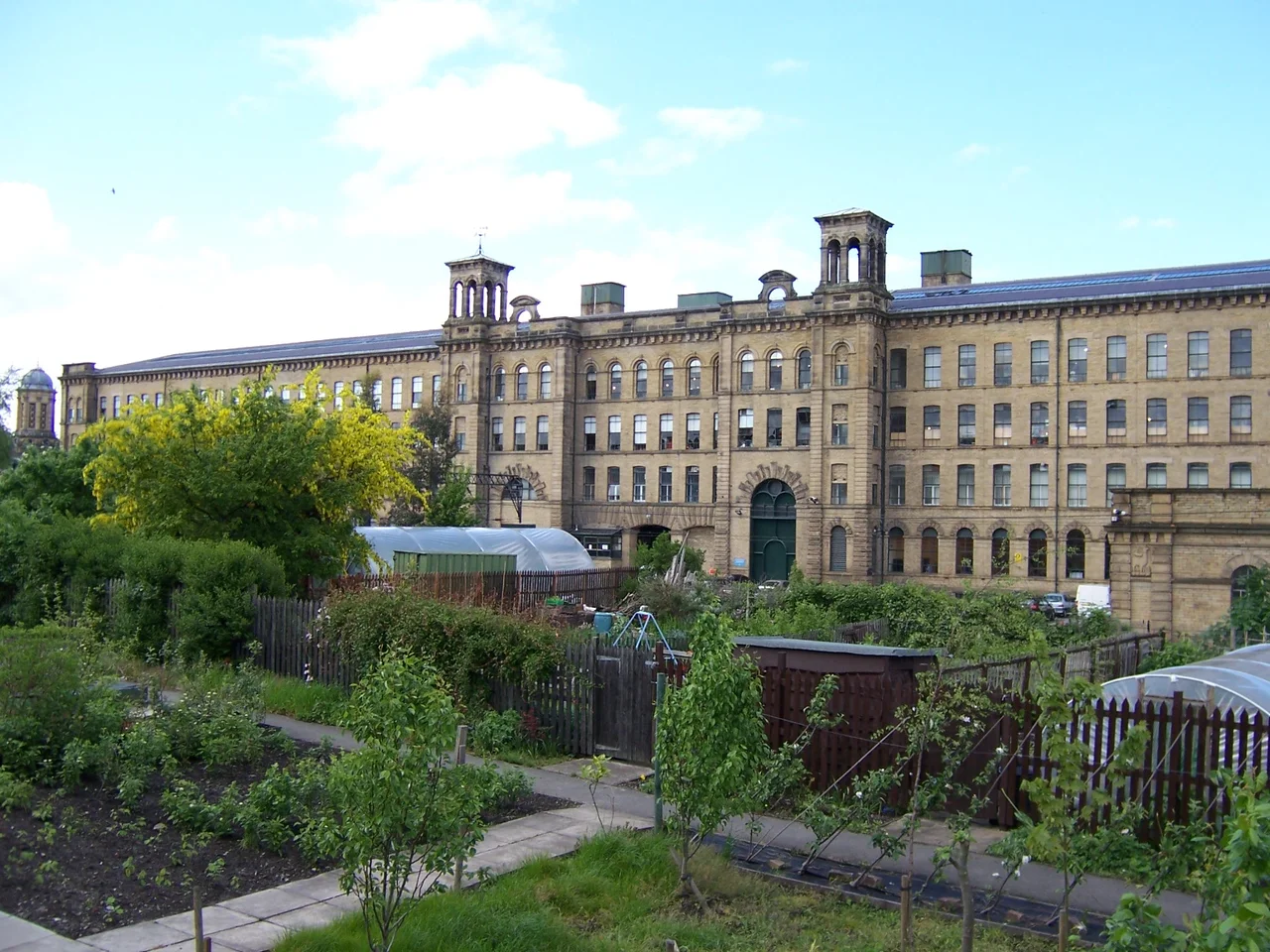

Saltaire
Sir Titus Salt did not like what Bradford was doing to its workers. In 1851, with his five mills profitable and his conscience uneasy, he picked a green patch of land downstream where the Aire ran past the new Leeds and Liverpool Canal and the new railway. There he built, all at once, an entire town: a great Italianate mill, neat stone terraces with running water, washhouses, baths, a hospital, almshouses, allotments, a school, a park, a library, a concert hall, a science lab, even a gymnasium. He banned pubs. He called the place Saltaire, his name joined to the river. In December 2001 UNESCO declared the whole village a World Heritage Site.
What Salt Built
Saltaire's plan, drawn up by Bradford architects Henry Lockwood and William Mawson, was completed across two decades from 1851 to 1871. By the 1871 census, Saltaire had 800 dwellings (755 houses and 45 almshouses) housing 4,389 people, almost all of them connected to the mill. The streets were broad enough to bring light into the rows. The houses had separate sculleries and bedrooms, the universal answer to the back-to-back terraces of Bradford where families lived ten to a room. There was no parish church at first; Salt built instead the Italianate Congregational church across from the mill entrance, with marble columns and a circular portico, where he would eventually be buried in 1876 in the mausoleum he had attached to it. The village was the most ambitious example of nineteenth-century enlightened industrial planning anywhere in Britain.
A Japanese Visit and a Russian Loss
In October 1872 Saltaire received an unusual group of visitors. The Iwakura Mission, sent by the Japanese government to tour the industrial cities of Europe and the United States, came to study the village as a model of modern manufacturing. Salts Mill, along with Dean Clough Mill at Halifax, was a featured highlight. When Salt's son Titus Junior died, ownership passed to a partnership including Sir James Roberts, a former Haworth mill boy who had risen through the wool trade. Roberts spoke fluent Russian, had invested heavily in Russia, and lost much of his fortune in the Russian Revolution of 1917. He endowed a chair of Russian at Leeds University and bought the Bronte Parsonage in Haworth in 1928 to give to the nation. T. S. Eliot mentions him by name in The Waste Land.
The Mill Closes, the Art Arrives
Salts Mill stopped spinning wool in February 1986, after 135 years. The next year the Bradford businessman Jonathan Silver bought it and began converting the vast space into something else. He had grown up in Saltaire and knew the artist David Hockney, who like Silver was from Bradford; he asked Hockney to mount a permanent exhibition of his work on the upper floors. The 1853 Gallery, opened the following year and named for the year Salt began the mill, has been showing Hockney pieces ever since. The mill complex now houses restaurants, bookshops, an enormous bookstore, and the head office of the technology company Pace plc. The British Film Institute holds a two-minute clip from 24 July 1900 showing the workforce streaming out of the mill at the end of a shift in their thousands. The shot still looks like Saltaire, because Saltaire still looks like itself.
Living in a World Heritage Site
Roberts Park, on the north bank of the Aire opposite the mill, was restored by Bradford Council in 2010 after years of neglect. Victoria Hall, originally the Saltaire Institute, still hosts concerts on its Wurlitzer theatre pipe organ. The village is served by Saltaire railway station, the same stop trains have used since the line opened. Every September the Saltaire Festival, first held in 2003 for the village's 150th anniversary, runs for eleven days. Every May the Arts Trail opens private houses as temporary galleries. Living inside a World Heritage Site has its frictions: in 2014 the council compiled a list of replacement front doors that were not in keeping with the buildings' historic status. The bypass that planners have wanted for years, to take traffic out of the conservation area, is still unbuilt. The village endures, almost embarrassingly intact.
From the Air
Saltaire sits at 53.837 N, 1.790 W in the Aire valley between Shipley and Bingley, about 3 nm north-west of central Bradford. Recommended viewing altitude 2,500 to 4,000 ft AGL; the visual landmark is the long six-storey block of Salts Mill with its Italianate chimney and the campanile-like tower of the Congregational church, set between the River Aire and the parallel ribbon of the Leeds and Liverpool Canal. Nearest airport is Leeds Bradford (EGNM) about 5 nm east-north-east. Manchester (EGCC) lies about 30 nm south-west. Expect frequent valley fog along the Aire.
Nearby Stories
- Battle of Seacroft Moor 3 km away
- RAF Topcliffe 7.4 km away
- Pretoria Pit Disaster 8.7 km away
- Lundhill Colliery Explosion 11 km away
- Forest of Bowland 12 km away
- Coverham Abbey 16 km away
- Macclesfield Canal 18 km away
- Leighton Hall, Lancashire 21 km away