
Saltcoats
The name tells you almost everything you need to know. In the cottages along the shore here, between the Firth of Clyde and the inland hills, salt was once made by boiling seawater. The cottages were called salt coats, and when the houses multiplied into a town, the town kept the working-class name. Saltcoats is what happens when an industry shapes a place so thoroughly that its smell, its labour, and its identity all merge into a single word. The salt pans are gone now, but the name remains, attached to a town of around eleven thousand on the west coast of North Ayrshire, one third of the Three Towns with Ardrossan and Stevenston.
Monks, Coal, and the First Pans
The story begins underground in the 1200s, when the monks of Kilwinning Abbey noticed something extraordinary about the coastline: coal seams that rose almost to the surface, accessible without the elaborate engineering most coal required. That coal made everything else possible. To boil seawater for salt you need fuel, and Saltcoats had it in abundance. By the 1500s, King James V was funding sheds along the shoreline to expand the operation, and the salt pans industry came into its own. A burgh charter followed in 1528, and a market grew up to serve it. By the mid-1600s, Saltcoats was exporting cattle, herring and grain to Ireland, importing corn and butter, and putting hand looms in cottage labourers' homes to weave muslins for the Glasgow and Paisley markets. On the edges of town, chemical works squeezed magnesium and Epsom salts out of the leftover brine, a small Ayrshire example of an industrial economy figuring out how to make use of its own waste.
The Shipbuilders and the Drift to Belfast
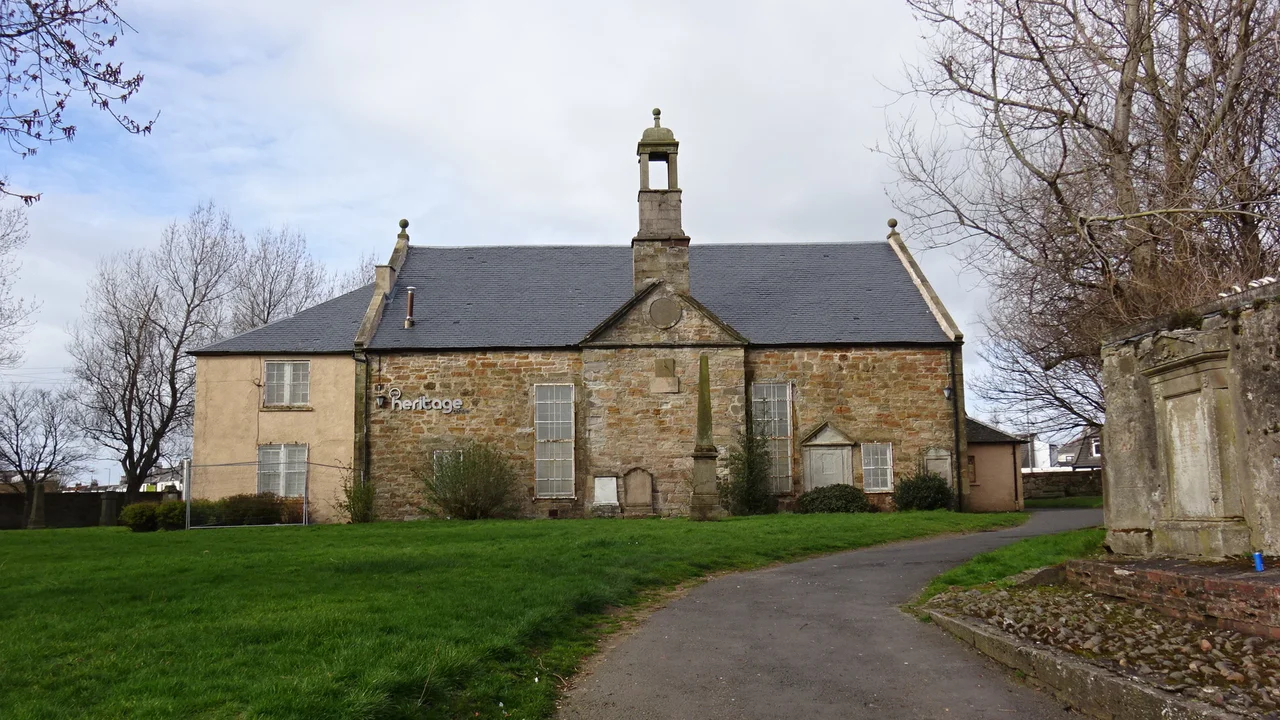
In the late eighteenth century, Saltcoats built ships. Several yards along the shore produced perhaps sixty to seventy vessels, and the leading builder was William Ritchie. Then in 1791 Ritchie moved his business to Belfast, and Saltcoats's shipyards began their slow contraction. By 1793 the town counted around four hundred houses and three working yards; by 1820, six hundred houses and a population of 3,413. The shipbuilding had effectively ended by the early nineteenth century. Saltcoats Town Hall, a Category B listed building, dates from 1826 and stands today as a relic of that prosperous transitional moment when the town still had reasons to invest in itself. The harbour was redesigned by James Jardine in 1811. No commercial cargo or passenger services run from it now.
South Beach and the Glasgow Fair
What replaced the salt pans and the shipyards was holidaymakers. South Beach, the broad protected bay between Saltcoats and Ardrossan, made the town a natural seaside resort. A Beach Pavilion went up in the 1920s, and during the Glasgow Fair, the two-week summer holiday traditionally taken by the city's working families, Glaswegians arrived in their thousands. Billy Connolly memorialised the era in his song Saltcoats at the Fair, first released on the Humblebums' First Collection of Merry Melodies in February 1969. The era ended quietly, defeated not by any local failure but by the rise of cheap air travel and the slow migration of British holidays to the Mediterranean. The pavilion, the harbour, the open-air pools that once drew crowds, all became history before most of the holidaymakers realised they had stopped coming.
The Crew Who Came From Here
For a town of its size, Saltcoats has launched a remarkable lineup. Alexander Allan, born here in 1780, founded the Allan Line Royal Mail Steamers, and his nephew Sir Hugh Allan extended the family's transatlantic shipping empire from Montreal. Betsy Miller, born in 1792, became the first woman registered as a captain of a British merchant ship. Hugh Munro, born in London in 1856 and raised on his family's Angus estate, gave his name to every Scottish mountain above 3,000 feet, the Munros that hillwalkers still spend decades collecting. Kenneth Campbell, born here in 1917 and killed in 1941, received a posthumous Victoria Cross for an attack on the German battle cruiser Gneisenau. The Australian rock band Men at Work's frontman Colin Hay was born in Saltcoats in 1953. The cyclist Graeme Obree, who broke the world hour record twice on a self-built bike, made his home here. So does Janice Galloway, one of the most distinctive Scottish novelists of her generation, and Michael Garrett, Fellow of the Royal Society and director of the Jodrell Bank Centre for Astrophysics. The town has stopped making salt and ships, but its export of remarkable people seems to be holding up.
From the Air
Located at 55.6352 degrees North, 4.7896 degrees West, on the west coast of North Ayrshire. Glasgow Prestwick (EGPK) lies about sixteen miles south. Glasgow International (EGPF) is about twenty-five miles northeast. From the air, Saltcoats blends into the continuous coastal urban band of the Three Towns: look for the broad arc of South Beach between Saltcoats and Ardrossan, the old harbour breakwater, and the railway line tracing the shore.
Nearby Stories
- Battle of Drumclog 2.2 km away
- Culzean Castle 3.3 km away
- Greenock 5.9 km away
- Lochranza 7.9 km away
- Battle of Kilsyth 16 km away
- Loch Fyne 19 km away
- Dunaverty Castle 25 km away
- Moniaive 27 km away