.jpg)
Saltram House
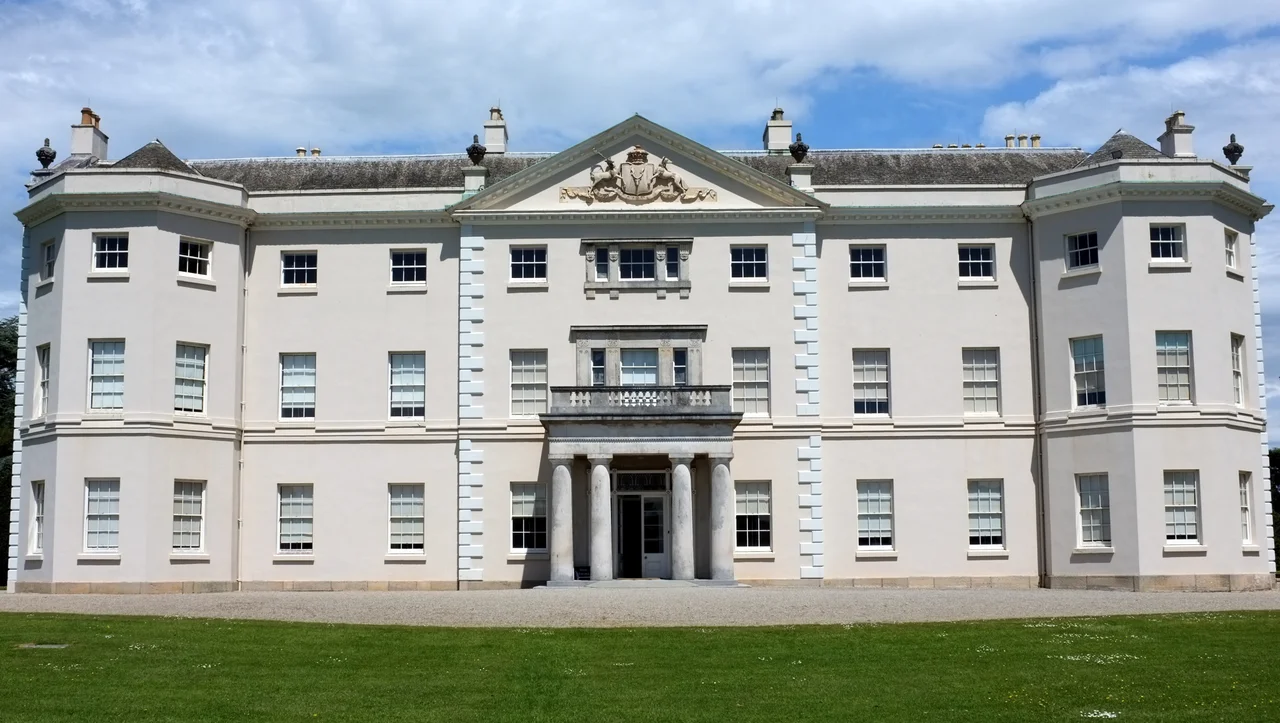
Robert Adam was given a Tudor house and asked to make it speak Georgian. What he produced inside Saltram House - particularly the great Saloon, begun in 1768 and completed in 1772 - is considered one of the finest neoclassical interiors anywhere in England. From the outside, you would never guess. Saltram looks like a single magnificent piece of Palladian symmetry, two long matching facades rising above lawns that slope down toward the tidal Laira. But the older Tudor walls are still inside there, swallowed and dressed up, and the house holds the layered story of three Devon families: the Mayhews, who farmed and fished here in the 1500s; the Baggs, who turned the farmhouse into a mansion and then lost everything to the Civil War; and the Parkers, who reigned for two and a half centuries and gave us, almost as a side effect, the best surviving collection of Joshua Reynolds portraits outside London.
Salt and a Homestead
The name itself records the geography of the place: salt from the nearby tidal estuary, and -ham from the Old English for homestead. Long before there was a mansion, there was a Tudor farmhouse on the site, and before that a settlement going back further still. The first family the records remember is the Mayhews, sometimes called Mayes or Mayhowes, yeoman farmers who owned Saltram for about fifty years in the sixteenth century. Their leases speak of a remarkably extensive operation: a 1588 grant let a tenant farm Saltram Wood with all its houses, quays and buildings, hold fishing rights at Laira Bridge Rock and at Culverhole, lease portions of a quay called Coldharbour, and use the Mayhowes' own fishing nets. By the end of the century the family was selling and leasing pieces of the estate to stay afloat. Saltram passed to the Baggs.
The Embezzler and the Civil War
Sir James Bagg, MP for Plymouth from 1601 to 1611 and later Mayor of Plymouth, bought Saltram in about 1614, and his son James II Bagg - Deputy Governor of Plymouth and a vice-admiral - probably turned the old farmhouse into something approaching a mansion. James II had powerful patronage in the person of George Villiers, Duke of Buckingham, the great court favourite of James I. He used it. He is believed to have embezzled Crown funds at least twice, the first occasion contributing materially to the disastrous failure of Buckingham's 1625 attack on Cadiz. For reasons no historian has ever satisfactorily explained, Charles I twice defended him. James II died in 1638, leaving the house to his son George Bagg, who inherited the family's job and none of the family's luck. George picked the Royalist side in the Civil War, and Saltram suffered badly at Parliamentary hands. He was forced to compound (pay a fine) of 582 pounds to keep his land. The Baggs lost Saltram entirely in 1660, when it was transferred to a former Parliamentary captain to settle one of George's debts. The Restoration then stripped it from him in turn and gave it to Sir George Carteret, in settlement of a loan Carteret had made to the king during the war.
The Parker Dynasty Arrives
In 1712, George Parker of Boringdon Hall - a Tudor manor just two miles north - bought the Saltram estate, and the Parker family began the dynasty that would shape the house we see today. His grandson John Parker inherited in 1743, married the wealthy Lady Catherine Parker (whose money largely funded everything that followed), and together they masked the Tudor bones of the house in symmetrical Palladian facades. Inside, Rococo ceiling plasterwork was applied delicately to the Entrance Hall, the Morning Room and the Velvet Drawing Room. When their son, also John Parker (later 1st Baron Boringdon), and his cultivated wife Theresa took the house, they commissioned Robert Adam in 1768 to design two new rooms: the Saloon and the Library. The six years before Theresa's early death are considered Saltram's golden age - a moment when one of the most fashionable architects in Europe was working for a young couple at the peak of their taste. Adam's Saloon survives almost untouched.
The Reynolds Collection
Joshua Reynolds was born in nearby Plympton in 1723 and the Parkers were among his closest friends. They bought his work prolifically. Saltram now contains thirteen paintings by Reynolds - one of the finest collections of his work anywhere outside the National Gallery and the Royal Academy. Walking through the house you see the Parker family painted by the painter who defined what the English aristocracy was supposed to look like: composed, lightly amused, set against soft classical backgrounds. Among them is a tomb monument elsewhere recording an eleven-year-old Viscount Boringdon, heir to the Earl of Morley, who died in Paris in 1817 and is commemorated in St Mary's, Plympton, by the French sculptor Francois-Nicolas Delaistre. The Parker collection is not just Reynolds, but Reynolds is the heart of it.
Handed to the Nation
The Saltram estate was transferred to the National Trust in lieu of death duties in 1957 and has been open to the public ever since. Nikolaus Pevsner, the most influential English architectural historian of the twentieth century, called Saltram simply the most impressive country house in Devon - high praise from a man who tended toward restraint. The Laira estuary in front of the house is tidal, so the view from the windows shifts between bright water and brown mud through every twelve-hour cycle. From the first floor and from the Castle summerhouse in the gardens you can see all the way down to Plymouth Sound. Robert Adam's plasterwork is still up there on the Saloon ceiling, and Reynolds's painted Parkers still watch you from the walls.
From the Air
Saltram House sits at 50.3817 deg N, 4.0825 deg W on the north bank of the tidal Plym estuary (the Laira), just east of Plymouth. From the air the house's symmetrical Palladian footprint is set in a substantial wooded park of about 500 acres, very visible against the surrounding urban fringe of Plympton. Best viewed at 2,000-3,000 ft, ideally on approach to Exeter (EGTE) from the southwest. The grassy mound of Plympton Castle is two miles to the northeast.
Nearby Stories
- Davidstow Circuit 3.7 km away
- Golden Hind 3.9 km away
- Powderham Castle 4.4 km away
- Fowey Lifeboat Station 5.1 km away
- Okehampton Castle 12 km away
- Battle of Plymouth (1652) 19 km away
- Goonhilly Satellite Earth Station 44 km away
- German Submarine U-672 73 km away