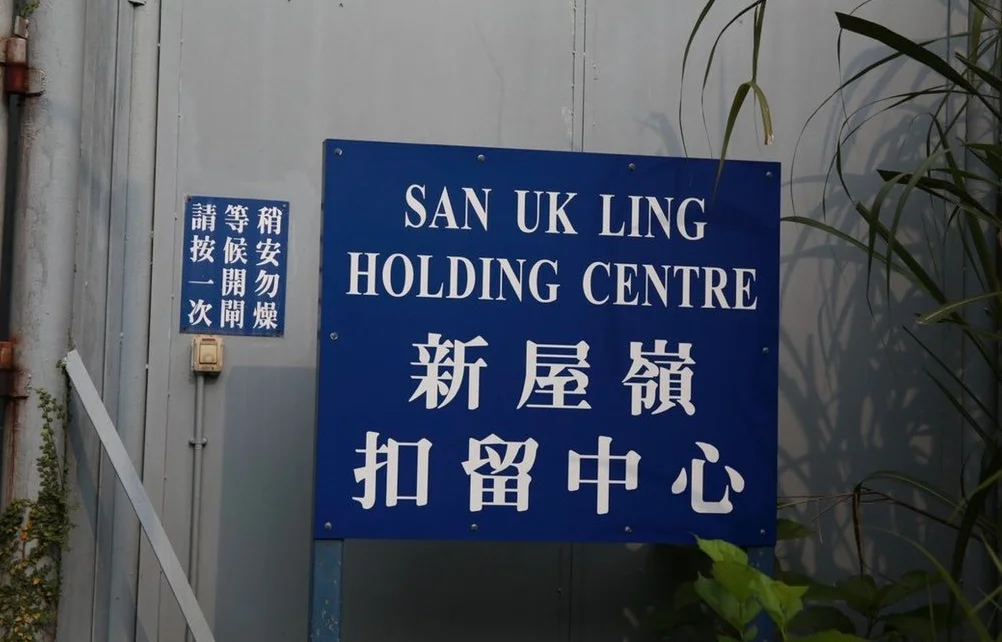

San Uk Ling Holding Centre
The facility sits a few hundred metres south of the Man Kam To border crossing, in a part of the North District that most Hongkongers never had reason to visit. San Uk Ling Holding Centre opened in July 1979. Its original purpose was straightforward: to provide capacity for immigration detainees awaiting repatriation, relieving an overcrowded facility at Ta Kwu Ling that could hold only 60 people. San Uk Ling could hold around 600. The accommodation was basic — units divided by steel fencing, designed for short stays, because under colonial policy detainees were to be repatriated within 24 hours. For most of its history, the centre was obscure, a functional facility in a remote location, doing administrative work at the edge of the city. Then 2019 arrived.
Built at the Border's Edge
The British colonial government constructed San Uk Ling in 1979 in response to a surge in illegal immigration from mainland China. The facility's position — immediately south of Man Kam To Control Point, which until 1985 was the only vehicular road link between Hong Kong and China — was not incidental. Each day, detainees held there were walked to the border crossing and handed over to Chinese authorities at 12:30 pm. The process was routine, the location functional. By mid-1986, the immigration pressures that had motivated the facility's construction had eased, and the centre often held fewer than 40 people at a time. It came to serve other purposes over the years: in June 1989, following the Tiananmen Square events, San Uk Ling briefly sheltered democracy movement leaders transported to Hong Kong during Operation Yellowbird. In December 2005, arrested Korean farmers who had protested at the WTO Ministerial Conference were held there. The centre existed at the intersection of Hong Kong's administrative life and the larger currents of regional history.
Protesters in a Remote Facility
During the 2019–2020 Hong Kong protests, police began using San Uk Ling as an overflow detention facility after 5 August 2019, when arrest numbers exceeded the capacity of closer police stations. On 11 August 2019 alone, 54 people arrested in Causeway Bay and Tsim Sha Tsui were transported there. The distance was significant. Unlike Yuen Long, Tuen Mun, Pat Heung, or Sheung Shui police stations — all closer to central Hong Kong — San Uk Ling's remoteness made it difficult for those detained to contact lawyers, family members, or support workers. This isolation was the first concern raised by observers. Justices of the peace who sought to inspect the facility were denied entry, according to the South China Morning Post. The ordinary accountability mechanisms that apply to detention facilities in more central locations were harder to exercise at this address.
Allegations, Denials, and an Independent Finding
In September 2019, 31 people who had been held at San Uk Ling were transferred to North District Hospital; among them, six had sustained bone fractures and some had suffered intracerebral haemorrhages. Detainees and their advocates alleged mistreatment during detention. They further alleged that police delayed medical care and withheld medication from injured people. Lawmakers including Tanya Chan raised these concerns formally with the government. John Lee, then Secretary for Security and later Chief Executive, responded that among the 30 arrestees who required medical treatment, none had reported injury during their detention — that 10 had reported injuries on arrival, and the remainder had sought treatment for illness. Regarding allegations of sexual assault, Lee stated that no such complaint against police had been received. The Police Public Relations Branch characterised the facility as a standard detention centre operating within regulations, and described all allegations as 'unnamed, unverified and untrue.' The Independent Police Complaints Council (IPCC) conducted its own review. Its conclusion was measured but pointed: 'with its limitations in set-up and equipment,' the centre 'was not suitable for use as a temporary holding area on that occasion.' The IPCC recommended that future facilities for mass arrests be held to current standards and that a formal policy govern the selection of such venues.
Fabricated Claims and a Court Finding
Into this already fraught situation came a separate thread: fabricated allegations. Poon Yung-wai, writing under the pseudonym 'Kim Jong-un,' published four posts in a Facebook group with more than 50,000 members in late September 2019. The posts claimed, without basis, that female protesters had been sexually assaulted after being injected with tranquilizers, and that officers had disposed of bodies. These claims were not true. Police arrested Poon in October 2019, and a subsequent court found him guilty of inciting unlawful assembly. He was sentenced to 13 months in prison. Chief Judge of the High Court Jeremy Poon described the offence as serious, citing its targeting of law enforcement and the risk of public disorder. The fabrications did not settle the broader dispute about what had occurred at San Uk Ling; they exist alongside the legitimate, attributed allegations from detainees and the IPCC's independent finding as a separate and distinct matter.
The Aftermath and Continuing Use
On 26 September 2019, the Chief Executive announced that police would stop using San Uk Ling to detain protesters. The police confirmed this the following day. The facility's physical structure — four cell blocks containing 16 detention cells, with stone beds, air conditioning, lighting, toilets, and interview rooms — was subsequently upgraded. Surveillance cameras were installed, a fixed-line telephone added, and broadband improved for security and communications. In May 2020, local lawmakers and press were invited to an open visit as part of a review process. San Uk Ling continued to be used for its original function: holding people detained while awaiting immigration repatriation across the nearby border. The building itself, in its remote position near Man Kam To, is unchanged. What changed, in the months between August and September 2019, was the weight that building now carries in Hong Kong's collective memory.
From the Air
San Uk Ling Holding Centre is located at 22.528°N, 114.132°E, immediately south of the Man Kam To Control Point border crossing in the North District of Hong Kong. From the air, the facility is situated in a relatively flat area between the border fence and the hills of the northern New Territories. The Man Kam To Road border infrastructure is visible to the north; the surrounding terrain is semi-rural with low-density development. Hong Kong International Airport (VHHH) is approximately 45 km to the southwest. The facility is not visually prominent from altitude, but its location near the border — where the demarcation between Hong Kong and Shenzhen is clearly traceable as a fenceline — gives it a legible context in the broader landscape of the closed border zone.
Nearby Stories
- Hong Kong Disneyland 4.1 km away
- Mount Guanyin (Dongguan) 7 km away
- 2024 Lixinsha Bridge Collapse 7.4 km away
- Portas do Cerco 12 km away
- Lotus Hill 15 km away
- Nanxiong Formation 78 km away
- Heyuan 130 km away
- Checheng Fu'an Temple 629 km away