_at_the_National_Archaeological_Museum_of_Athens_on_22_July_2018.jpg)
Sanctuary of Amynus
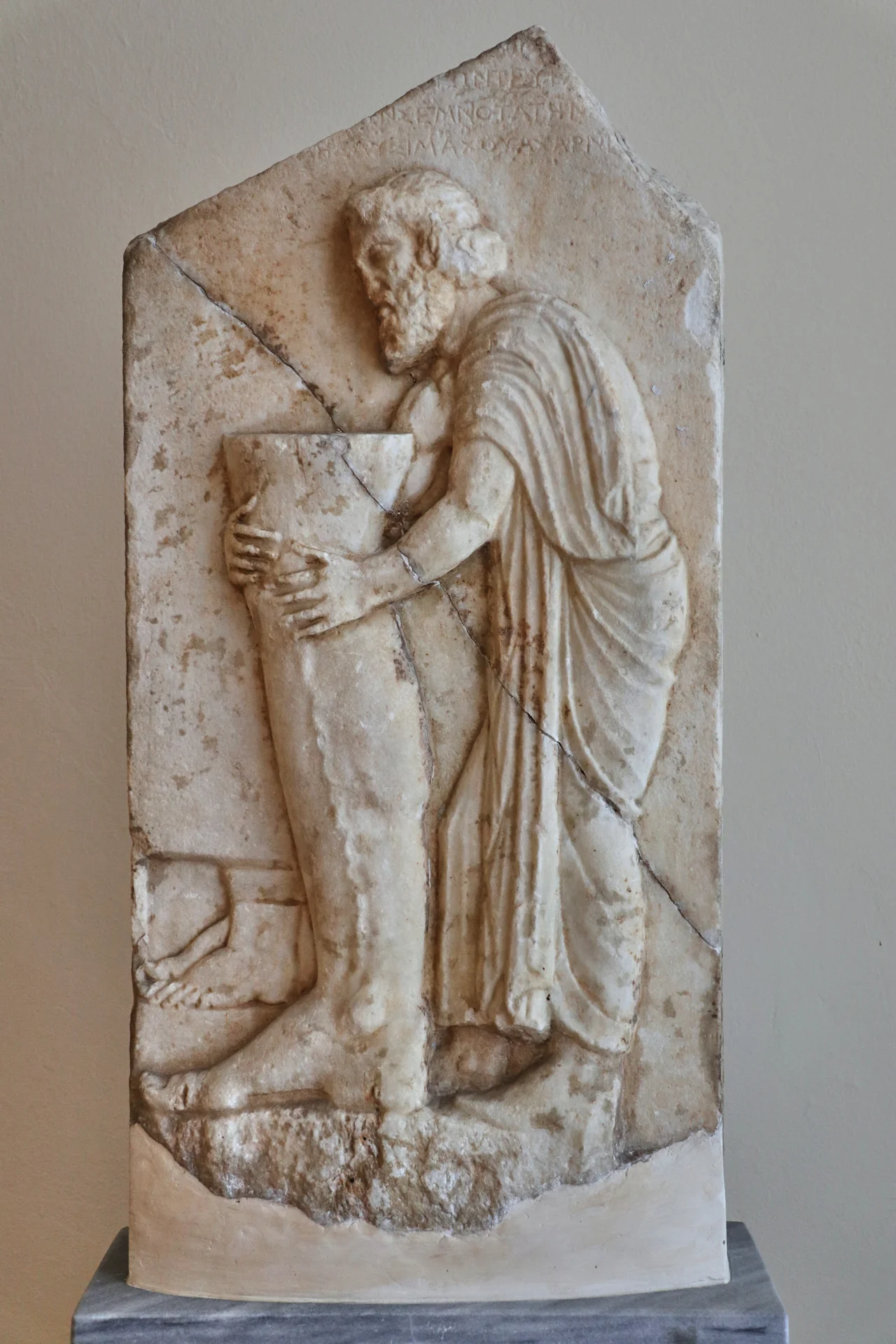
A bearded man carries an enormous severed leg, and on it a varicose vein bulges in stone. The marble relief is among the most arresting objects ever pulled from the soil of Athens, and it tells you exactly what kind of place once stood west of the Acropolis. The Sanctuary of Amynus was a healing shrine, and the sick came here to leave behind images of the body parts they prayed to mend. The man with the leg was thanking a hero for a cure, the way a modern patient might keep an X-ray. He left his gratitude in marble.
The Hero Who Wards Off
Long before doctors, Athens had heroes. The sanctuary was dedicated to Amynus, an obscure healing figure whose name comes from the Greek verb amyno, "to ward off," the same root that gave Apollo one of his healing titles. To ward off, in his case, meant to ward off sickness. The shrine sat at a crossroads on the western slope of the Acropolis, where the main road climbed from the Pnyx, the hill of the assembly, up toward the sacred gateway above. Pottery buried beneath its walls reaches back to the eighth century BC, and the compound took its lasting shape in the sixth century, in the age of the tyrant Peisistratus. For more than a thousand years, Athenians in pain came to this modest courtyard to bargain for their health.
Water and Marble Bodies
It was a small place, an irregular courtyard barely nineteen meters long, walled in hard blue limestone quarried right at hand. At its heart was water. A fountainhead more than four meters deep, lined with slate, fed a pool in the center of the precinct, and that water carried the cure. Worshippers used it in healing rituals, and remarkably, when archaeologists arrived in 1896, water was still flowing into the ancient fountain after twenty-four centuries. Around the pool, the sick left their offerings: relief plaques and statue bases crowded the enclosure, and against the north wall leaned carved marble images of the afflicted parts of the body, ears, breasts, genitals, and that unforgettable swollen leg. Each was a prayer made visible, a piece of a person's suffering set down in stone in hope of relief.
When the God Came to Stay
For centuries the hero Amynus healed alone. Then, in 420 BC, Athens welcomed a more famous physician. Asclepius, the great healing god of Epidaurus, was brought to the city during a time when plague and war had taught Athenians the value of any cure. He took a grand shrine on the south slope of the Acropolis, but he also moved in here, beside Amynus, sharing the modest courtyard. A small religious association, the orgeones, tended the joined cult. Among its members, the inscriptions reveal, was honored a man called Dexion, "the Receiver" - none other than the playwright Sophocles, who had reportedly given the new god shelter in his own home when Asclepius first arrived. After his death, grateful Athens made the great tragedian a healing hero too.
Lost and Found Again
The sanctuary stayed in use into Late Antiquity, its last inscriptions dating to the first century AD, the courtyard somehow kept clear of the building that crowded the rest of the city. Then it slipped from memory entirely. In 1892 the German archaeologist Wilhelm Dorpfeld stumbled onto it almost by accident, while hunting for a famous lost fountain, and returned in 1895 to excavate in full. The finds, the strange anatomical reliefs, an offering table with snakes carved along its edge and lions' feet at each corner, a marble hand holding a bowl from a lost statue of Hygieia, the goddess of health, went to the National Archaeological Museum. Some have since been lost again. But the bearded man and his marble leg endure, a four-hundred-year-old thank-you note from a person who once hurt, and then did not.
From the Air
The Sanctuary of Amynus lay at 37.971 degrees N, 23.722 degrees E on the western slope of the Acropolis in Athens, between the sacred rock and the Pnyx hill. Recommended viewing altitude 1,500 to 3,000 feet AGL. The Acropolis with the Parthenon is the dominant landmark immediately to the east; the rounded Pnyx and Philopappos Hill rise to the southwest. Nearest airport is Athens International (Eleftherios Venizelos, LGAV), about 17 nm east. The site itself is small and easily missed from the air, but the surrounding archaeological slopes below the Acropolis are clearly visible in the typically clear Athenian sky.
Nearby Stories
- Great Sand Beach 5 km away
- Battle of Delium 7.7 km away
- Tower of Aliartos 9 km away
- HMHS Britannic 10 km away
- Saronic Gulf 15 km away
- Sousaki Volcano 17 km away
- Sanctuary of Apollo Maleatas 24 km away
- Skyros 66 km away