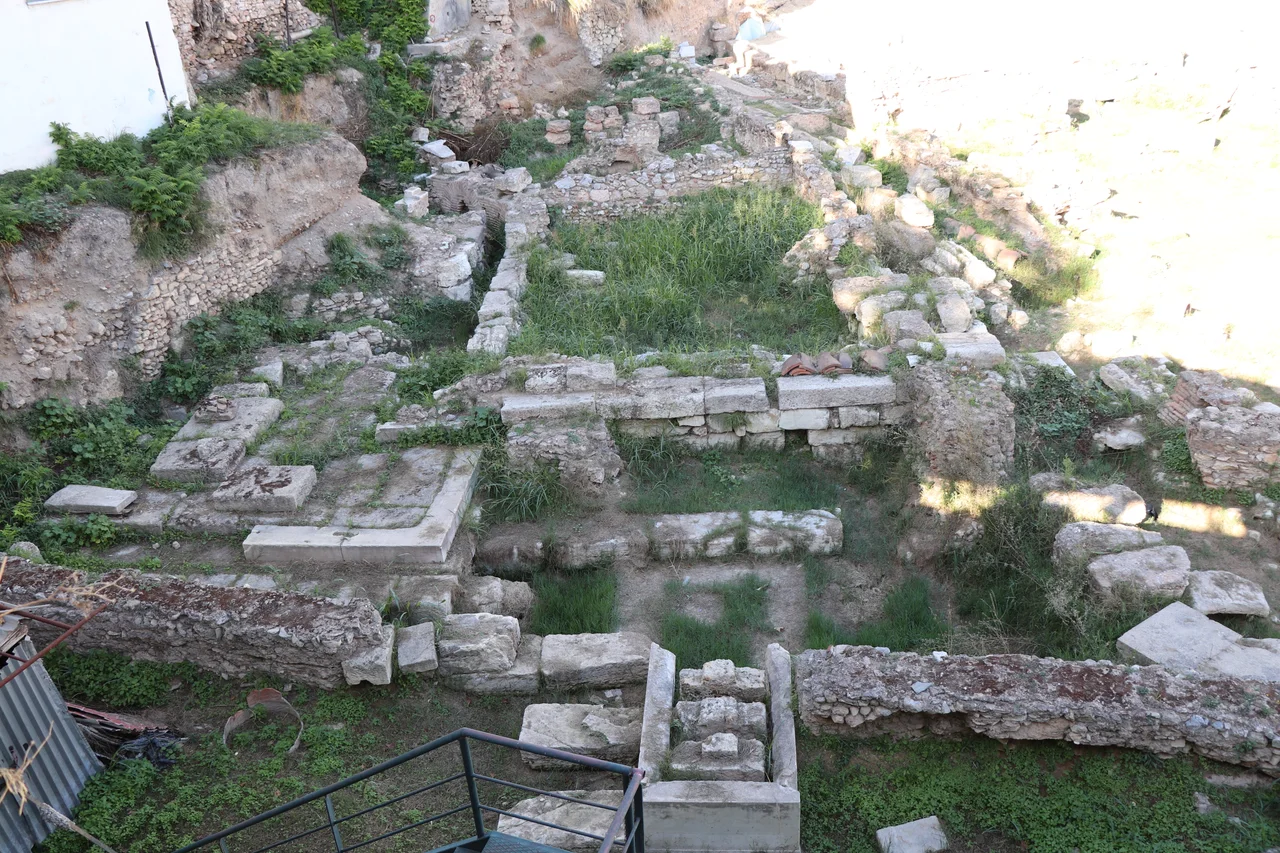

Sanctuary of Aphrodite Urania
The proof was in the bones. When American excavators sifted through the ash packed inside a battered marble altar at the northwest corner of the Athenian Agora, they recovered more than eighty thousand fragments. Most were charred goat. But scattered among them were the delicate, hollow bones of doves - and in Greek religion, doves were sacrificed to exactly one deity. This was the Sanctuary of Aphrodite Urania, Aphrodite "of the Heavens," a small shrine that for nearly a thousand years stood quietly beside the city's busiest road.
Reading the Ash
The altar was built around 500 BC, a low marble box about five metres long with painted barriers shaped like little pediments at each end. On its western side ran a narrow strip of stone, just wide enough for a priest to stand and work. There, in mid-April when the kids were six to eight weeks old, young goats were killed, butchered, and their inedible parts burned as offerings while the worshippers ate the rest. Of the thousands of identifiable bone fragments, four in five came from goats. But nearly a fifth came from birds, and most of those were doves - the bird sacred to Aphrodite alone. A votive relief found nearby sealed the case: a veiled woman descending a ladder, holding out an incense burner, an image instantly recognizable as Aphrodite Urania.
A Borrowed Masterpiece
For five centuries the altar stood mostly open to the sky. Then, in the first decades of the Roman Empire, Athens gave its old goddess a proper temple. The builders did not invent a new design - they copied the most beautiful porch in the city. The north porch of the Erechtheion, with its slender Ionic columns, was reproduced here at roughly three-quarters scale, the columns a precise imitation right down to their carved tops. It was a deliberate act of nostalgia, the Roman age dressing itself in Classical Athens. The small temple faced due south, its central axis lined up exactly with the ancient altar, as if the new architecture reached back to borrow the holiness of the old.
The Slow Burial
Athens kept rising around the shrine, layer by layer, century by century. The altar that began life below the level of the nearby Stoa Poikile was gradually swallowed as the ground climbed. The Persian sack of 480 BC may have cracked its upper courses; repairs followed in the 420s, when the ash and dove bones were sealed inside. A Roman bath complex crowded in from the north, complete with a marble latrine pressed against the temple wall - the sacred and the mundane sharing a party wall. By the fifth century AD the temple was a ruin, buried under a concrete platform, then a colonnade, then ordinary Byzantine houses. Worship simply stopped, and the city forgot the goddess had ever stood there.
Found, Then Doubted
Modern archaeology nearly missed it. In 1939 the Agora excavators pinned the sanctuary on a different ruin entirely, one scarred by the Athens-Piraeus railway. Only when fresh digs reached the true corner of the Agora at 13 Hadrianou Street, between 1980 and 1993, did the altar and its dove bones surface. Even now the identification is not unanimous - some scholars argue these stones mark a statue of Hermes that the traveler Pausanias mentions in nearly the same breath. It is a fitting uncertainty for a shrine that always hid in plain sight, beside the road, under the dust, identified at last by what it burned.
From the Air
The sanctuary sits at 37.9761 degrees N, 23.7217 degrees E, at the northwest corner of the Ancient Agora in central Athens, just below the Acropolis and the temple-crowned hill of Kolonos Agoraios. From the air the Agora reads as a green archaeological clearing in the dense city grid, framed by the Acropolis to the southeast. Recommended viewing altitude 2,000-3,000 feet AGL for the Agora and Acropolis together. The nearest airport is Athens International (LGAV), roughly 20 nautical miles east. Athens enjoys long stretches of clear Mediterranean visibility, though summer haze and afternoon heat shimmer can soften the view of the marble ruins.
Nearby Stories
- Great Sand Beach 5 km away
- Battle of Delium 7.7 km away
- Tower of Aliartos 9 km away
- HMHS Britannic 10 km away
- Saronic Gulf 15 km away
- Sousaki Volcano 17 km away
- Sanctuary of Apollo Maleatas 24 km away
- Skyros 66 km away