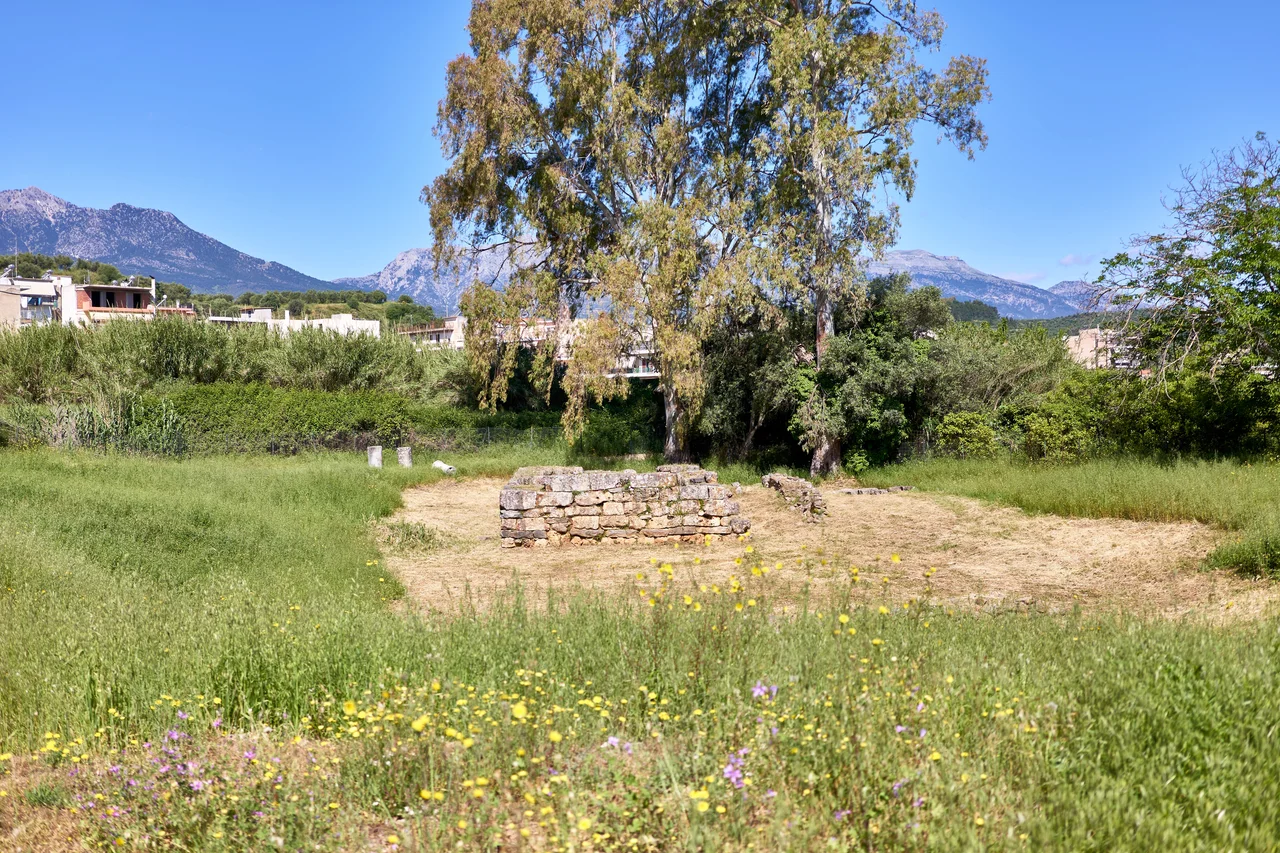

Sanctuary of Artemis Orthia
Cheese piled on an altar. Adults with whips standing guard. Young men of Sparta rushing the heap, braving the lash to prove what they were made of. The ritual called diamastigosis — the endurance ordeal at the Sanctuary of Artemis Orthia — was not a punishment but a rite of passage, part of the brutal education system the Spartans called the agoge. What began as a solemn religious test of character became, by the Roman era, a spectacle that drew curious visitors from across the empire. A stone amphitheatre was built in the third century CE so the crowds could watch in comfort. The boys enduring the whips had no such comfort at all.
A Cult Older Than the City
The sanctuary stands on the south bank of the Eurotas River, within the district of Limnae, one of the four villages whose merger formed Sparta. Pottery fragments from the late Greek Dark Ages — roughly the tenth century BCE — suggest the cult of Orthia predates the Spartan city-state itself, making this one of the oldest continuously active religious sites in the Greek world. The name Orthia likely refers to the upright, or erect, one: an epithet for a goddess of fierce and vigilant character.
The original sanctuary was built around 700 BCE. It was rebuilt around 570 BCE — possibly during the joint reign of Leon of Sparta and Agasicles, when military successes provided the funds — and the new temple was positioned further north, oriented toward the southeast. The site suffered severe flooding during the sixth century BCE. Rather than abandon it, the Spartans buried the existing layers under sand to raise the sanctuary beyond the reach of the river. That act of preservation accidentally created an archaeological gift: the flood layer sealed the earliest artefacts in place, isolating them for modern excavators.
The Goddess and Her Effigy
Artemis Orthia was no gentle woodland deity. The cult object at the heart of the sanctuary was a xoanon — an archaic wooden effigy of fierce reputation. According to Euripides, the image had been stolen from Tauride by Orestes and Iphigenia and carried back to Greece, stained by the blood rites of a foreign land. Whether or not the Spartans believed this particular myth, they treated the effigy with the gravity owed to something dangerous.
Carved ivory objects found at the site depict the winged goddess grasping a bird or animal in each hand — the ancient image type known as Potnia Theron, Mistress of Animals. The ivory work appears to have been produced locally; half-finished pieces found at excavations show craftspeople shaping the images on the spot. Artemis was associated with nature, nourishment, and childbirth, and the bear held particular symbolic weight in her Spartan cult, linked to the nurturing of children. Offerings at the temple frequently included animal dedications, with deer especially common — understood as substitutes for the hunt itself.
The Ordeal of Diamastigosis
The ritual that gave this sanctuary its lasting fame was the diamastigosis, from the Greek word meaning to whip harshly. As Plutarch, Xenophon, Pausanias, and Plato all describe it: cheeses were piled upon the altar and guarded by adults armed with whips. The young men — the epheboi, those in the later stages of Spartan education — would attempt to seize the cheese, enduring the whipping without flinching or crying out. Success, or simply the endurance of the ordeal, was the prize. For the agoge that shaped Spartan warriors, this was a test of the quality the Spartans prized above all others: the capacity to bear pain without breaking.
The youths who ran this gauntlet were real people, not symbols. They had names, families, ambitions. The agoge extracted from boys an extraordinary toll — years of deprivation, exposure, and physical hardship beginning in childhood. The diamastigosis was the culminating ordeal of that formation, its sting made meaningful by years of preparation. What it demanded was real courage, and what it cost was real suffering.
When Sparta Became a Roman Tourist Attraction
By the Roman period, Sparta's military glory was history, but its reputation had become a commodity. Visitors came to the city to observe what they believed were ancient customs preserved in amber. According to Cicero, the diamastigosis evolved during this era into something more brutal — a spectacle, sometimes fatal, performed for audiences drawn from across the empire. Libanios, writing in the fourth century CE, records that the crowds were still coming.
To accommodate them, a stone amphitheatre was constructed around the sanctuary in the third century CE. The semicircular seating framed the altar like a stage set, transforming a religious ordeal into entertainment. The sanctuary itself continued to function as a place of worship until the fourth century CE, when the persecution of non-Christian religions brought its twelve centuries of use to an end. Excavated votive offerings span the entire arc of that history: miniature lead wreaths, hand-formed and wheel-turned vases, figurines of warriors, dancers, musicians, and female figures. A significant collection now rests in the World Museum in Liverpool, spanning the eighth century BCE to the third century CE.
What the Ground Remembers
Archaeological excavations at the site have been especially revealing precisely because of the flooding that once threatened it. The sand layer that preserved the sanctuary's early years also preserved the objects left there — offerings that were personal rather than prescribed, chosen by worshippers from their own belongings rather than from any ritual formula. In that sense the votive record is unusually intimate: what people brought here says something about what they hoped for, feared, and valued.
Today the ruins of the sanctuary are modest — low stone courses near the Eurotas, a place easier to imagine than to see. The amphitheatre outline is still traceable on the ground. What cannot be seen is the noise that once filled it: the crack of leather, the silence of young men who would not give their audience the satisfaction of a cry.
From the Air
The Sanctuary of Artemis Orthia sits at approximately 37.083°N, 22.435°E on the south bank of the Eurotas River in the valley below Mount Taygetos. From the air at around 3,000 feet, the flat river valley floor and the distinctive shape of the Evrotas (Eurotas) cutting through the plain are clearly visible, with modern Sparti's street grid to the west. The nearest major airport is Kalamata International (LGKL), approximately 60 km to the southwest. Approach from the southwest follows the Eurotas valley north, with Taygetos (peak 2,407 m) as an unmistakable landmark to the west. Clear conditions prevail over the Peloponnese in summer; expect valley thermals in afternoon hours.
Nearby Stories
- Iklaina 6.6 km away
- Kalamakia Cave Site 7.8 km away
- Cleomenean War 9.7 km away
- Epidaurus Limera 16 km away
- Leonidio 18 km away
- Lepreum 20 km away
- Franchthi Cave 30 km away
- El-Kouf National Park 448 km away