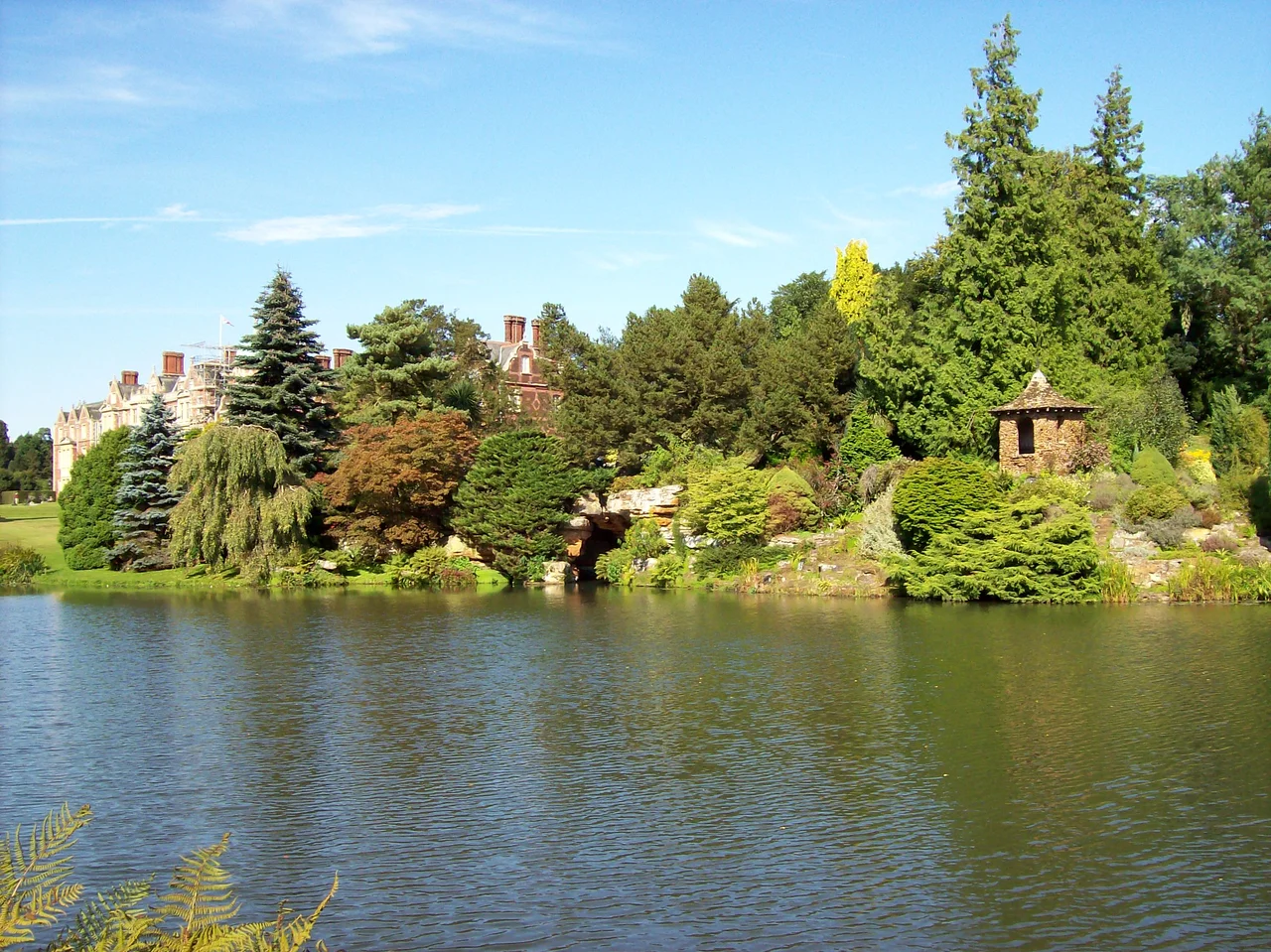

Sandringham House
For thirty-five years, every clock on the Sandringham estate ran half an hour ahead of Greenwich Mean Time. Edward VII invented this tradition — 'Sandringham time' — to lengthen the hours available for shooting during the winter season, which ran from October to February. It was maintained through his son's reign and into his grandson's. On the night George V died at the house, in January 1936, his son Edward VIII ordered the clocks reset to standard time immediately. It was one of the first things he did as king.
The House That Was Built Twice
Sandringham appears in the Domesday Book as 'sant-Dersingham' — the sandy part of Dersingham. The land passed through centuries of ownership before arriving, in the 1860s, at a crucial moment: Prince Albert Edward, the future Edward VII, was 20 years old, had been disappointing his parents, and needed, in his father Prince Albert's estimation, to be grounded in country life.
Prince Albert reviewed 18 possible country estates before settling on Sandringham. The price — £220,000 for the house and just under 8,000 acres — has been called 'exorbitant,' though recent scholarship suggests it was reasonable. The original hall was immediately found too small for the prince's entertaining ambitions. In 1865, two years after moving in, Edward commissioned architect A. J. Humbert to demolish the hall and build something larger. The new red-brick house was complete by 1870. A decade later it was still too small, and architect Colonel R. W. Edis added the Bachelors' Wing. Then came the fire of 1891, and Edis returned to rebuild again, maintaining the Jacobethan style throughout. The house today is substantially the product of these expansions.
A Life Built Around the Estate
Edward VII transformed Sandringham into what his friend Charles Carington called 'the most comfortable in England.' The kitchen gardens employed more than 100 gardeners at their peak. The shooting parties were legendary — game books recorded annual bags of between 6,000 and 8,000 birds in the 1870s, rising to more than 20,000 a year by 1900. The game larder, the largest in Europe, was inspired by the one at Holkham Hall. Guests arrived at Wolferton railway station, 2.5 miles away, on royal trains from St Pancras; the station served the house from 1862 until it closed in 1969.
George V loved Sandringham with particular intensity, describing it as 'dear old Sandringham, the place I love better than anywhere else in the world.' His interests were shooting and stamp collecting, both pursued to a high standard. In 1932 he gave the first royal Christmas broadcast from a studio at the house — the speech written by Rudyard Kipling, beginning 'I speak now from my home and from my heart to you all.' He died there on 20 January 1936, with his physician hastening the end so the announcement could appear in the following morning's Times.
Tragedies Quiet and Otherwise
The estate has held private griefs alongside its public occasions. Prince Albert Victor, Edward VII's eldest son and heir, died of pneumonia at the house on 14 January 1892. He is commemorated in the clock tower, which carries a Latin inscription translating as 'the hours perish and will be charged to our account.'
Prince John, the youngest child of George V and Queen Mary, was born in 1905 with epilepsy and spent much of his short life in relative seclusion at Wood Farm, a farmhouse on the estate. He died there on 18 January 1919, at 13 years old. Wood Farm later became the home of the Duke of Edinburgh during his final years after retiring from official duties in 2017.
The King's Own Sandringham Company — a territorial unit of the Fifth Battalion of the Royal Norfolk Regiment — lost all but two of its men at Suvla Bay during the Gallipoli Campaign in 1915. A memorial to the dead stands on the estate.
Royal Ownership and Public Access
Unlike the official royal palaces — Buckingham Palace, Windsor Castle, Holyrood — Sandringham is owned personally by the monarch rather than by the Crown. This has meant that inheritance requires actual purchase. When Edward VIII abdicated in 1936, his brother George VI had to buy the estate outright for £300,000, a transaction that caused friction between the brothers.
Queen Elizabeth II spent approximately two months at Sandringham each winter and opened the house to the public in 1977, for her Silver Jubilee. She made her last visit there in July 2022, a few months before her death. The estate passed to Charles III, who continues the tradition of spending Christmas at Sandringham and attending the Christmas Day service at St Mary Magdalene with the royal family.
The grounds are a 20,000-acre estate in the Norfolk Coast Area of Outstanding Natural Beauty. The house, gardens, and museum are open to visitors from spring through autumn. Trespass on the estate is a criminal offence under a 2007 designation.
From the Air
Sandringham House lies at 52.830°N, 0.514°E in northwest Norfolk, approximately 11 km north-east of King's Lynn. The nearest airports are King's Lynn (EGYL) to the south-west and Norwich International Airport (EGSH) roughly 65 km to the east. From the air, the red-brick Jacobethan house is visible in a large wooded estate, distinct from the surrounding agricultural land. The Church of St Mary Magdalene stands close to the house. The Appleton Water Tower — designed in Italianate style, with its foundation stone laid by Princess Alexandra in 1877 — can be identified at the estate's highest point. Best viewed at low altitude on a clear day, when the formal garden layout to the south and east of the house is visible.
Nearby Stories
- RAF East Kirkby 5.9 km away
- RAF Feltwell 8.6 km away
- RAF Matlaske 10 km away
- Chain Bridge Forge, Spalding 10 km away
- Norfolk Tank Museum 12 km away
- Skegness Lifeboat Station 14 km away
- Connington South Rail Crash 20 km away
- HMS Cobra 39 km away