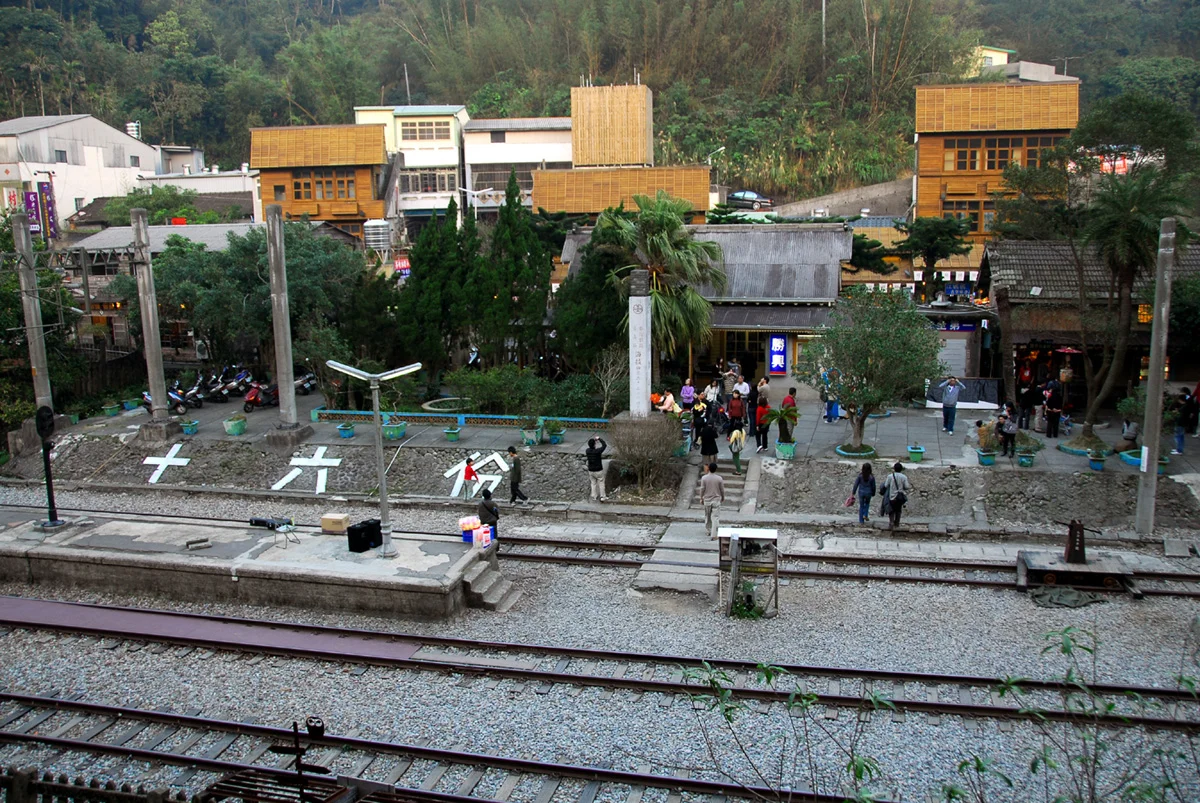

Sanyi, Miaoli
Walk down the main street of Sanyi and the air tells you what this place does. There is a faint, clean scent of camphor and cut wood that drifts from open workshops, where sculptors work pieces of driftwood, camphor root, and teak into figures ranging from thumb-sized Mazu statuettes to life-size carved elephants. At its peak, over 80% of Sanyi's families made their living this way. The 'Woodcarving Kingdom of Taiwan' is not a slogan invented by a tourism office; it describes something that genuinely happened here, in a mountain township in southern Miaoli where timber, craft, and geography converged.
How a Mountain Town Found Its Trade
Sanyi sits in the mountains of northwestern Taiwan — or more precisely, at the point where the mountains begin. Huoyan Mountain stands to the east at 602 meters, its red laterite cliffs visible from the township. Sanjiao Mountain rises to the northeast at 567 meters. The terrain is too steep and rocky for the rice paddies that cover the plains further west, so Sanyi's early settlers worked with what the mountains offered. Timber was the first economy: the forests yielded logs, hides, and camphor. Tung oil came next, pressed from the seeds of the abundant tung trees that still bloom white and pink across the hillsides each spring. From timber and camphor it was a short step to carving: the raw material was at hand, camphor wood is particularly well-suited to fine carving (aromatic, durable, insect-resistant), and the craft skills were already present in the community. The woodcarving industry grew alongside the other forest trades and eventually overtook them.
The Woodcarving Kingdom at Its Height
By the mid-20th century, Sanyi had become Taiwan's premier center for decorative and artistic woodcarving. Families who had been farmers or loggers were now sculptors, passing techniques from parent to child. The township's workshops produced everything from ornate temple fittings — altar tables, incense burners, deity statues — to export pieces destined for international buyers. At the peak of the industry, that 80% employment figure captured the reality: woodcarving was not a side occupation in Sanyi. It was the community's defining economic activity. The Museum of Wood Sculpture, established by the Miaoli County Government, now collects and displays the tradition's highest achievements: master pieces that demonstrate the full range of what Sanyi's carvers developed over generations. The museum also documents the tools, techniques, and timber species that defined different eras of the craft.
The Old Mountain Railway and Shengxing Station
Sanyi's other great attraction is one that arrived before the woodcarving fame: the railway. The Old Mountain Line of Taiwan's West Coast railway passed through the township in the early 20th century, negotiating the steep terrain with a series of switchbacks and tunnels. Shengxing Station, completed in 1905, sat at 402 meters above sea level — the highest point on the main north-south railway in Taiwan at the time. It was built entirely of wood, assembled without nails, and it took five years to complete. The last regular passenger train stopped on 23 September 1998, when the line was superseded by a less precipitous route. Nearby, a 726-meter tunnel built in 1905 has survived intact, including the 1999 Chi-Chi earthquake that measured magnitude 7.6 and damaged structures across central Taiwan. At the tunnel entrance, old barracks remain from World War II, when local troops were stationed here to guard the rail line.
Tung Blossom Season and the Tourist Economy
At the end of the 20th century, Sanyi began cultivating a second identity alongside woodcarving: a tourist destination. The combination proved more compelling than either element alone. Visitors come for the carving workshops, the museum, and the old railway; they also come in April and May for the tung blossom season, when the hillsides turn white with the tree's four-petaled flowers. Fallen blossoms carpet forest paths in what locals call a 'Hakka snowfall.' The Longteng Bridge ruins — a remnant of an old railway viaduct partially collapsed by a 1935 earthquake — draw photographers year-round, offering a quietly dramatic image of infrastructure reclaimed by moss and time. The township of about 15,000 people (as of 2023) manages the balance between working craft community and heritage attraction with more success than most.
From the Air
Sanyi Township is centered at approximately 24.417°N, 120.767°E in southern Miaoli County. From the air at 4,000 feet, the transition from the coastal plain to the mountain terrain of Sanyi is visible as the flat agricultural land gives way to forested ridges. Huoyan Mountain's distinctive red laterite cliffs are visible to the east-southeast as a useful landmark. The old railway route through the hills — now a hiking corridor — can be traced by the tunnel portals and stone embankments visible from low altitude. Nearest major airport: RCMQ (Taichung International), approximately 22 km to the south-southeast. In spring, the hillsides show white tung blossoms — an aerial marker of the season.
Nearby Stories
- Wufeng Lin Family Mansion and Garden 6.5 km away
- Tapung Old Fort 9.4 km away
- 1991 Miaoli Train Collision 9.7 km away
- Taroko National Park 20 km away
- China Airlines Flight 204 21 km away
- Taiwan Strait 38 km away
- Taixi, Yunlin 43 km away
- China Airlines Flight 611 69 km away