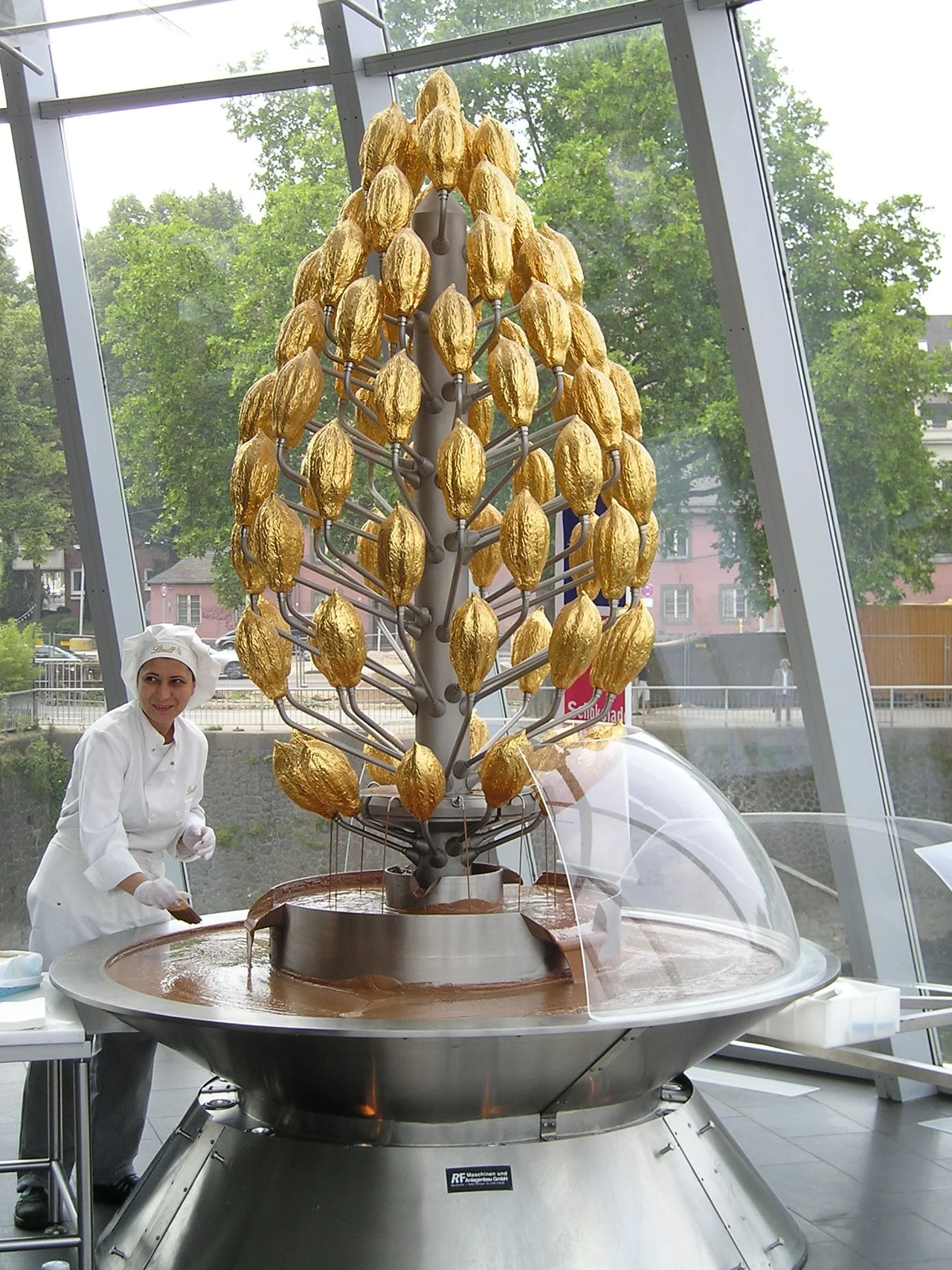

Schokoladenmuseum Köln
The fountain is three metres tall, and it does exactly what you hope a three-metre chocolate fountain will do: it pours, continuously, while a museum employee dips wafers into the warm flow and hands them across to whoever happens to be standing closest. This is the centerpiece of the Schokoladenmuseum Köln, but it is also a kind of test. If you are not delighted by a chocolate fountain, the rest of the museum's ride through five thousand years of cacao history is going to be wasted on you. Six hundred and fifty thousand visitors a year suggest the test is being passed.
The Wager
Hans Imhoff had a problem. He had bought the venerable Cologne chocolate maker Stollwerck in 1972, and as he was moving the company in 1975 he kept tripping over things: old wooden moulds, Victorian vending machines, hand-painted ceramic jars meant for drinking chocolate in eighteenth-century Vienna. He decided what Cologne needed was a museum to hold all of it. Almost everyone he told thought he was joking. So in 1989, to mark Stollwerck's 150th anniversary, he ran an experiment. He rented the Gürzenich, the city's grand banquet hall, set up a chocolate fountain, and waited. Within six weeks more than five times the projected number of visitors had turned up. Imhoff had his answer, and Cologne would get its museum.
The Ship on the Rhine
The building Imhoff commissioned from architect Fritz Eller is meant to look like a ship, and from the river side it nearly succeeds: a glass-and-steel prow noses out into the Rheinauhafen, the old harbour basin south of the cathedral. The site itself is a small piece of preserved Cologne. To build the museum Imhoff had bought Hall 10, the 1898 Prussian Customs Office, the Malakoff Tower, and the harbour's swing bridge, then added the new glass pavilion alongside. When it opened on 31 October 1993 it had cost 53 million Deutschmarks and made the Rheinauhafen the trendy waterfront district it has remained. The whole operation runs without subsidy.
Three Thousand Years in a Glass Cube
Inside, the exhibition begins with the Olmecs, who were grinding cacao beans in Mesoamerica around 1500 BCE, and walks forward through Maya tribute payments, Aztec ceremonial drinks, the Spanish conquest, and the moment in the seventeenth century when Europeans figured out you could sweeten the bitter brew with sugar. A ten-square-metre glass cube houses living cacao trees, Theobroma cacao and Theobroma grandiflorum, breathing their tropical humidity in a city where the January average is barely above freezing. Beyond the tropicarium, miniature versions of industrial machinery turn cocoa mass into bars in real time, and you watch the bar that will be handed to you at the door.
Vessels for a Sacred Drink
The most valuable items in the collection are not the working machines but the small things that survive from the centuries when chocolate was a luxury sipped, not eaten. There are pre-Columbian Mesoamerican vessels designed for the foaming, spiced cacao drink that the Aztecs offered to Moctezuma's court. There are eighteenth- and nineteenth-century porcelain cups and silver chocolate pots from the European aristocracy that picked up the habit and made it their own. Cologne's connection to all of this is Stollwerck, founded in the city in 1839, and through Stollwerck a whole genealogy of industrial chocolate-making in the Rhineland. Imhoff sold Stollwerck to Barry Callebaut in 2002. In 2006 the museum's industrial partner became Lindt and Sprüngli, which is why the gift shop now smells distinctly Swiss.
Why It Works
Most museums struggle for visitors. This one is in the top ten in all of Germany and the most visited in Cologne, which is itself a city dense with museums. Part of the explanation is the fountain, and part is that everyone gets a chocolate bar at the entrance and another wafer at the fountain. But the deeper reason is that the museum trusts its subject. Chocolate is genuinely interesting. The plant has a real botanical strangeness, the trade has a real and sometimes ugly history, the chemistry of crystallisation is real engineering. Imhoff understood that if you took it seriously, people would line up around the block, and they have, since 1993, without ever quite stopping.
From the Air
50.9322 N, 6.9643 E. The museum sits on a small artificial peninsula in the Rheinauhafen on the left bank of the Rhine, roughly 1.5 km south of Cologne Cathedral and easily picked out from altitude as a small glass ship moored beside the green-painted Severins Bridge. Nearest airport is Cologne/Bonn (EDDK), 14 km southeast. Düsseldorf (EDDL) is 35 km north. Weather in the Rhine valley is often hazy in summer and frequently low-cloud in winter.
Nearby Stories
- Diamond Interchange: How a Simple Idea Reshapes Towns Like Julich 2.8 km away
- Dusseldorf-Unterbach 6.1 km away
- Baumwollspinnerei Ermen & Engels 11 km away
- RAF Bruggen 15 km away
- Hagen Open-air Museum 21 km away
- Belgium 130 km away
- Marcinelle Mining Disaster 173 km away
- Zwingenberg Castle 178 km away