.jpg)
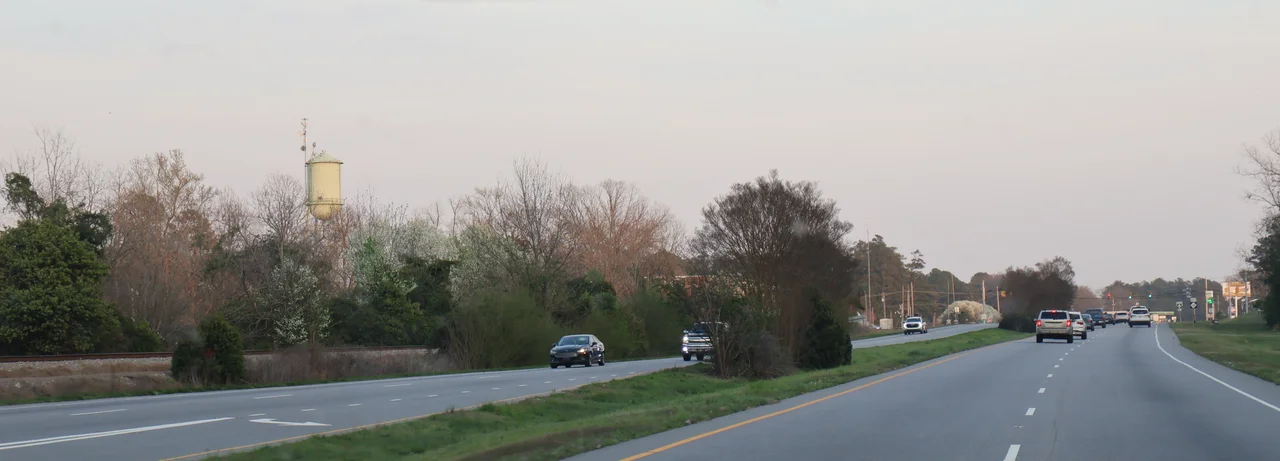
Scotland County, North Carolina
Gaelic was still spoken in the swamps and millponds of this corner of North Carolina until the 1860s. The Highland Scots who settled here in the 1730s and 1740s arrived in such numbers that the language followed the river systems for over a century — into a region they would help name. Today the high school football team is the Fighting Scots, the marching band wears kilts and Glengarry bonnets, and the county still answers to a name pinned on it in 1899 not by the descendants of those Highlanders but by a political maneuver in Raleigh designed to break apart an inconvenient electorate. Scotland County has been carrying that legacy ever since.
Carved Out for a Reason
The political math behind Scotland County is uglier than the romantic name suggests. In the 1890s, the parent county, Richmond, had a majority Black population that reliably voted Republican — at a time when North Carolina Democrats were waging a violent statewide campaign to take back the legislature. In Laurinburg, a town in the Richmond's eastern half, white Democrats had built a strong machine. The 1898 white-supremacy election (the same campaign that produced the Wilmington massacre) deployed paramilitary Red Shirts at Laurinburg's polls. After the Democrats regained the General Assembly, they rewarded their Laurinburg allies with a county of their own: on February 20, 1899, Scotland was carved out of Richmond, the new boundary engineered to give Laurinburg Democrats secure home rule. The name honored the Highland heritage. The motive did not.
Laurel Hill and the Lumber River
Before the political surgery, the land was Cheraw country, then Highland Scots country, then a mixed-tongued frontier where Germans, Welsh, English, Ulster Scots, and enslaved Africans all lived within wagon distance of one another. The first major community was Laurel Hill, near the Laurel Hill Presbyterian Church of 1797. When the Wilmington, Charlotte and Rutherford Railroad came through in 1861, the community simply picked itself up and moved south to the new rail line. The county's eastern boundary is the Lumber River — blackwater, slow, choked with bald cypress, named by the Lumbee people whose territory begins just across it. Lumber River State Park runs through the county. The Sandhills cover the northern third. Several hundred Carolina bays — those mysterious oval depressions of unknown origin — dot the landscape.
Smallest, Distressed, Diverse
Scotland is the smallest county in North Carolina by area. It is also one of the most economically distressed — ranked second-worst in the state's 2024 economic tier ratings, with the highest unemployment rate in North Carolina as recently as September 2024. The 2020 census showed 34,174 residents, declining about five percent over the preceding decade. The demographic mix is striking: 42 percent white, 38.5 percent Black, 11 percent Native American (the third-highest Native share of any North Carolina county), 3 percent Hispanic. Most of the Native population is Lumbee — Scotland is one of the four counties the Lumbee Tribe of North Carolina considers home, with tribal council representation extending here from the seat in Pembroke.
Two Schools That Mattered
Laurinburg, the county seat, is home to two institutions that punched far above their weight. The Laurinburg Institute, founded in September 1904, is the oldest historically Black preparatory school still operating in the United States — a school that taught a young Dizzy Gillespie among many others. St. Andrews University, a Presbyterian liberal-arts college, ran from 1961 until its May 2025 closure, leaving behind a quiet campus and a community trying to figure out what to do with it. The local public schools, after years of being state-classified as low-performing, climbed back above that line in 2022. The story Scotland County tells about itself runs through its schools more than its courthouses.
Kilts on the Football Field
There is no escaping the Scottish branding, and the county does not try. The Scotland High School Fighting Scots' marching band performs in full Highland dress — kilts, sporrans, plaid shawls, Glengarry bonnets — making it one of the most visually distinctive bands in North Carolina high school football. The county also hosts the annual Kuumba festival celebrating African American heritage, the Highland Games every spring at the John Blue House in Laurinburg, and the cultural cross-currents of three centuries of Highland Scots, enslaved African descendants, Lumbee neighbors, and recent arrivals all living within twenty miles of each other. Hurricane Florence hit hard in 2018. The downturn after the textile mills left still hasn't lifted. But the marching band still kilts up in October, and the Lumber River still runs blackwater slow toward the sea.
From the Air
Scotland County sits at roughly 34.84°N, 79.48°W in southern North Carolina along the South Carolina border, covering 320 square miles. Laurinburg, the county seat, lies near the county's center. Nearest airports: Laurinburg-Maxton (KMEB) at the eastern edge near the Robeson border, Richmond County (KRCZ) 20 miles north, and Florence Regional (KFLO) 50 miles southwest. From altitude, look for the Sandhills band crossing the northern third (distinctive sandy color), the blackwater Lumber River forming the eastern boundary, and Carolina bays speckled across the lowlands as oval depressions oriented northwest-southeast. Camp Mackall's vast Army training area extends into the county's northeast corner.
Nearby Stories
- Bennettsville, South Carolina 5.1 km away
- Green Ramp disaster 7.1 km away
- Lumberton, North Carolina 8.2 km away
- Carolina Sandhills 17 km away
- Fayetteville Regional Airport 23 km away
- Reed Gold Mine 32 km away
- Lynches River 37 km away
- Battle of Hanging Rock 47 km away