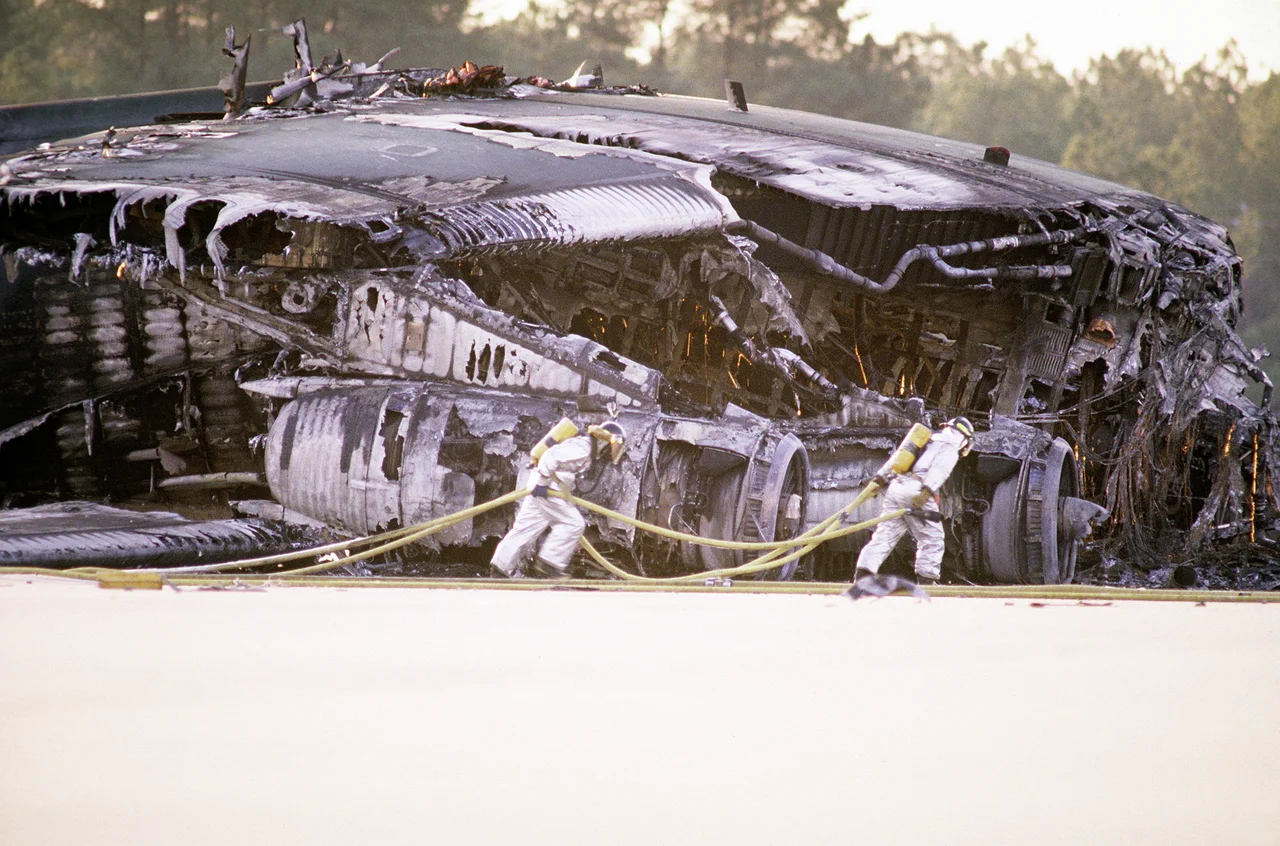

Green Ramp disaster
Just after two in the afternoon on Wednesday, March 23, 1994, about 500 paratroopers of the 82nd Airborne Division were standing, sitting, and kneeling on the Green Ramp at Pope Air Force Base, rigging chutes and waiting for the C-130s and C-141s that would take them up to jump. The sky above them was full - F-16s, A-10s, and other C-130s flying training patterns into the same runway. Most of the men had done this hundreds of times. Two miles overhead, an F-16D from the 74th Fighter Squadron was setting up a simulated flameout approach to Runway 23. It would not see the C-130 already on short final.
The Collision
At about 300 feet above the ground, the nose of the F-16D sliced through the C-130E's right elevator. The fighter pilots, Captains Joseph Jacyno and Scott Salmon, slammed into afterburner trying to fly out of it, but their aircraft began to come apart, scattering debris across the runway. They ejected. Their seats worked. The C-130 crew - Captain Jose Raices, Lieutenant Adam Zaret, and Sergeant Joel Myers - knew something had hit them but not what or how badly. They steadied the airplane, ran their checks, and turned back toward Pope. They would land on the debris-strewn runway minutes later. The empty F-16, still on full afterburner, continued in a low arc to the west, toward Green Ramp.
Into the Crowd
The wreckage hit the ramp between two parked C-130s whose crews were still aboard. Its momentum carried it westward through the right wing of a C-141B Starlifter from the 438th Airlift Wing, parked there for the jump. The fuel tanks ruptured. A fireball rose, gathered the F-16 wreckage with it, and rolled west between Building 900 and the personnel shed, straight into the grassy staging area where the paratroopers were rigged and waiting. There was nowhere to go. The fire passed through hundreds of standing men in seconds. Twenty 20mm rounds from the F-16's gun cooked off in the flames. Twenty-three men died on the ramp. Eighty-some more were burned or wounded. One severely burned paratrooper, Specialist Martin "Marty" R. Lumbert, Jr., of the 2nd Battalion, 504th Infantry, lingered until January 3, 1995, then became the twenty-fourth.
What Witnesses Did
The paratroopers who could still move went back into the fire to pull out the ones who could not. They carried friends through exploding ammunition, smothered burning gear, organized triage on the grass between buildings. The injuries were terrible - jet fuel and parachute nylon and webbing burning together against skin. Several of the worst-burned were flown to the U.S. Army Institute of Surgical Research at Brooke Army Medical Center in Texas. The 82nd had not lost this many people in a single afternoon since the end of the Second World War. It remains the largest accidental ground death toll from any aircraft crash on American soil.
Cause and Consequence
The Air Force investigation found multiple causes and put most of the blame on air traffic control. The F-16 crew bore part of it for failing to see and avoid the C-130 as regulations required, though there were extenuating circumstances - the controller had alerted the pilots to the C-130 only as they began the low approach that put them in its path. Two officers were relieved of duty. Three enlisted controllers were disciplined; one faced Article 15 action. A later review faulted the F-16 pilots more directly, but they received no formal punishment. The Army's response - the surgical effort, the long burn-unit recoveries, the quiet retraining of survivors - became a study taught at military medicine schools, and the disaster reshaped joint Army-Air Force pre-jump procedures across the force.
What Remains at Green Ramp
Pope Air Force Base became Pope Field in 2011, absorbed into Fort Bragg. The ramp where it happened still operates, still loads paratroopers, still launches C-130s. A memorial at the base lists the twenty-four names. Each March 23, survivors return - some still bearing the burn scars of that afternoon - to read them aloud. The North Carolina General Assembly passed Senate Joint Resolution 1100 in 1995 honoring the dead, calling them what their friends had always called them: not casualties but paratroopers, lost on a routine training mission. The 82nd's motto is All American. The afternoon of March 23 is one of the days that phrase had to mean something specific.
From the Air
Pope Field (KPOB) lies at 35.171N, 79.014W, 12 miles northwest of Fayetteville and now part of the Fort Bragg installation. Runway 23 - the same runway involved in the 1994 collision - is the primary east-west surface. Green Ramp parallels the runway on its west end. Fayetteville Regional (KFAY) sits about 12 nm southeast; Raleigh-Durham (KRDU) is about 50 nm north. Pope is military-controlled airspace; transient civil traffic must coordinate well in advance. Field elevation is roughly 218 ft MSL over the Sandhills.
Nearby Stories
- Johnston County, North Carolina 2.9 km away
- Battle of Bentonville 9.7 km away
- Rockingham Speedway 14 km away
- Haw River 15 km away
- Red Springs, North Carolina 30 km away
- Richmond County, North Carolina 38 km away
- North Carolina Aviation Museum 43 km away
- Duplin County, North Carolina 43 km away