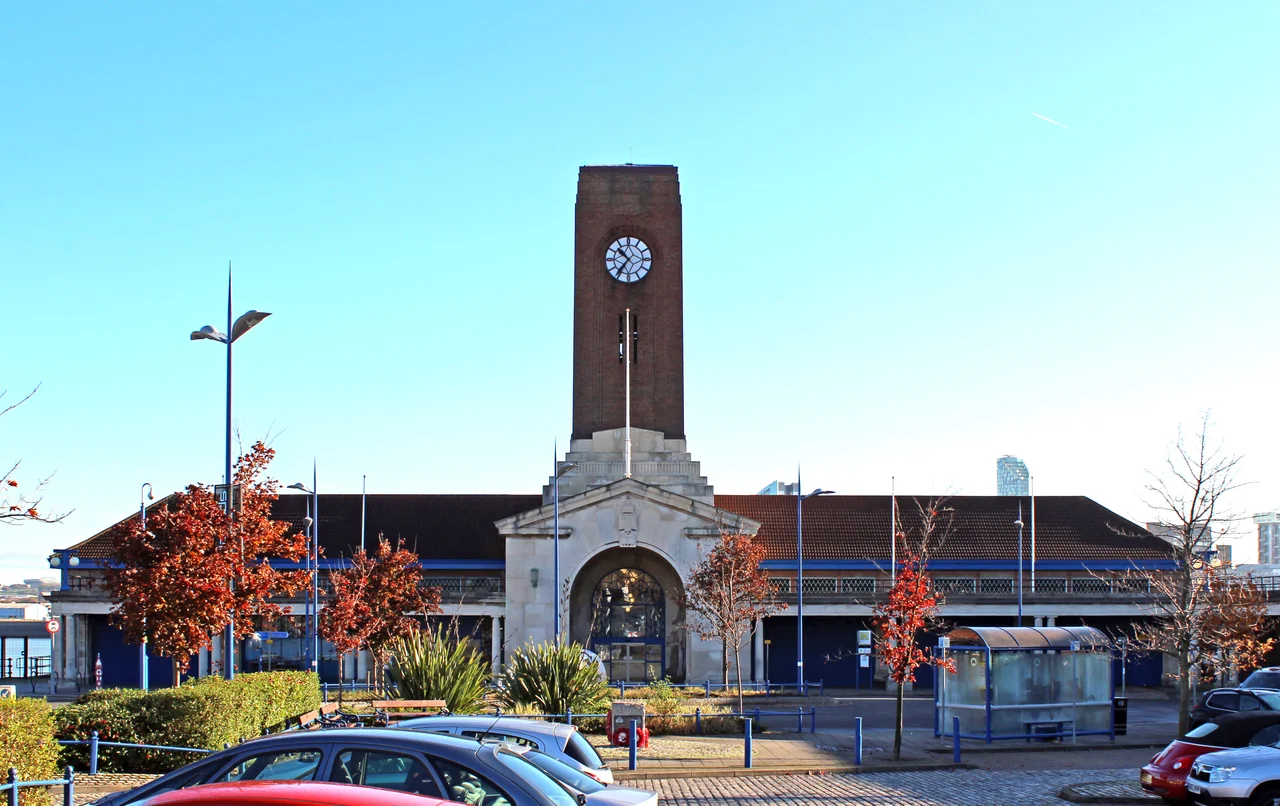

Seacombe
Gerry Marsden's voice is the one most people hear when they think of Seacombe, though he never names it. The ferry he sang about in 1965 - the Ferry Cross the Mersey - has been making the triangular run between Liverpool Pier Head, Woodside on the Birkenhead side, and Seacombe at the northern end of Wallasey's waterfront for nearly two centuries. The Seacombe terminal sits where the river bends toward the Irish Sea. Behind it stands the strangest piece of architecture on the Mersey: a vast brick and concrete ventilation building for the Kingsway Tunnel, two huge grilles flanking a flue-like central tower, looking for all the world like a pair of stereo speakers waiting to play the city a song.
Seccum in the Domesday Book
The settlement is older than its name. In the Domesday Book of 1086 it appears as Seccum - a Norse-influenced name like so many on the Wirral, where Vikings had settled centuries before the Normans arrived to write things down. The land here was low-lying marsh between the Mersey and the higher ground inland at Liscard and Wallasey village. For most of its history Seacombe was a windy, salt-tasting place that flooded easily. In 1845 the civil engineer George Turnbull designed and built the Seacombe Wall - a sea defence that drained the marshes behind the town and made systematic development possible. With the marshes gone, terraces and small industries spread across the new ground. By the late nineteenth century Seacombe had become a working district of the Wallasey conurbation, with its own ferry terminal, its own railway, and its own swimming baths.
The Ferry's Northern Door
The Mersey Ferries have run from Seacombe since the mid-1800s. The current ferry terminal handles the modern triangular service - Liverpool Pier Head, Woodside, Seacombe - which is now operated more as a heritage cruise than a commuter route, though residents still use it. The Wirral Railway also terminated here once. Passenger services to Seacombe railway station ended on 4 January 1960 and all services on the line stopped on 16 June 1963. The cutting that carried the railway was repurposed almost immediately: when the new Kingsway Tunnel was being built between Liverpool and Wallasey in the late 1960s, engineers needed a route for the approach road, and the old railway cut delivered one almost ready-made. So if you drive into the Kingsway Tunnel from the Wirral side, you are travelling along the path of a Victorian railway line, with the Seacombe terminal that closed when the trains stopped now repurposed for ferries.
Spaceport and Science
On 26 July 2005 a strange thing opened next to the ferry terminal: Spaceport, a space-themed visitor attraction promoted by Merseytravel. The Wirral had no obvious connection to spaceflight, but the building was striking - all silver curves and astronaut imagery - and it pulled in school trips and weekend tourists for fifteen years. It closed at the end of 2019 with mounting losses. The site did not stay quiet long. In November 2022 Eureka! Science + Discovery opened in the same building, a children-focused interactive science centre run by the same trust that operates the original Eureka! museum in Halifax. The new attraction welcomed 100,000 visitors in its first year. The space rockets gave way to physics experiments and biology demonstrations, and the wedge-shaped silver building once again echoes with school groups.
Guinea Gap and the Town Hall
Two other Seacombe institutions deserve notice. Guinea Gap Baths is the oldest swimming pool in the Wirral. The first swimming club here was founded in the 1890s, and the pool itself was for many years filled with Mersey sea water, drawn straight from the river just yards away. The water is now filtered municipal supply, but the building survives and still serves the borough's swimmers. A short walk inland on Brighton Street is Wallasey Town Hall - a Grade II listed Edwardian Baroque pile of red brick and pale Portland stone, completed in 1920 and still the seat of the local council. During the First World War the half-finished building was pressed into service as a military hospital for wounded soldiers brought back from the Western Front. Once the war ended it was completed as planned and opened as the town hall.
Stapledon, Lewis, and Marjorie Cottle
Falkland Road - a residential street running from Brighton Street to Liscard Road - has an unusual claim. The philosopher and science fiction writer Olaf Stapledon was born here in 1886. His birth certificate, with characteristic Victorian fuzziness on local boundaries, says Poolton-cum-Seacombe. Stapledon would go on to write Last and First Men in 1930 and Star Maker in 1937, two of the most ambitious works of cosmic imagination in any language - Stapledon's narrators describe two billion years of human evolution and the cosmic history of consciousness itself. Arthur C. Clarke called Star Maker the most ambitious science fiction novel ever written. Seven years later and a few doors down, at 61 Falkland Road, the Welsh dramatist Saunders Lewis was born on 15 October 1893. He became one of the founders of Plaid Cymru and a major figure in twentieth-century Welsh literature. The pioneering female motorcyclist Marjorie Cottle, who rode the length of Britain in 1924 to prove women could endure long-distance motorcycling, was born in Seacombe in 1900. The street that produced an interplanetary philosopher, a Welsh-nationalist playwright, and a record-breaking female motorcyclist now looks like any other Wirral residential terrace. The houses keep their secrets.
From the Air
Seacombe sits at 53.409°N, 3.029°W on the northeast Wirral, on the west bank of the Mersey directly opposite Liverpool's Pier Head. Best viewed at 1,500-3,000 ft. Liverpool John Lennon Airport (EGGP) is 7 nm south-southeast. Look for the ferry terminal jutting into the river, with the distinctive Kingsway Tunnel ventilation building (two large grilles flanking a central tower) immediately behind it. Wallasey Town Hall's bell tower is visible inland.
Nearby Stories
- RAF Wrexham 3.3 km away
- Birkdale Palace Hotel 3.7 km away
- Turton Tower 4.1 km away
- Tatton Park 5.6 km away
- Abergele Rail Disaster 9.6 km away
- Diglake Colliery Disaster 13 km away
- Ysbyty Ifan 16 km away
- Celtic Array 62 km away