
Sellafield Railway Station
Most rural railway stations get noticed only when they close. Sellafield, in west Cumbria, has the opposite problem: nobody outside the industry pays much attention, yet for decades it has been one of the busiest freight stations of its size in Britain. The trains that pull in here are not carrying coal or cement. They are carrying spent nuclear fuel - from Barrow-in-Furness docks, from power stations elsewhere in the UK - bound for the THORP reprocessing complex that sits a short way inland. The Cumbrian Coast Line passes through, twice an hour or so. The freight goes when it goes, on its own schedule, behind security that travels with it.
1850 and the Furness Railway
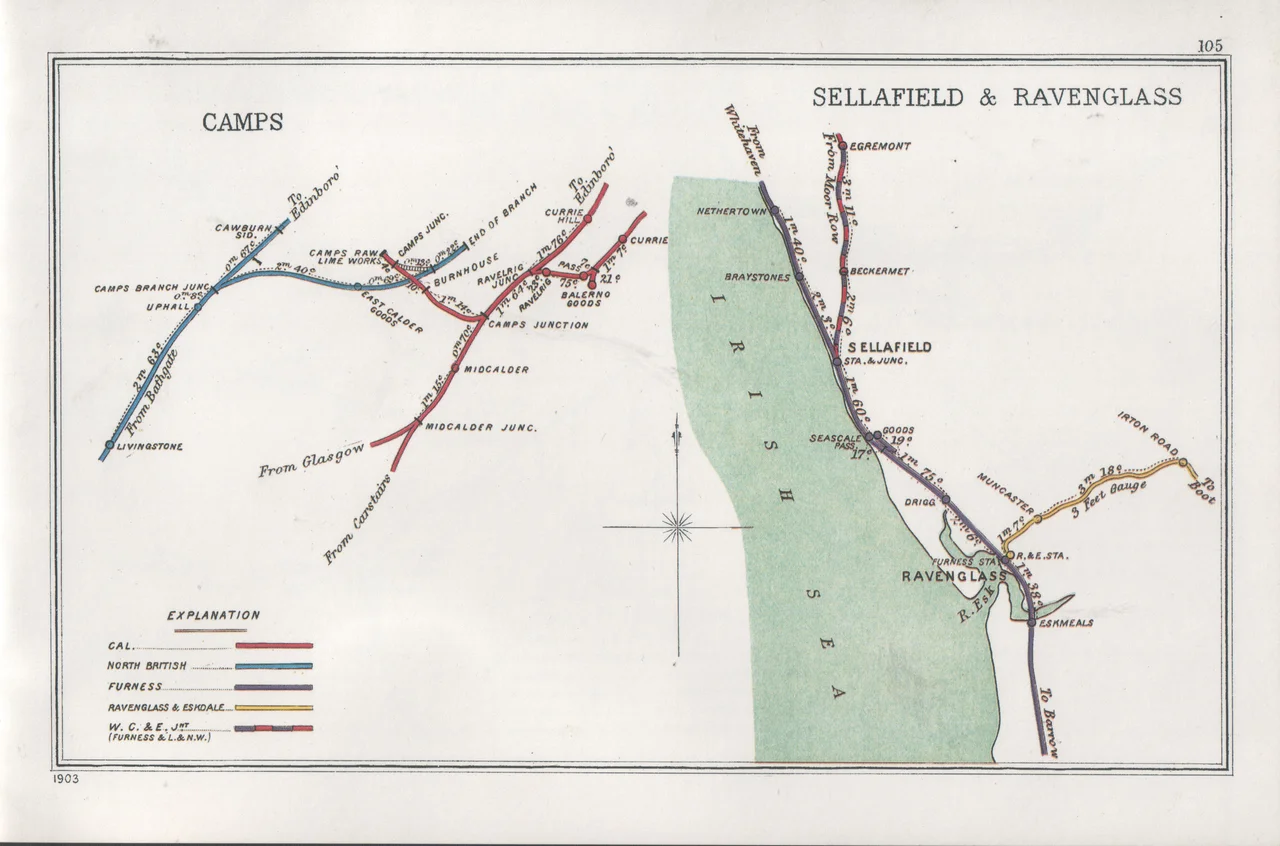
The station opened in 1850 as part of the Furness Railway's long push up the Cumbrian coast, linking Whitehaven southwards to Barrow-in-Furness through a string of small fishing and farming villages. It sat thirty-five miles north-west of Barrow, between the dunes and the western fells. For nearly a century, it served farmers, holidaymakers and the occasional pilgrim heading inland to Wasdale. Then, from August 1869 until March 1964, Sellafield was also the southern terminus of the Whitehaven, Cleator and Egremont Railway - the iron-ore line that wound through the orefields east of the coast. That branch is gone now, lifted in the 1960s when the iron ore went with it. The station configuration still betrays its junction past: the southbound 'up' line is bi-directional, with platform faces on both sides, though only the eastern face is in regular use.
The Cargo Nobody Talks About
Calder Hall opened across the river in 1956. Windscale was already producing plutonium up the road. The trains came. By the time the Thermal Oxide Reprocessing Plant - THORP - opened in 1994, Sellafield Station had become the rail gateway for a global nuclear logistics network. Spent fuel arrived from Japan via the Barrow docks. It arrived from Hinkley Point, from Heysham, from Dungeness. The exchange sidings to the south of the station, and the locomotive depot used by Direct Rail Services for its freight trains, handled material that almost nowhere else in Britain handled. Two water cranes - one at each end of the station - sit as physical reminders of an older railway era, but the working freight is thoroughly modern: heavily-shielded flask wagons hauled by Class 88 electro-diesels and the older Class 37s that DRS keeps running.
The People Who Get Off Here
Sellafield as a workplace employs around ten thousand people. They do not all live in Seascale or Gosforth. Between May 2015 and December 2018, Direct Rail Services ran four trains a day each way of hired Mark 2 coaches behind Class 37 diesels - workers' trains in the most literal sense, hauling commuters in from Carlisle and other towns up the coast. The idea had been floated in November 2011, when DRS applied to the Office of Rail Regulation for permission to run one train each way. Demand grew. The trains became part of the rhythm of the site - shift workers in high-visibility jackets piling into compartments that had been hauled across the country in another life. The station is unstaffed now. A ticket machine sits inside the main building. The other rooms are in private commercial use, and there is no car park. Sellafield's workforce comes and goes, mostly by car, but the trains still call hourly in each direction.
The Bridge Without Ramps
The two platforms are linked by a footbridge that does not include ramps. Only the Barrow-bound platform has step-free access. The waiting room is on the southbound platform. The shelter on the opposite side is more notional than substantial. The signal box at the north end of the station still controls the layout, including the single-line section that runs north to St Bees, worked using the electric key token system - one of the last places in Britain where the small brass token is still passed hand-to-hand to authorise a train to enter the single track. Past the southern end of the platforms, the freight sidings curve away towards the plant. Beyond them, the four cooling towers that defined the Calder Hall skyline are gone - imploded in 2007 - but the buildings remain. Sellafield station is a portal to a place most travellers will never visit, doing work most passengers will never see.
From the Air
Located at 54.417 N, 3.510 W. Recommended viewing altitude 2,000-3,500 ft. Visual landmarks: the Sellafield nuclear site immediately to the south (large concrete reactor buildings and reprocessing plant), the Cumbrian Coast Line running along the shore, Seascale village 3 miles south. Nearest airports: Carlisle Lake District (EGNC) 35 nm northeast, Isle of Man Ronaldsway (EGNS) 60 nm west, Blackpool (EGNH) 50 nm south. Prohibited area EG-P611 surrounds the Sellafield complex - check NOTAMs and maintain clearance.
Nearby Stories
- Isel Hall 3.3 km away
- Walney Island 7.1 km away
- Kendal 9.7 km away
- Lancaster Priory 10 km away
- Raeberry Castle 15 km away
- Cross Fell 21 km away
- Ramsey Bay 29 km away
- Santon Railway Station 47 km away